


The hardest part of an approaching eAssessment is often not the question on the screen. It is the question already running through your mind: What if I freeze? Reducing exam anxiety for MYP Individuals and Societies begins by replacing that uncertain threat with a process you have practised.
You do not need to feel completely calm to perform well. You need to know what to do when anxiety appears: settle your breathing, identify the command term, plan one step, and begin. This guide combines focused preparation, gradual timed practice, and a short reset for difficult moments.
Your calm preparation checklist
Keep the plan deliberately simple:
- Turn general worries into specific, trainable skills.
- Revise Criteria A, B, C, and D rather than memorising content alone.
- Practise source analysis and command terms on a screen.
- Begin with short timed sets before attempting full simulations.
- Review errors by cause rather than treating them as personal failures.
- Use the same breathing reset during practice and the assessment.
- Protect sleep and seek support if anxiety becomes disruptive.
Understand what you are preparing for
Anxiety grows around vague threats. A two-hour assessment sounds enormous when imagined as one uninterrupted test of everything you know. In practice, the official Individuals and Societies on-screen examination is divided into three tasks: Investigating, Communicating, and Thinking critically.
These tasks draw on four criteria:
- Criterion A: Knowing and understanding
- Criterion B: Investigating
- Criterion C: Communicating
- Criterion D: Thinking critically
The Thinking critically task carries the largest share of marks, but that does not mean every revision session should involve a full essay. Repeatedly practise smaller skills: interpreting sources, identifying limitations, comparing perspectives, selecting evidence, and forming supported judgements.
Read how MYP Individuals and Societies is assessed, then write the tasks and criteria on one page. Knowing the assessment's shape gives your attention somewhere useful to go.
Use this same-day anxiety reduction method
This 45-minute method is short enough to start today and specific enough to produce evidence of progress.
Settle your body for two minutes
Place both feet on the floor and release your shoulders. Breathe in gently for four seconds and out for six seconds. Repeat five times without forcing an unusually deep breath.
Use this before every revision block. The goal is not to eliminate every nervous sensation; it is to create enough space to make the next decision.
Name one precise worry
Write the thought creating the most pressure. Then translate it into a skill you can train.
| Anxious thought | Trainable version |
|---|---|
| I will forget everything | Test what I can retrieve without notes |
| I cannot analyse sources | Identify origin, purpose, value, and limitation |
| I always run out of time | Complete one response within a realistic limit |
| My essays are not good enough | Build and grade one argument paragraph |
“I am going to fail” offers no next action. “I need to practise evaluating source limitations” does.
Run an eight-minute retrieval check
Choose a concept or case study from the MYP Individuals and Societies resource hub. Close your materials and recall relevant terminology, causes, consequences, evidence, perspectives, and limitations.
Check your attempt against Study Notes. Add only what was missing, then use Flashcards to retrieve those ideas again. This reveals the difference between recognising information and recalling it independently.
Complete a 20-minute question set
Choose a small Questionbank set and work without notes. Before answering, identify the command term and translate it into an instruction:
- Describe: give a detailed account.
- Explain: show how or why something happens.
- Analyse: examine relationships, patterns, or consequences.
- Evaluate: weigh strengths and limitations before reaching a judgement.
Treat the timer as information, not punishment. If 20 minutes feels overwhelming, begin with ten. The MYP eAssessment success guide explains how short screen-based rehearsals can build toward longer attempts.
Review errors for ten minutes
Do not simply count incorrect answers. Label each problem and assign a response:
| Error type | Next action |
|---|---|
| Missing knowledge | Review the explanation, then retrieve it closed-book |
| Misread command term | Rewrite the task in plain language |
| Weak evidence | Add one precise, relevant example |
| Limited analysis | Explain why the evidence matters |
| Unbalanced judgement | Add another perspective or limitation |
| Timing problem | Set a move-on point for the next attempt |
RevisionDojo's Grading tools connect feedback to criterion language. AI Chat can challenge vague claims, while the MYP criteria guide shows what stronger performance looks like.
End with a three-line record
Complete these statements:
- Today I improved...
- I still need to practise...
- Tomorrow I will begin with...
Then stop. A clear ending prevents a focused session from becoming an anxious, unfocused evening.
Build confidence through gradual exposure
Avoiding timed work provides temporary relief but leaves exam conditions unfamiliar. Starting with a complete simulation can be equally unhelpful when anxiety is already high. Use a progression:
- Stage one: one untimed source question with notes closed.
- Stage two: a 15-minute question set on one criterion.
- Stage three: a 30-minute mixed set under quiet conditions.
- Stage four: a longer Mock Exam or Predicted Paper where available.
Move forward when you can complete the current stage while using your reset, not when you feel perfectly relaxed. Predicted Papers are for rehearsal rather than guessing exact questions. The 30-day MYP eAssessment study plan can help you space this progression.
Build a connected revision loop: Study Notes clarify gaps, Flashcards strengthen recall, the Questionbank tests application, and AI Chat probes reasoning. Grading tools reveal where criteria are missing. Mock Exams build stamina, while the Coursework Library provides examples of structure without inviting copying. RevisionDojo Tutors can offer human guidance when confusion persists.
Use a reset when anxiety rises during the exam
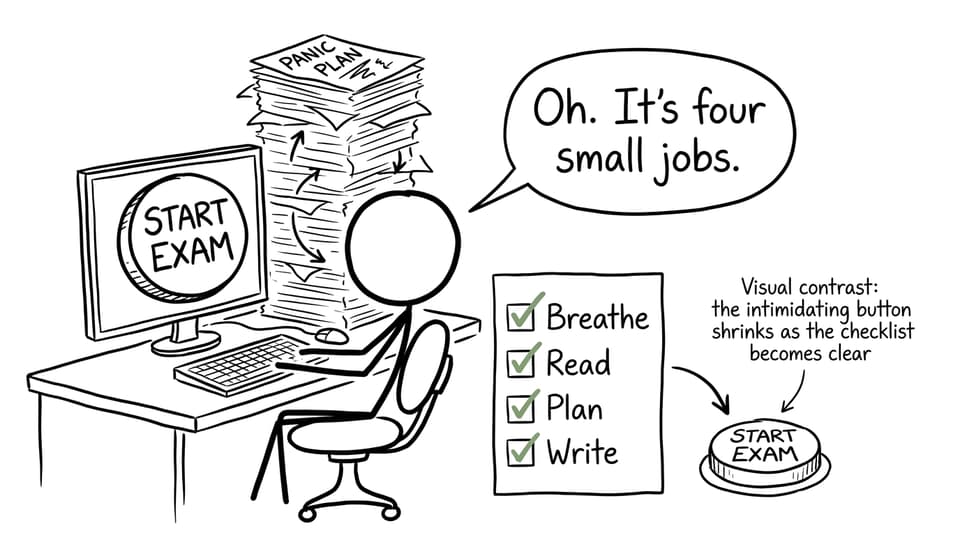
Remember four words: Breathe, Read, Plan, Write.
Stop typing and make one slow exhale. Read only the current instruction and identify its command term. Write a one-sentence plan or judgement. Then produce one valid point supported by evidence from the source or your knowledge.
If you remain stuck, move on when the rules and interface allow it, then return later. This prevents one difficult prompt from consuming time needed elsewhere. Rehearse the approach with the guide to staying calm during timed exams.
Protect the basics in the final days
Sleep, regular meals, movement, and practical preparation support attention and reduce avoidable pressure. Keep the final evening light: review your error log, retrieve a few flexible examples, confirm the assessment details, and follow your normal sleep routine.
If anxiety repeatedly disrupts sleep, causes panic symptoms, or prevents you from attending lessons or assessments, tell a parent, teacher, school counsellor, or trusted adult. Study techniques can reduce uncertainty, but severe or persistent anxiety deserves personal support. The MYP assessment stress guide can help you begin that conversation.
Calm comes from knowing your next move
Confidence is rarely a feeling that arrives before you begin. More often, it is a record of small promises kept: one source evaluated, one command term decoded, one timed response completed, and one mistake corrected.
Start with the 45-minute method, then repeat it while gradually increasing the challenge. RevisionDojo brings that process together through its Questionbank, Study Notes, Flashcards, AI Chat, Grading tools, Predicted Papers, Mock Exams, Coursework Library, and Tutors. The assessment may still matter deeply to you. It simply no longer has to feel unknown.