
The first paper ends, but your mind keeps writing. It replays the calculation you rushed, the quotation you forgot, or the conclusion that could have been sharper. Meanwhile, another exam is approaching.
If you need to recover mentally between backtoback exam papers, the most effective approach is simple: close the previous paper psychologically, restore your body, and review only a small amount of high-value material for the next session. Do not conduct an answer post-mortem. Eat familiar food, drink water, move briefly, regulate your breathing, and follow a prepared review list.
That restraint matters during the November session. According to the final IB schedule, the 2026 examination window runs from 23 October to 13 November, with morning and afternoon sessions determined by exam zone. Your subjects may create consecutive papers, same-day sessions, or several demanding days in succession. The goal is not to feel completely fresh each time. It is to become reliably ready again.
Your between-paper reset checklist
Use this sequence whenever one paper ends and another is close:
- Leave conversations about answers immediately.
- Drink water and eat a familiar meal or snack.
- Walk, stretch, or sit somewhere quieter for 5-10 minutes.
- Use slow breathing to reduce physical tension.
- Review only preselected essentials for the next paper.
- Stop reviewing before entering the exam room.
- Treat the next paper as a separate event.
The routine looks almost too ordinary. That is its strength. Under pressure, a fixed sequence reduces the decisions your tired brain must make.
Why answer discussions drain your next performance
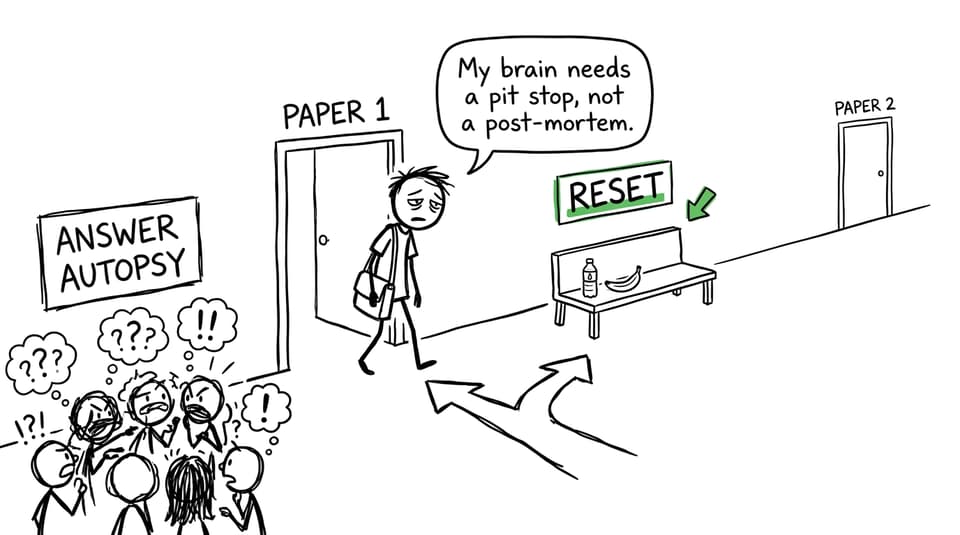
After an exam, uncertainty feels uncomfortable. Comparing answers appears to offer closure, but it often creates a problem you cannot solve. If classmates disagree, your stress rises. If they agree, you may still replay the question. Neither response earns marks on the next paper.
Create a clear boundary instead. Once you leave the room, allow yourself one factual note, such as “I spent too long on the first essay.” Save that lesson for later rather than reconstructing every answer.
Tell friends beforehand that you will not discuss the paper until the session is over. Muting exam group chats is not avoidance. It is attention management. RevisionDojo’s guide to beating IB exam anxiety offers more techniques for interrupting rumination and panic.
Reset the body before asking more from the mind
Mental recovery is partly physical. Stress can leave your shoulders tight, breathing shallow, and attention scattered. Before opening notes, bring those systems closer to normal.
Eat and drink predictably
Choose food you know sits comfortably. A balanced sandwich, rice dish, yoghurt, fruit, nuts, or another familiar option is more sensible than experimenting with a heavy meal. Drink water steadily instead of consuming an uncomfortable amount just before the next paper.
Be cautious with energy drinks or unusually high caffeine intake. They can make an already tense student feel more restless, while late caffeine may interfere with sleep. Food and water are not performance tricks. They are basic maintenance.
Move and breathe
Take a short walk, stretch your back and shoulders, or stand outside if your school permits it. The purpose is to change state, not exhaust yourself. Moving to another physical space can help your mind stop treating the previous exam as an active problem.
Try breathing in gently for four counts and out for six. Repeat this five times without forcing an unusually deep breath. Then identify three neutral things you can see and feel both feet on the floor. You are not trying to eliminate every nerve. You are redirecting attention toward the present environment and the next controllable action.
Use a small review menu, not the whole syllabus
The break between papers is a poor time to discover new content. Your working memory is already carrying fatigue from the first session. Unfamiliar explanations can replace useful confidence with confusion.
Prepare a one-page review menu for each paper before the examination window. It might contain:
- essential formulas and conditions
- command-term reminders
- common errors from timed practice
- essay structures or comparison frameworks
- key definitions, quotations, or case-study prompts
- one pacing rule for the paper
If you have 30 minutes, that does not mean you should study for all 30. Use 10-15 minutes for gentle retrieval, then stop. RevisionDojo Flashcards and IB resources let you retrieve compact information without opening several textbooks or rebuilding notes.
If one idea remains unclear, use Study Notes or Jojo AI Chat for a focused explanation. Ask one precise question, confirm the answer, and close the platform. Between sessions, RevisionDojo should reduce friction rather than create another revision marathon.
Train the recovery before November arrives
A reset routine works better when it feels familiar. During the fall term, schedule several two-session rehearsals based on your November timetable. Complete a timed morning task, take a realistic break, and begin a second task later that day.
RevisionDojo’s November 2026 schedule and study plan can help you identify where subjects cluster. For dense combinations, review the hardest November exam days and compare them with the personalised timetable supplied by your coordinator. Start times vary by exam zone, so your school’s instructions remain decisive.
A rehearsal should test more than knowledge. Notice what lunch works, where you can sit quietly, which conversations increase stress, and how much review leaves you alert rather than overloaded.
Use RevisionDojo’s Questionbank for timed blocks and a Mock Exam or Predicted Paper for occasional full simulations. Grading tools can identify specific weaknesses, while Study Notes, Flashcards, and AI Chat help repair them. The RevisionDojo exam preparation workflow connects those steps within one system. The Coursework Library and Tutors are most useful earlier in the term, when resolving persistent gaps can protect your capacity during the examination window.
Match your recovery to the available gap
| Time available | Best response |
|---|---|
| Under 30 minutes | Water, familiar snack, bathroom, slow breathing, and 5 minutes of essential prompts |
| 30-90 minutes | Eat, walk briefly, avoid exam discussion, then complete 10-15 minutes of light retrieval |
| Several hours | Eat a proper meal, decompress, take a genuine break, then complete one focused review block |
| Overnight | Record brief lessons, prepare materials, use light recall, and protect sleep |
For an overnight gap, resist the belief that a disappointing paper must be compensated for with late-night studying. That bargain borrows attention from tomorrow. Follow a stable night-before IB exam routine, pack what you need, and stop at a predetermined time.
Build a response for returning panic
A recovery routine does not guarantee calm. If you feel shaken when the next paper begins, put both feet on the floor, exhale slowly, read the instructions carefully, and identify the easiest available mark. Then begin with one concrete action.
The shift from “I must feel confident” to “I must complete the next action” matters. Confidence is not always available on demand. Behaviour is.
If stress repeatedly disrupts sleep, eating, concentration, attendance, or daily functioning, speak to a trusted adult, IB coordinator, school counsellor, or qualified health professional. Recovery strategies do not replace appropriate support.
Protect the next paper, not the last one
Back-to-back exams test emotional switching as much as endurance. The student who keeps analysing the previous paper carries two exams at once. The student who follows a reset routine carries only the one ahead.
Use the official-timetable revision method to mark pressure points, then rehearse your food, movement, review, and breathing sequence. RevisionDojo’s guide to staying sane during IB exam season connects recovery with active practice and realistic planning.
RevisionDojo is the ultimate IB resource because the full preparation cycle can live in one system: Questionbank practice, Study Notes, Flashcards, AI Chat, Grading tools, Predicted Papers, Mock Exams, the Coursework Library, and Tutors. When November arrives, the advantage is not having more material to consume. It is knowing what to open, what to ignore, and when to stop.