
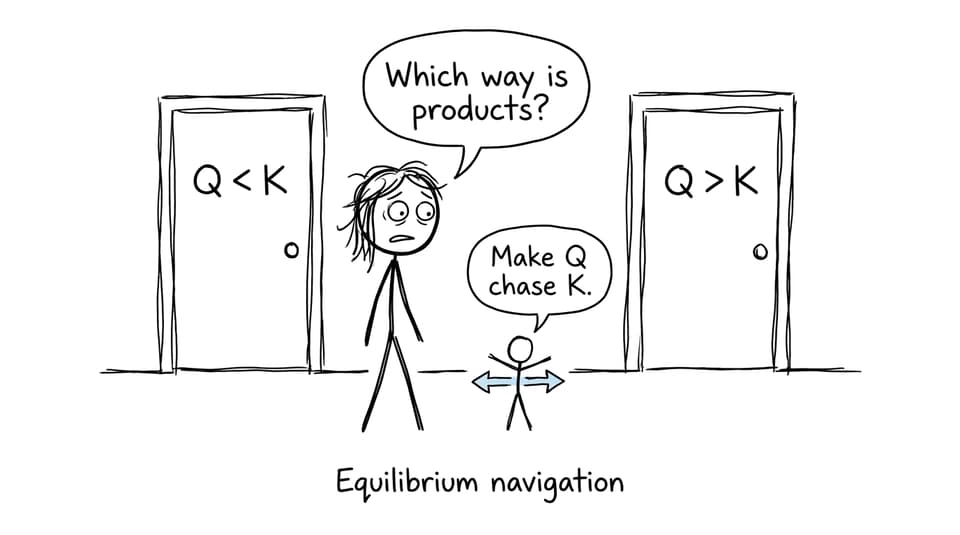
The reaction quotient, Q, measures the current product-to-reactant ratio using the equilibrium expression. Compare it with K at the same temperature: if Q < K, the net reaction proceeds toward products; if Q > K, it proceeds toward reactants; and if Q = K, the mixture is at equilibrium.
It is a small calculation with an unusually large job. Q takes a snapshot of a reaction mixture and tells you what must happen next. For IB Chemistry HL students, that makes it both an equilibrium calculation and a test of chemical reasoning.
Reaction quotient checklist
Before working through the details, remember this sequence:
- Balance the chemical equation.
- Write products over reactants.
- Turn stoichiometric coefficients into exponents.
- Substitute concentrations measured at the same moment.
- Calculate Q without attaching units.
- Compare Q with K at the same temperature.
- State the direction of the net reaction, not merely which side is “favoured.”
The current IB Chemistry guide places Q under Reactivity 2.3.5 as Higher Level content. Students are expected to calculate it from non-equilibrium concentrations and determine the direction in which a reaction proceeds to reach equilibrium. The syllabus assessment is limited to homogeneous equilibria, but understanding why pure solids and liquids are omitted remains useful when building equilibrium expressions.
What Q actually tells you
Consider the general reaction:
aA + bB ⇌ cC + dD
Its concentration quotient is:
Qc = ([C]^c[D]^d) / ([A]^a[B]^b)
This has the same form as the equilibrium constant expression. The distinction is timing:
- Q uses concentrations at any specified moment.
- K uses the composition at equilibrium and has a fixed value at a given temperature.
Q is therefore a moving snapshot; K is the destination. At equilibrium, Q = K.
| Comparison | Meaning | Net direction |
|---|---|---|
Q < K | The product-to-reactant ratio is too small | Forward, toward products |
Q > K | The product-to-reactant ratio is too large | Reverse, toward reactants |
Q = K | The equilibrium ratio has been reached | No net change |
A useful mental check is to imagine Q trying to reach K. If Q is too small, it must increase, so products form. If Q is too large, it must decrease, so products are consumed.
For a syllabus-aligned explanation and supporting media, use RevisionDojo’s reaction quotient HL study notes. The broader IB Chemistry equilibrium resource hub also lets you move among Study Notes, videos, Flashcards, and practice questions.
Worked reaction quotient examples
Example: Q is smaller than K
For the Haber equilibrium:
N2(g) + 3H2(g) ⇌ 2NH3(g)
At a particular temperature, suppose:
[N2] = 0.50 mol dm^-3[H2] = 0.20 mol dm^-3[NH3] = 0.10 mol dm^-3Kc = 4.0
First write the expression:
Qc = [NH3]^2 / ([N2][H2]^3)
Substitute:
Qc = (0.10)^2 / ((0.50)(0.20)^3)
Qc = 0.010 / 0.0040 = 2.5
Because 2.5 < 4.0, Q must increase. The system undergoes a net forward reaction, consuming nitrogen and hydrogen while producing more ammonia until Q = K.
Notice the reasoning after the calculation. An answer that stops at Q < K may not fully address a command such as “determine the direction.” Write the chemical conclusion explicitly.
Example: Q is larger than K
Consider:
N2O4(g) ⇌ 2NO2(g)
Suppose [N2O4] = 0.40 mol dm^-3, [NO2] = 0.30 mol dm^-3, and Kc = 0.150 at the stated temperature.
Qc = [NO2]^2 / [N2O4]
Qc = (0.30)^2 / 0.40 = 0.225
Here, Q > K. Q must fall, so NO2 is consumed and N2O4 forms through a net reverse reaction.
These questions become easier through repetition rather than rereading. Use the equilibrium Questionbank to practise writing expressions, substituting values, and interpreting comparisons as one continuous method.
How Q appears in IB Chemistry exam questions
A typical question may provide a balanced equation, several concentrations, a value of K, and a temperature. You may then be asked to calculate Q and predict the direction of change.
Use this exam routine:
- Inspect the equation. Check coefficients and physical states before touching the numbers.
- Write the expression symbolically. This protects method marks if arithmetic later goes wrong.
- Substitute carefully. Exponents apply to the entire concentration value.
- Compare, do not merely calculate. Q has little meaning without K.
- Describe the net change. Name the species formed and consumed where appropriate.
- Check the temperature. Q and K can only be compared meaningfully for the same reaction and stated temperature.
Do not confuse equilibrium position with reaction rate. Q predicts the direction of net change, not how quickly equilibrium will be reached. A catalyst can shorten the time required to reach equilibrium, but it does not change K or the final equilibrium composition.
This distinction connects naturally with Le Chatelier’s principle in IB Chemistry. Le Chatelier offers a qualitative prediction; Q explains a concentration disturbance mathematically. For example, adding a reactant usually increases the denominator, lowers Q, and causes a net forward reaction while temperature remains constant.
Common mistakes that lose marks
Reversing the comparison
Students often remember the symbols but reverse the direction. Ask what Q must do:
- Too small? Increase it by forming products.
- Too large? Decrease it by consuming products.
Forgetting stoichiometric powers
For N2 + 3H2 ⇌ 2NH3, the powers are 1, 3, and 2. They come from the balanced equation, not the concentration values.
Using equilibrium concentrations automatically
Q can use non-equilibrium values. In fact, that is its central purpose. K is the value of the same expression specifically at equilibrium.
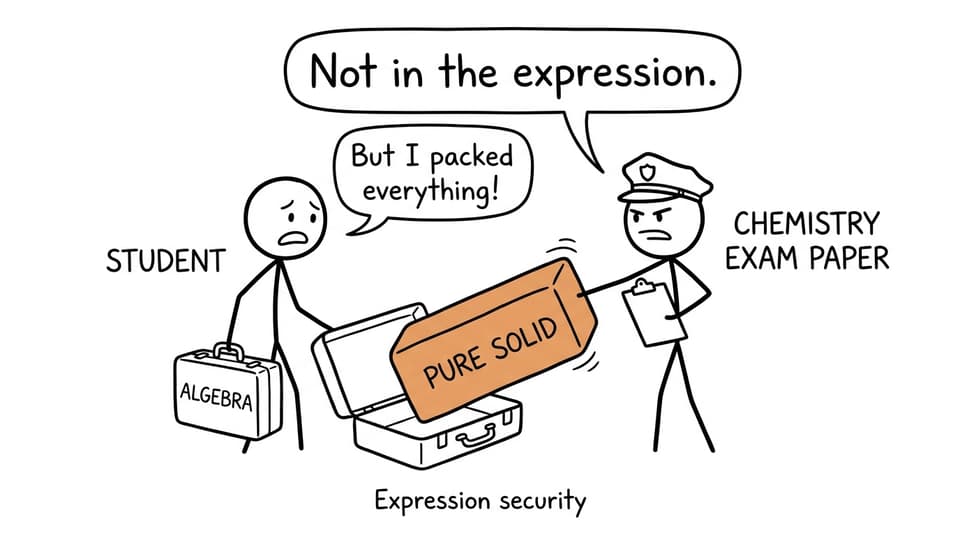
Including every substance blindly
Equilibrium expressions are based rigorously on activities. Pure solids and pure liquids have constant activity and are omitted, while aqueous and gaseous species are normally included in the relevant classroom expression. Always read the physical-state symbols.
Reporting units for Q
Thermodynamic Q is dimensionless because it is formally defined using activities relative to standard states. IB calculations commonly use concentration notation, but you should normally report Q without units.
Claiming the reaction stops
When Q = K, dynamic equilibrium has been reached. Forward and reverse reactions continue at equal rates; there is simply no net change in composition.
RevisionDojo’s guide to common IB Chemistry equilibrium mistakes is useful for diagnosing whether an error came from chemistry, algebra, or exam language.
Quick-reference revision summary
- Q uses the same mathematical expression as K.
- Q describes the mixture at a specified moment; K describes equilibrium at a fixed temperature.
- Products belong in the numerator and reactants in the denominator.
- Balanced coefficients become exponents.
Q < Kmeans a net forward reaction.Q > Kmeans a net reverse reaction.Q = Kmeans dynamic equilibrium.- Q predicts direction, not speed.
- Pure solids and liquids are omitted from general equilibrium expressions.
- Q and K are dimensionless when defined using activities.
Turn the method into exam confidence
Knowing the rule is only the first layer. The real skill is moving reliably from equation to expression, from expression to calculation, and from calculation to chemical conclusion.
RevisionDojo brings that process together. Begin with equilibrium notes organised by subtopic, recall the comparisons with Flashcards, and apply them in the Questionbank. Then use AI Chat and grading tools to investigate errors before testing your timing with Chemistry Predicted Papers and Mock Exams.
The wider RevisionDojo IB exam-preparation platform also connects students with the Coursework Library and Tutors when revision or internal assessment work needs more support. Q may be a snapshot, but good preparation is a sequence. RevisionDojo helps ensure each step points in the right direction.