
The rate constant, k, is the proportionality factor connecting reaction rate to reactant concentrations in a rate expression. At a fixed temperature and for a particular reaction pathway, its value does not change with concentration. Its units depend on overall reaction order, while temperature and catalysts can change its value.
That definition is compact. Exam questions rarely are. The real challenge is moving confidently between experimental data, rate expressions, units, and the Arrhenius equation without losing a mark to one small assumption.
Rate constant checklist for IB Chemistry
Before attempting a kinetics question, remember:
- A rate expression has the general form rate = k[A]ᵐ[B]ⁿ.
- The orders m and n are determined experimentally, not normally copied from the balanced equation.
- Overall order equals m + n.
- Calculate k by rearranging the experimentally determined rate expression.
- Derive the units of k from the equation rather than memorizing them blindly.
- A higher temperature generally gives a larger value of k.
- In an Arrhenius plot of ln k against 1/T, the gradient is −Eₐ/R.
This material appears in Reactivity 2.2 of the current course, with the quantitative treatment of k and the Arrhenius equation forming part of Higher Level study. RevisionDojo’s focused R2.2.11 rate constant notes provide a useful syllabus-aligned starting point.
What the constant actually tells you
Consider the experimental rate expression:
rate = k[A]²[B]
The concentrations describe how much reactant is available. The exponents describe how sensitively the rate responds when those concentrations change. The constant k connects these variables to the measured rate.
Calling it a constant can be misleading. It is constant only for a specified reaction under specified conditions, particularly temperature and reaction pathway. Changing concentration does not change k at a fixed temperature. Heating the system usually does. Adding a catalyst also changes the effective value because the catalyst provides a different pathway with a different activation energy.
This distinction is highly examinable:
- Increasing concentration can increase rate without changing k.
- Increasing temperature usually increases both rate and k.
- A catalyst changes the pathway and therefore changes k, but it does not alter the equilibrium constant.
For the wider conceptual picture, use RevisionDojo’s chemical kinetics study notes alongside the guide explaining why temperature affects reaction rate.
How to calculate k from a rate expression
Suppose experiments establish this rate expression:
rate = k[A]²[B]
At a particular temperature:
- rate = 4.80 × 10⁻⁴ mol dm⁻³ s⁻¹
- [A] = 0.200 mol dm⁻³
- [B] = 0.100 mol dm⁻³
Rearrange before inserting values:
k = rate ÷ ([A]²[B])
Substitute:
k = (4.80 × 10⁻⁴) ÷ ((0.200)² × 0.100)
k = 0.120 dm⁶ mol⁻² s⁻¹
The arithmetic is short. The reasoning earns the reliability:
- The reaction is second order with respect to A.
- It is first order with respect to B.
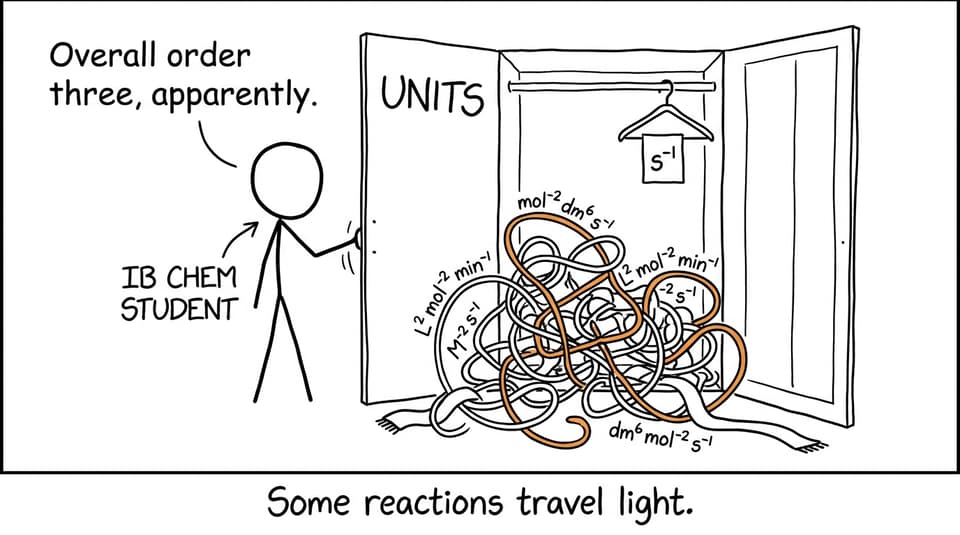
- Its overall order is three.
- The units must therefore be those of a third-order rate constant.
On an exam, show the rate expression, rearrangement, substitution, value, and units. This creates a visible chain of reasoning and makes a calculator slip easier to identify.
Deriving the units without guessing
Reaction rate normally has units of mol dm⁻³ s⁻¹, while each concentration has units of mol dm⁻³. For an overall order p:
units of k = (mol dm⁻³ s⁻¹) ÷ (mol dm⁻³)ᵖ
| Overall order | Typical units of k |
|---|---|
| Zero | mol dm⁻³ s⁻¹ |
| One | s⁻¹ |
| Two | dm³ mol⁻¹ s⁻¹ |
| Three | dm⁶ mol⁻² s⁻¹ |
Units are more than presentation. They can reveal the overall order and expose an incorrect rate expression. If your calculated units do not agree with the order, pause before moving on.
Temperature and the Arrhenius equation
The quantitative connection between temperature and k is:
k = Ae^(−Eₐ/RT)
Here, A is the Arrhenius or pre-exponential factor, Eₐ is activation energy in J mol⁻¹, R is the gas constant, and T is absolute temperature in kelvin.
Its linear form is:
ln k = ln A − (Eₐ/R)(1/T)
Comparing this with y = mx + c gives:
- y-axis: ln k
- x-axis: 1/T in K⁻¹
- gradient: −Eₐ/R
- intercept: ln A
If an Arrhenius graph has a gradient of −7200 K:
Eₐ = −gradient × R
Eₐ = 7200 K × 8.31 J K⁻¹ mol⁻¹
Eₐ = 5.98 × 10⁴ J mol⁻¹ = 59.8 kJ mol⁻¹
The negative slope does not mean activation energy is negative. The gradient already contains the negative sign in −Eₐ/R. RevisionDojo’s Arrhenius equation guide develops this method further, while the short activation energy video lessons offer a visual refresher.
How rate constant questions appear in exams
A question may ask you to:
- infer reaction orders by comparing initial-rate experiments;
- construct the rate expression from experimental evidence;
- calculate k and state its units;
- predict how k changes with temperature;
- interpret an Arrhenius plot;
- calculate activation energy or the Arrhenius factor;
- evaluate whether a proposed mechanism agrees with the rate expression.
For initial-rate tables, compare two experiments where only one concentration changes. If doubling [A] doubles the rate, the reaction is first order in A. If doubling [A] quadruples the rate, it is second order. If the rate remains unchanged, it is zero order.
Practise those decisions in the IB Chemistry kinetics Questionbank, then move to timed Chemistry Predicted Papers when the method feels secure.
Common mistakes that lose marks
Taking orders from stoichiometric coefficients
A balanced equation describes overall chemical change. It does not normally reveal the experimental rate expression. Derive orders from the supplied evidence unless the question explicitly concerns an elementary step.
Giving k the units of reaction rate
The units of k depend on overall order. Derive them by dividing the rate units by the concentration terms in the rate expression.
Using Celsius in an Arrhenius calculation
Arrhenius calculations require kelvin. Convert with T/K = temperature/°C + 273.15 before calculating 1/T.
Mixing joules and kilojoules
When using R in J K⁻¹ mol⁻¹, convert activation energy to J mol⁻¹. Convert the final answer back to kJ mol⁻¹ only if appropriate.
Saying heat lowers activation energy
A temperature increase does not lower Eₐ. It increases the fraction of particles with sufficient energy to react. A catalyst lowers the activation energy by creating an alternative pathway.
A practical revision method
Use three passes. First, learn the relationships from RevisionDojo’s complete IB Chemistry resources. Second, use Flashcards to retrieve definitions, units, and graph relationships without notes. Third, solve Questionbank problems and ask AI Chat or a Tutor to diagnose any step you cannot explain.
As exams approach, combine Grading tools, Mock Exams, and Predicted Papers to practise complete solutions under time pressure. The Coursework Library can also show how kinetics data and Arrhenius plots are communicated in scientific investigations.
The goal is not to memorize one more symbol. It is to recognize the chain: experimental data gives orders, orders give the rate expression, the rate expression gives k and its units, and temperature dependence leads to Arrhenius analysis. Once that chain is secure, kinetics questions become less like puzzles and more like procedures.