
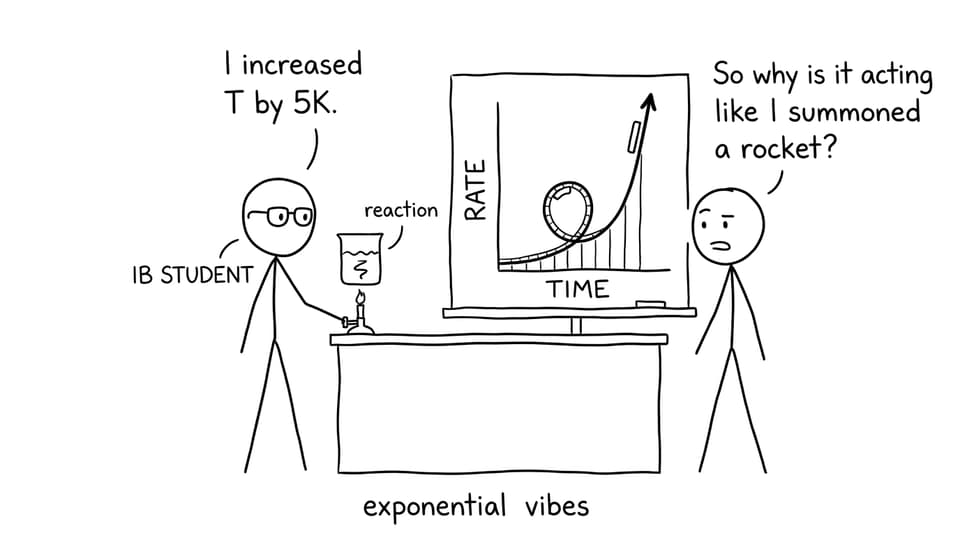
Temperature questions in IB Chemistry can feel unfair. You do one tiny thing, warm a reaction a little, and suddenly the numbers jump as if the molecules got a group chat and decided to sprint.
That confusion is exactly what the Arrhenius equation clears up. It doesn’t just say “higher temperature, faster rate.” It explains why the change is dramatic, where activation energy fits in, and how you can turn a messy kinetics data set into something you can actually calculate with in IB Chemistry exams.
Arrhenius equation overview (what to memorize)
Keep this quick checklist ready for IB Chemistry:
-
Know the equation: k = A e^(−Ea/RT)
-
Know the rearranged linear form (HL): ln k = −Ea/R (1/T) + ln A
-
Remember T must be in kelvin
-
Remember R = 8.314 J mol⁻¹ K⁻¹ (so Ea should be in J mol⁻¹)
-
Be able to explain catalysts as “lower Ea” in words and in the equation
If you want the bigger kinetics picture first, pair this with RevisionDojo’s explanation of rate of reaction and how temperature affects rate.
What is the Arrhenius equation in IB Chemistry?
In IB Chemistry, the Arrhenius equation links the rate constant (k) to temperature (T) and activation energy (Ea):
k = A e^(−Ea/RT)
Where:
-
k = rate constant (how fast the reaction is, mathematically)
-
A = frequency factor (collision frequency + orientation probability)
-
Ea = activation energy (J mol⁻¹)
-
R = gas constant (8.314 J mol⁻¹ K⁻¹)
-
T = temperature (K)
-
e = exponential constant
This is why IB Chemistry teachers keep saying “rate increases exponentially.” The exponential term is doing the heavy lifting.
For syllabus-aligned practice, RevisionDojo’s Arrhenius equation Questionbank is the fastest way to see how exam questions actually phrase this.
What the symbols actually mean (in exam language)
Frequency factor A (pre-exponential factor)
In IB Chemistry, you can describe A as the “collision part” of collision theory: how often particles collide and how likely they are to be oriented correctly. It’s reaction-specific (different mechanisms, different shapes, different orientation needs). In many exam problems, A is treated as constant across a small temperature range.
Activation energy Ea
Ea is the minimum energy barrier that must be overcome for successful collisions. High Ea means that, at a given temperature, fewer molecules have enough energy to react. If you need a clean definition and how it appears on energy profile diagrams, use What is activation energy?.
Temperature T (kelvin only)
Temperature increases particles’ kinetic energy, but the key IB Chemistry idea is this: raising T increases the fraction of molecules with energy ≥ Ea, and that fraction changes sharply. That’s why modest heating can cause big rate changes.
Why the Arrhenius equation matters in IB Chemistry exams
The Arrhenius equation helps you explain four “classic” kinetics outcomes that show up repeatedly in IB Chemistry:
-
Heating speeds reactions up a lot because k increases exponentially.
-
Low Ea reactions are fast at room temperature because many particles already exceed Ea.
-
High Ea reactions can be essentially frozen at room temperature because k becomes tiny.
-
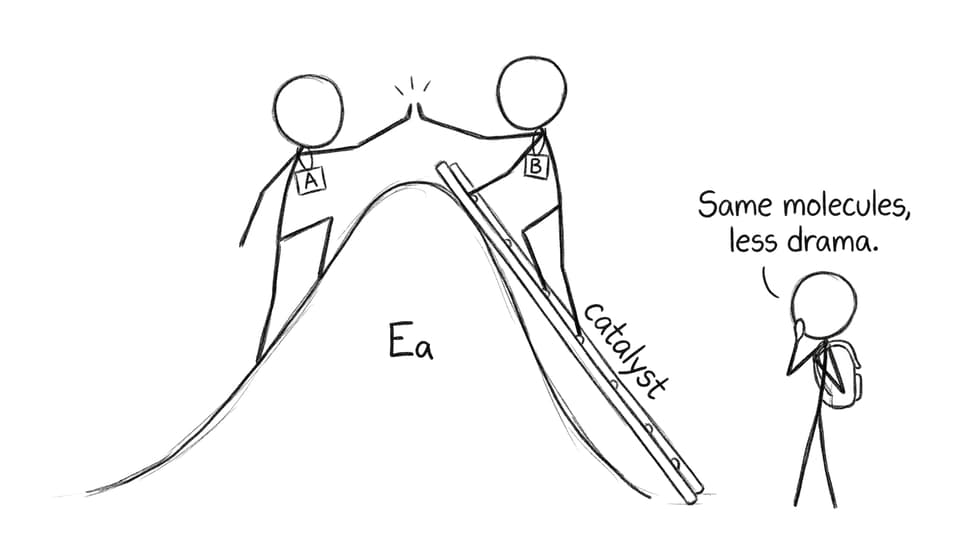
Catalysts increase rate because they lower Ea, boosting the exponential term.
Catalyst explanations are especially testable. If you want a strong wording template, read How catalysts affect activation energy and deepen it with heterogeneous vs homogeneous catalysis.
Arrhenius plot (HL): turning a curve into a straight line
HL IB Chemistry often asks you to extract Ea from data. Rearranging gives:
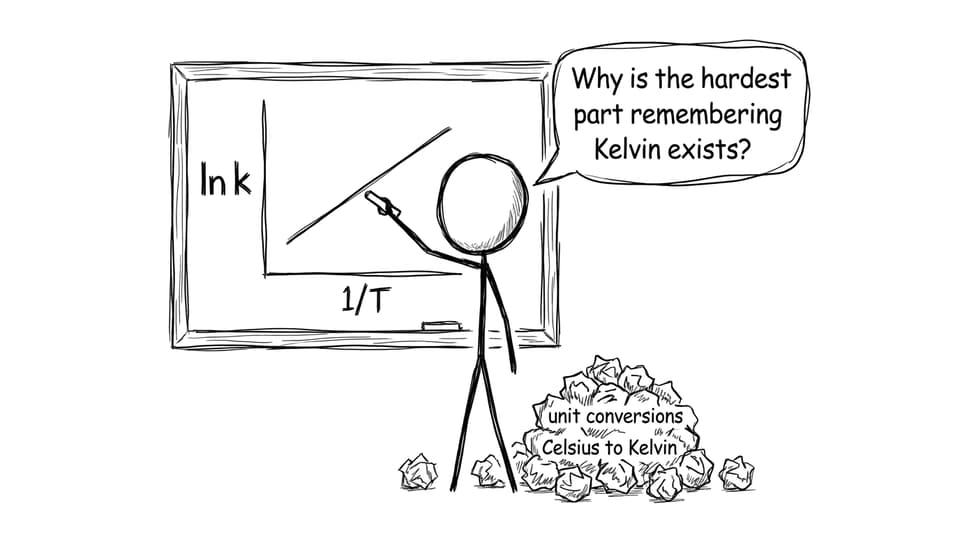
ln k = −Ea/R (1/T) + ln A
This matches y = mx + c:
-
y = ln k
-
x = 1/T
-
slope m = −Ea/R
-
intercept c = ln A
So if you find the slope, you can calculate:
Ea = −(slope) × R
Two common exam traps:
-
Using °C instead of K (always convert)
-
Mixing kJ mol⁻¹ and J mol⁻¹ (match units with R)
For a quick refresher of how k behaves in rate laws, connect this to the RevisionDojo note on rate constant (HL).
How RevisionDojo makes Arrhenius questions feel predictable
The best feeling in IB Chemistry is realizing the question isn’t “hard,” it’s just patterned. RevisionDojo is built around that idea:
-
Use the Study Notes to lock in definitions and equation meaning (especially Ea, k, and catalyst language).
-
Drill the Arrhenius workflow with the Questionbank: Arrhenius equation practice.
-
Convert memory into reflex with Flashcards: Arrhenius equation flashcards.
-
When you miss a step, ask AI Chat to diagnose which assumption broke (units, log rules, or graph reading).
-
If you’re aiming higher, use Mock Exams, Predicted Papers, and Grading tools to train timing and accuracy.
-
If kinetics is part of your coursework thinking, browse the Coursework Library for structure and ideas, like this temperature and rate exemplar.
-
If you want a human plan, RevisionDojo Tutors can help you build a repeatable method instead of one-off fixes.
Conclusion: make IB Chemistry kinetics feel calmer
The Arrhenius equation is one of those IB Chemistry ideas that feels intimidating until you see what it’s really saying: reactions speed up because the fraction of particles exceeding Ea grows fast with temperature. Once you connect the symbols to the story, HL Arrhenius plots and catalyst explanations stop being “new topics” and become the same idea in different outfits.
If you want this to stick, do it the RevisionDojo way: read the notes, drill the Questionbank, lock in the definitions with flashcards, and use AI Chat to correct your method before it becomes a habit. That’s how IB Chemistry becomes predictable, and predictability is what exam confidence is made of.