


A parent-teacher conversation can become strangely numerical. There is a grade, a deadline, perhaps a comparison with the previous term. Yet the most useful questions to ask an MYP History teacher are not really about a number. They reveal what your child is learning, which skill is holding them back, and what manageable action would help next.
Start with four areas: the course, assessment criteria, current evidence, and appropriate support at home. Ask the teacher to translate comments such as “needs more analysis” into something observable. Then leave with one or two priorities rather than a long rescue plan. MYP History develops knowledge, but it also asks students to investigate, interpret evidence, compare perspectives, communicate, and make supported judgments.
A quick parent-teacher meeting checklist
If time is limited, take these questions with you:
- What units and historical concepts will students study?
- Which assessment criterion is currently my child's strongest?
- Which criterion should they focus on next?
- What would improvement look like in an actual response?
- Is the main difficulty knowledge, research, communication, or critical thinking?
- How should my child use feedback after an assessment?
- What amount of independent study is realistic each week?
- Which resources match the units taught at this school?
- What is one low-pressure action we can take at home?
- When should my child ask you directly for help?
That final question matters. Supporting independence sometimes means helping a child formulate a question, then allowing them to ask it themselves.
Ask what MYP History means at your school
MYP History can look different between schools. The IB places History within Individuals and Societies, but schools may teach it separately, through modules, or within integrated humanities. There is no single chronological sequence followed by every MYP school.
Ask how History is organized, which units and case studies students will encounter, and what they should be able to do by the end of the year. You can also ask whether the school participates in MYP eAssessment and whether that is relevant to your child.
These questions prevent families from buying resources or encouraging revision that does not match the course. RevisionDojo's guide to topics covered in MYP History explains why themes can be similar even when schools select different events. The difference between MYP History and DP History also clarifies how MYP inquiry skills lead toward more specialized DP study.
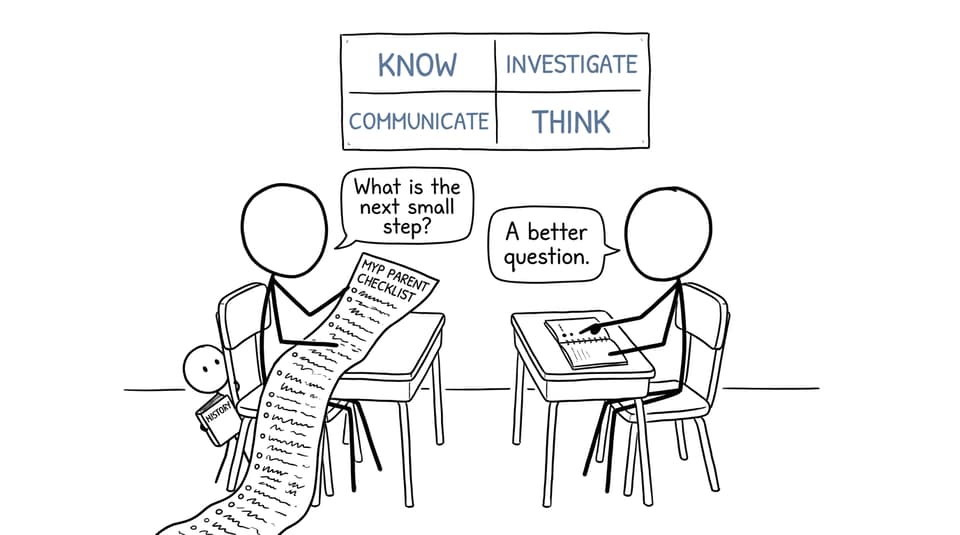
Ask how the four criteria appear in real work
MYP Individuals and Societies uses four equally weighted assessment criteria. Each has achievement levels from 1 to 8, but the descriptor matters more than the number because it shows what the student demonstrated.
| Criterion | What it broadly examines | A useful parent question |
|---|---|---|
| A: Knowing and understanding | Knowledge, concepts, terminology, and explanation | Does my child know too little, or struggle to apply what they know? |
| B: Investigating | Research questions, planning, evidence, and reflection | Which stage of investigation needs attention? |
| C: Communicating | Organization, expression, formats, and documentation | Is the argument unclear or poorly documented? |
| D: Thinking critically | Analysis, perspectives, evidence, and judgments | Where does the response describe instead of analyze? |
Ask, “Could you show me what the current criterion level looks like in my child's work?” Then ask what the next level would require. A concrete comparison is more useful than asking how your child can simply “get a better grade.”
The MYP Individuals and Societies criteria guide translates the framework's language, while IB coursework criteria explained for parents provides broader context.
Ask what is actually getting in the way
A disappointing result can have several causes. A student may understand the topic but misread the command term. They may have evidence but fail to explain its significance. They may communicate clearly while relying on too few sources.
Ask whether your child answers the precise question, distinguishes explanation from analysis, uses evidence effectively, and manages citations and deadlines. Also establish whether the issue appears across several tasks or reflects one isolated result.
If source work is the concern, ask what students are expected to examine. This may include origin, purpose, audience, context, value, and limitations. RevisionDojo's guide to analyzing historical sources in MYP History shows why evaluation must relate to the investigation rather than end with the vague statement that a source is biased.
“Revise more” is an instruction without a diagnosis. “Explain how this evidence supports your claim” gives the student a skill they can practise.
Ask how feedback should become action
Feedback has little value if it remains at the bottom of a finished assignment. Ask which comment your child should act on first, whether they can apply it in another task, and what signs would demonstrate progress.
A calm routine could involve revisiting one paragraph rather than repeating an entire assignment. The student can underline the claim, circle the evidence, and explain aloud how the two connect. If that link is missing, the problem becomes visible without a parent rewriting the response.
RevisionDojo's MYP History resource hub supports focused practice. Study Notes and Flashcards can rebuild knowledge, while the Questionbank helps students apply it. AI Chat can challenge vague explanations, and Grading tools can support review against expectations. Mock Exams, Predicted Papers, the Coursework Library, and Tutors offer further support when appropriate, but should complement the school's programme rather than create a parallel curriculum.
Support progress without taking ownership
Parents can protect study time, provide a quiet place, listen to an explanation, or divide a deadline into stages. They should not choose the argument, perform the analysis, or rewrite the work.
Useful prompts include: “What is the question asking?” “Which evidence is most useful, and why?” and “Which teacher comment are you applying today?” The MYP Individuals and Societies resources can then help students review the relevant topic instead of revising indiscriminately.
Finish the meeting by asking, “If we focus on one thing before the next assessment, what should it be?” Write down the answer, involve your child in choosing the approach, and set a sensible review point. With the teacher's insight and RevisionDojo's connected resources, the next step can remain focused, independent, and manageable.