
The properties of covalent compounds depend mainly on structure and particle attractions. Molecular substances generally have low melting and boiling points, variable solubility, and poor electrical conductivity. Giant covalent structures usually have very high melting points, are insoluble, and do not conduct electricity, although graphite is an important exception.
That answer is short. Exam questions are harder because they ask why. The marks usually sit in a chain of reasoning: identify the structure, describe the particles or forces involved, and connect them to the observed property.
What IB Chemistry students need to know
The current IB DP Chemistry course places this material within Structure 2.2: The covalent model. You should be able to:
- distinguish molecular from giant covalent structures
- explain volatility using intermolecular forces
- predict solubility from polarity and intermolecular attractions
- explain conductivity through the presence or absence of mobile charged particles
- compare substances using molecular size, shape, polarity, and hydrogen bonding
- recognize exceptions without turning them into inaccurate general rules
The central idea is simple: the word covalent tells you how atoms are bonded, but it does not by itself tell you how the whole substance behaves. For the underlying bonding model, review RevisionDojo's covalent model notes.
Molecular and giant covalent structures
A covalent bond is the electrostatic attraction between a shared pair of electrons and the positively charged nuclei. These bonds are strong, but their effect on physical properties depends on how far the bonding extends.
Molecular covalent substances
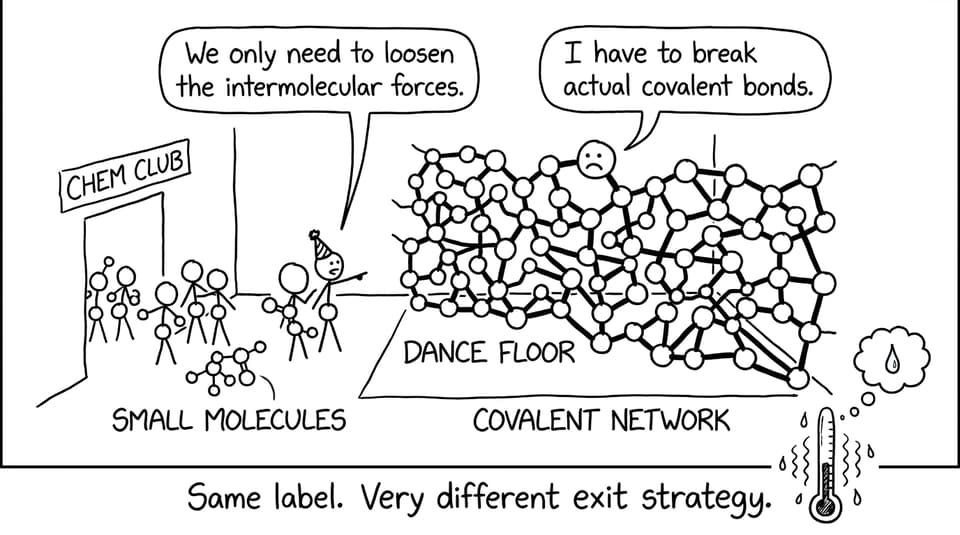
Molecular substances contain separate, discrete molecules. Strong covalent bonds hold the atoms together within each molecule, while intermolecular forces attract one molecule to another.
Examples include methane, carbon dioxide, water, ammonia, and iodine. When one of these substances melts or boils, its molecules normally remain intact. Energy overcomes attractions between molecules, not the covalent bonds inside them.
Giant covalent structures
In a giant covalent structure, atoms are joined by covalent bonds in a continuous network. There are no separate molecules to pull apart. Diamond, graphite, silicon, and silicon dioxide are familiar examples, although some are elements rather than compounds.
Melting a network structure requires many strong covalent bonds to be broken. This demands far more energy than overcoming intermolecular attractions, so these substances generally have very high melting points.
Melting point, boiling point, and volatility
Many molecular covalent substances have relatively low melting and boiling points because their intermolecular forces are much weaker than covalent bonds. Those with low boiling points tend to be more volatile, meaning they evaporate readily.
However, writing “covalent compounds have low boiling points” is too broad. You must consider the intermolecular forces:
- London dispersion forces occur between all atoms and molecules.
- Dipole-dipole attractions occur between polar molecules.
- Hydrogen bonding occurs when hydrogen bonded to nitrogen, oxygen, or fluorine interacts with a lone pair on an appropriate atom in another particle.
Larger, more polarizable electron clouds generally create stronger dispersion forces. Molecular shape also matters because greater surface contact can strengthen attractions. When comparing similar molecules, hydrogen bonding often produces a substantial increase in boiling point.
The intermolecular forces and physical properties notes develop these comparisons in greater depth.
Solubility is about competing attractions
“Like dissolves like” is a useful starting heuristic, not a complete explanation. A substance dissolves when the new solute-solvent attractions can compensate sufficiently for attractions disrupted within the solute and solvent.
Polar molecular substances may dissolve in polar solvents through dipole-dipole attractions or hydrogen bonding. Non-polar molecules are often more soluble in non-polar solvents, where dispersion forces dominate. Solubility can also change as a molecule gains both polar and non-polar regions, so avoid judging it from one bond alone.
Giant covalent structures are generally insoluble. A solvent cannot normally provide enough stabilizing interaction to compensate for breaking the extensive network of strong covalent bonds.
Electrical conductivity and its exceptions
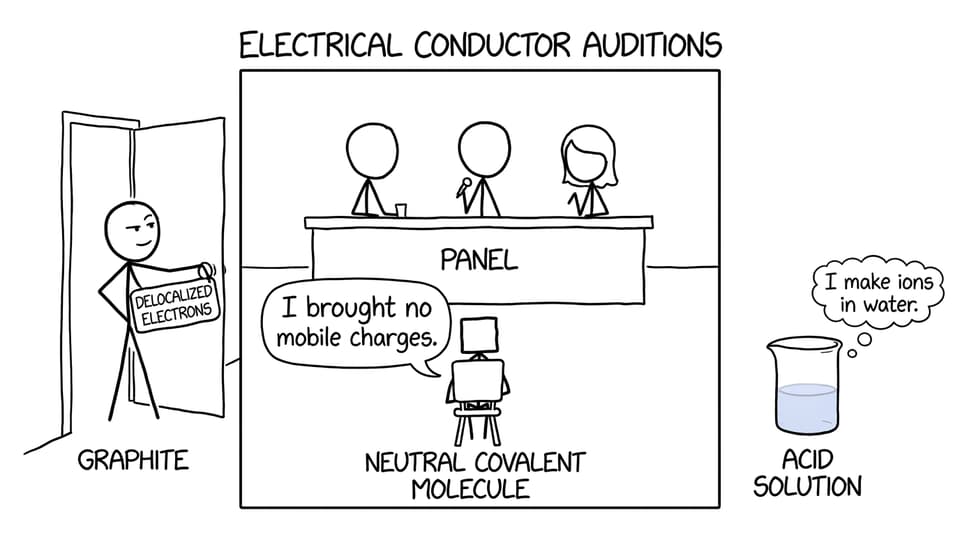
Most molecular covalent substances do not conduct electricity because they contain neutral molecules and have no mobile ions or delocalized electrons. The same reasoning usually applies when they melt.
Some molecular substances produce conducting aqueous solutions because they ionize through reaction with water. Hydrogen chloride is covalent as a pure molecular substance, but in water it forms ions that can move and carry charge. Do not claim that every dissolved covalent substance conducts.
Most giant covalent structures are also non-conductors because their electrons are localized in bonds. Graphite is the classic exception: each carbon forms three covalent bonds, leaving electrons delocalized within its layers. Those electrons can move along the layers and carry charge.
Worked IB Chemistry examples
Comparing methane and ammonia
Question: Explain why ammonia has a higher boiling point than methane.
Reasoning:
- Both are molecular covalent substances.
- Methane is non-polar and experiences London dispersion forces between molecules.
- Ammonia is polar and its molecules can form hydrogen bonds because hydrogen is bonded to nitrogen and nitrogen has a lone pair.
- More energy is required to overcome the stronger intermolecular attractions between ammonia molecules.
- Ammonia therefore has the higher boiling point.
Notice the structure of the answer: comparison, force, energy, conclusion. Saying only “ammonia has hydrogen bonding” identifies a feature but does not fully explain its effect.
Comparing carbon dioxide and silicon dioxide
Question: Explain why silicon dioxide has a much higher melting point than carbon dioxide.
Model answer: Carbon dioxide forms discrete molecules, so melting requires intermolecular forces between its molecules to be overcome. Silicon dioxide has a giant covalent network, so many strong covalent bonds must be broken during melting. Considerably more energy is required, giving silicon dioxide a much higher melting point.
This comparison tests whether you distinguish the bond inside a molecule from the attraction between molecules. Build that distinction with RevisionDojo's IB Chemistry bonding and structure guide.
How the topic appears in exam questions
Questions may provide a structure, physical data, or an unfamiliar material and ask you to explain or predict a property. A reliable response pattern is:
- Structure: molecular or giant covalent?
- Particles: molecules, atoms, ions, or delocalized electrons?
- Attraction: which intermolecular force or covalent network is relevant?
- Mobility or energy: what can move, or what must be overcome?
- Property: what conclusion follows?
Pay close attention to the command term. State needs a concise result; explain requires a cause-and-effect chain; compare requires direct reference to both substances. The IB Chemistry command terms guide is useful when correct knowledge is not yet turning into complete answers.
After revising, apply the model through the IB Chemistry Questionbank. Topic practice reveals whether you can transfer the idea to unfamiliar compounds rather than merely recognize a definition.
Common exam mistakes
Claiming covalent bonds break during boiling
For a molecular substance, boiling normally overcomes intermolecular forces. The covalent bonds inside each molecule remain intact.
Treating every covalent substance as molecular
Giant covalent structures behave very differently. Always establish the structure before predicting physical properties.
Calling a polar bond a polar molecule
Molecular polarity depends on both bond polarity and geometry. Bond dipoles may cancel in a symmetrical molecule, as they do in carbon dioxide.
Saying electrons cannot move without naming the particles
A stronger conductivity explanation states that there are no mobile charged particles. For graphite, identify delocalized electrons and specify that they move along the layers.
Using absolute solubility rules
Polarity is important, but molecular size, functional groups, and competing solute-solvent attractions also matter. Use “likely” or “generally” unless the evidence supports certainty.
Quick-reference summary
| Structure | Melting and boiling behaviour | Conductivity | Solubility |
|---|---|---|---|
| Molecular, non-polar | Often low; volatility may be high | Usually none | Often better in non-polar solvents |
| Molecular, polar | Variable; stronger attractions can raise boiling point | Usually none when pure; some ionize in water | Often greater in polar solvents |
| Giant covalent | Usually very high melting point | Usually none; graphite conducts along layers | Generally insoluble |
A final memory rule helps: structure determines particles, particles determine forces and mobility, and those determine properties.
Turn the model into marks
The properties of covalent compounds become manageable once you stop memorizing disconnected lists. Begin with the structure, then reason toward energy, charge mobility, or solute-solvent attractions. That method survives unfamiliar examples, which is exactly why it is valuable in IB Chemistry.
RevisionDojo brings the full process together: concise Study Notes and Flashcards for recall, a Questionbank for application, AI Chat and Grading tools for feedback, and Chemistry Predicted Papers and Mock Exams for timed preparation. Its Coursework Library and Tutors can support the wider course when revision pressure grows. Start with one explanation, diagnose the first missing link, and rebuild it until every sentence earns its place.