


Preparing for MYP Physics eAssessment is most effective when you combine targeted concept review with investigation practice, data analysis, real-world evaluation, and timed work on a screen. Do not spend your entire revision period reading notes or memorizing equations. Learn a small amount, apply it immediately, examine your mistakes, and repeat the skill under harder conditions.
Rereading feels comfortable because it hides uncertainty. Attempting a difficult question does the opposite. Yet Physics becomes dependable only when you can use an idea without being shown the route first.
This guide provides a practical system you can begin today, even if the examination is still months away.
Your MYP Physics preparation checklist
Use this checklist to keep revision connected to the assessment:
- Map your strong, uncertain, and weak Physics topics.
- Review the four MYP Sciences criteria.
- Practise formulas, substitutions, units, and appropriate precision.
- Design investigations with justified variables, controls, ranges, and repeats.
- Interpret tables, graphs, simulations, and unfamiliar evidence.
- Evaluate real-world applications using balanced reasoning.
- Follow command terms such as state, explain, calculate, and evaluate.
- Complete timed work using on-screen tools.
- Record mistakes as specific rules and retest them.
The RevisionDojo MYP Physics resource hub is a practical starting point for organizing this work by topic.
Understand what the MYP Physics eAssessment tests
The MYP Physics eAssessment is an optional two-hour on-screen examination for students in the final year of the programme. Current IB guidance describes three broad task areas:
| Task area | Main demand | Typical preparation |
|---|---|---|
| Knowing and understanding | Apply Physics knowledge and solve problems | Concepts, equations, units, explanations |
| Investigation skills | Inquire, design, process, and evaluate | Variables, methods, graphs, conclusions |
| Applying science | Examine science in a real-life issue | Evidence, impacts, judgments, scientific language |
The published sciences blueprint allocates approximately 25 marks to knowing and understanding, 50 to investigation skills, and 25 to applying science. Questions may draw on multiple criteria, while the four MYP Sciences criteria remain equally weighted overall.
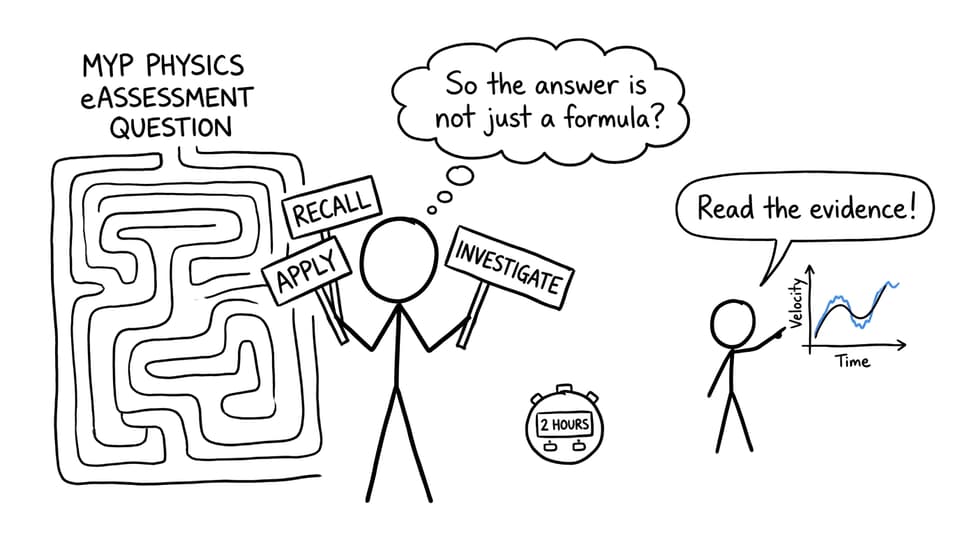
The lesson is simple: knowing formulas is necessary, but insufficient. A student may recall the speed equation yet struggle to select it from an unfamiliar scenario, rearrange it, show the substitution, include the correct unit, and decide whether the result is reasonable.
For more detail, read the MYP Science criteria guide with examples.
The same-day preparation method
You do not need a perfect timetable before beginning. You need one completed feedback loop. Set aside about 75 minutes and follow these steps.
Choose one narrow topic
Select a specific area such as energy efficiency, parallel circuits, wave refraction, pressure, or radioactive half-life. Avoid something as broad as “forces.” Narrow targets make weaknesses visible.
Spend five minutes writing everything you remember without notes. Include definitions, equations, units, diagrams, and one application. Empty spaces reveal more than another highlighted paragraph.
Repair the concept briefly
Use the MYP Physics Study Notes and resources for ten to fifteen minutes. Correct your recall sheet in another color, close the notes, and explain the concept aloud.
Your explanation should answer three questions:
- What happens?
- Why does it happen?
- How could it be measured or tested?
Study Notes should function like a pit stop, not a waiting room. Once the gap is repaired, return to performance.
Complete a mixed mini-set
Spend twenty minutes answering four or five questions. Include a calculation, explanation, data-based item, and unfamiliar application. RevisionDojo’s Questionbank supports targeted practice, while Flashcards help with definitions, units, equations, and command terms.
Before answering, translate the command term:
- State means give a concise answer.
- Describe means give a detailed account.
- Explain means connect an outcome to its causes.
- Calculate means show a logical numerical method.
- Evaluate means reach a supported judgment.
This pause takes seconds and can stop a correct idea from becoming an incomplete response.
Diagnose and retest mistakes
Spend fifteen minutes checking your work. Do not label an error “careless.” Classify it as a knowledge gap, equation error, missing unit, command-term problem, weak interpretation, incomplete investigation, unsupported evaluation, or timing issue.
Turn the error into a rule. For example: “When evaluating a method, identify a limitation, explain its effect on the data, and propose a specific improvement.” Then redo the question without support. Schedule another attempt within two or three days so the improvement lasts.
This learn-attempt-review-retest cycle is central to revising MYP Sciences without excessive memorization.
Practise all four criteria deliberately
Students often devote most of their time to Criterion A because calculations and factual questions are easy to organize. Criteria B, C, and D need deliberate practice too.
Train investigation and data skills
Once a week, design an investigation around a Physics relationship. Write a focused question and supported hypothesis. Identify the independent, dependent, and controlled variables. Give a realistic range, describe measurement methods, include repeats, and note relevant safety precautions.
Next, imagine the results. Select an appropriate graph, predict the trend, and explain how you would identify an anomaly. Add one plausible limitation and a matching improvement. “Use better equipment” is vague; naming an instrument and explaining how it reduces uncertainty is stronger.
When reading data, check the title, axes, units, and scale before describing the relationship. Support your observation with values, identify anomalies, explain the pattern using Physics, and decide whether the evidence supports the claim. The sample MYP assessment tasks by subject group provide useful criteria-first models.
Build balanced Criterion D responses
For a real-life application, identify the relevant Physics before examining benefits, limitations, and environmental, economic, social, ethical, or political factors. Use supplied evidence and finish with a reasoned judgment.
A list of advantages and disadvantages is not yet an evaluation. The judgment turns separate observations into an argument.
Make revision resemble the on-screen examination
The assessment may use graphs, simulations, animations, videos, drawing areas, and an on-screen calculator. Paper-only practice therefore leaves part of the challenge untouched.
At least weekly, complete a timed set on a computer. Practise scrolling without losing your place, entering equations, reading graphs, editing extended responses, and moving between information and answer fields. Keep a short list of anything that wastes time.
During longer sessions, answer accessible questions first and then return to demanding calculations or extended responses. Preserve time to check units, unanswered parts, graph labels, and command terms. The guide to using technology for MYP eAssessments offers further ways to reduce digital friction.
Turn the method into a weekly plan
A sustainable week can be simple:
| Session | Focus |
|---|---|
| Monday | Retrieve and repair one weak concept |
| Tuesday | Calculation and explanation questions |
| Wednesday | Flashcards and error-log retesting |
| Thursday | Investigation design and data analysis |
| Friday | Criterion D real-world response |
| Weekend | Timed mixed set and full review |
If the examination is approaching, adapt the 30-day MYP eAssessment study plan instead of inventing a complicated schedule.
RevisionDojo brings the loop together: Study Notes for clarification, Flashcards for retrieval, the Questionbank for application, AI Chat for explanations, and Grading tools for criteria-aware feedback. Mock Exams and Predicted Papers, where available, help rehearse timing rather than forecast exact questions. The Coursework Library can develop investigation thinking, while Tutors can diagnose persistent gaps.
Prepare for performance, not familiarity
The best MYP Physics study tips share one principle: revise the action you must perform. If you need to interpret a graph, interpret one. If you need to design a method, write one. If you need to evaluate an application, construct and support a judgment.
Begin with one topic and one 75-minute cycle. Over time, the examination becomes less mysterious because its demands become familiar: retrieve, calculate, investigate, interpret, evaluate, and communicate. With RevisionDojo as your central MYP resource, every question, correction, and retest becomes part of a visible path toward readiness.