

A physics assessment can go wrong in surprisingly ordinary ways. A student understands Newton's laws but misses the command term. Another calculates the correct number but forgets its unit. Someone else draws an accurate graph without labeling either axis.
Avoiding mistakes in MYP Physics assessments is not just about learning more content. It is about making your knowledge visible in the form the task requires. Identify the assessed criterion, translate the command term, show complete reasoning, and check your response with a consistent routine.
That is encouraging because many assessment mistakes are habits, and habits can begin changing today.
Your quick MYP Physics assessment checklist
Before submitting a response, ask:
- Have I followed the exact command term?
- Have I written the equation before substituting values?
- Are all quantities in compatible units?
- Have I shown working and included the final unit?
- Are graph axes labeled with quantities and units?
- Does my conclusion use actual evidence?
- Is each improvement connected to a specific limitation?
- Have I explained implications rather than listed them?
Keep this checklist nearby when using the MYP Physics Questionbank. Repetition turns a deliberate check into an automatic habit.
Understand what the four criteria reward
MYP Sciences uses four equally weighted assessment criteria, each with a maximum achievement level of 8. Your task sheet should identify the criteria and strands being assessed.
| Criterion | What your work must demonstrate | Common mistake |
|---|---|---|
| A: Knowing and understanding | Knowledge, application, and scientifically supported judgments | Recalling facts without applying them |
| B: Inquiring and designing | A testable question, hypothesis, variables, and workable method | Designing a vague investigation |
| C: Processing and evaluating | Organized data, interpretation, conclusions, and evaluation | Describing results without reasoning |
| D: Reflecting on impacts | Applications, implications, scientific language, and documented sources | Giving unsupported, one-sided opinions |
The criteria determine what a successful answer looks like. Memorizing may support Criterion A, but an unfamiliar problem requires you to recognize when the relationship applies. Knowing the definition of a controlled variable does not complete Criterion B unless you explain how and why it will be controlled.
Use MYP Science criteria explained with examples alongside your task-specific rubric. Focus on the evidence the marker needs to see, not merely the wording of descriptors.
Match the answer to the command term
A scientifically correct sentence can still be incomplete. This often happens when a student describes something the question asks them to explain.
- State: Give a brief, specific answer.
- Calculate: Provide working and a numerical answer.
- Describe: Give a detailed account of what happens.
- Explain: Present reasons, causes, or mechanisms.
- Analyse: Identify relationships and draw meaning from information.
- Evaluate: Consider strengths and limitations before reaching a supported judgment.
Highlight the command term and translate it into an action. For example, turn “evaluate the method” into “identify important strengths and limitations, explain their effects, and judge the method's validity.”
Practise this translation separately from content. Select prompts from the RevisionDojo MYP Physics resources, hide the answers, and write a one-line response plan for each. This prevents an otherwise accurate paragraph from drifting away from the question.
Stop losing marks in calculations
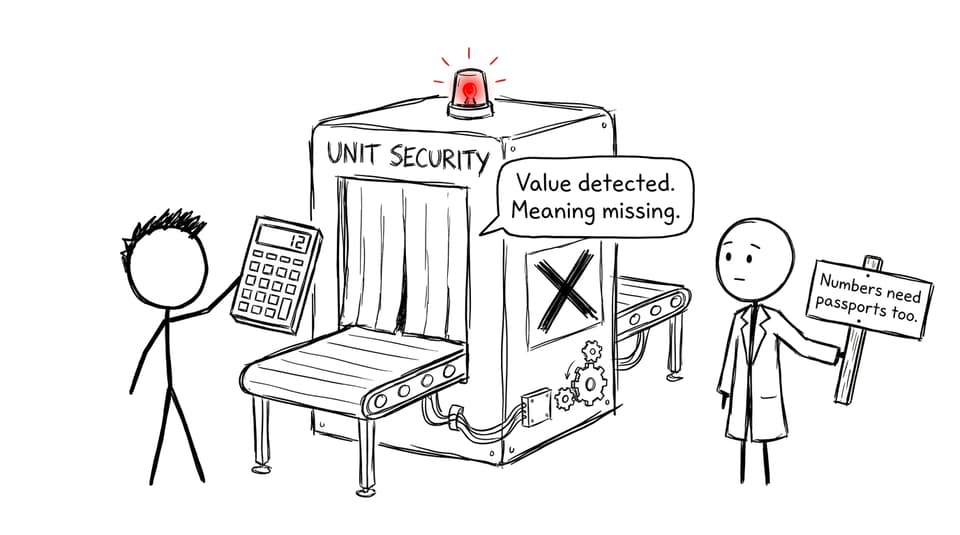
Calculation errors often form a chain: an unconverted unit leads to incorrect substitution, and the final result is accepted without a reasonableness check.
Use the G-U-E-S-S check:
- Given: List known values and units.
- Unknown: State what you need to find.
- Equation: Write the relationship symbolically.
- Substitute: Insert values after checking units.
- Solve: Retain enough precision during intermediate steps.
- Sense-check: Add the unit and test whether the result is plausible.
If a car travels 150 m in 12 s, write , followed by . Visible working communicates your reasoning and makes arithmetic errors easier to find.
Apply the routine across topics such as forces and Newton's laws and work, power, and efficiency. Mental practice alone does not prepare you to communicate the method clearly.
Make investigations specific enough to repeat
In Criterion B work, “measure the time and repeat” is not a complete method. Another student should be able to identify what changes, what is measured, what remains constant, and how enough data will be collected.
Build the investigation in this order:
- Write a focused question naming the independent and dependent variables.
- Form a testable hypothesis supported by physics.
- Explain how the independent variable will change across a suitable range.
- State how the dependent variable will be measured, including equipment and units.
- Identify controlled variables and explain how each stays constant.
- Include repeats, safety precautions, and enough detail for replication.
Avoid saying only that something will be “kept the same.” In a pendulum investigation, for example, explain how the release angle will be measured and kept constant. Precision protects the validity of the comparison.
Turn data into an argument
Criterion C requires more than a neat graph. Data should move through a chain: presentation, processing, interpretation, scientific explanation, conclusion, and evaluation.
Tables need headings and units. Graphs need suitable scales and labeled axes. Describe the overall trend, identify relevant anomalies, and support conclusions with values. Replace “the graph went up” with a quantified statement explaining what increased and what physical relationship the pattern suggests.
Evaluation requires equal specificity. “Human error” explains little. Name the limitation, describe its effect, and propose a realistic improvement. Video analysis or an electronic sensor may reduce reaction-time uncertainty during manual timing. Repetition helps reveal random variation, but it does not automatically remove systematic error.
The measurement in science resources can strengthen your handling of units, uncertainty, data, and evidence.
Build balanced Criterion D responses
Criterion D connects physics with a real-world problem or issue. A weak response explains the technology and stops. A stronger response considers benefits, limitations, and environmental, economic, social, ethical, or safety implications.
Explain the application, examine one evidence-supported benefit and limitation, and reach a balanced judgment tied to the issue. Use precise scientific vocabulary and document sources according to your school's required referencing system.
Use a same-day correction cycle
Set aside 45 minutes and complete this routine:
- Choose one weakness for five minutes. Use teacher feedback or select one narrow topic.
- Review for eight minutes. Read Study Notes and test definitions with Flashcards in the MYP resource hub.
- Answer for twelve minutes. Complete three targeted questions without notes.
- Diagnose for eight minutes. Label each mistake as knowledge, command term, calculation, evidence, or checking.
- Write one error rule for two minutes. For example: “I will convert units before substitution.”
- Redo for seven minutes. Rewrite the weakest response instead of rereading its solution.
- Check for three minutes. Apply the checklist from the beginning of this guide.
This works better than vaguely rereading a chapter because each error creates a specific next action. The guide to revising MYP Sciences without memorising everything can help you extend the cycle across the week.
RevisionDojo supports the complete loop. Study Notes and Flashcards rebuild recall, while the Questionbank develops application. AI Chat can challenge your reasoning, and Grading tools can highlight missing criterion evidence. Mock Exams and Predicted Papers, where available, add timed practice. The Coursework Library demonstrates effective scientific communication, while Tutors offer human guidance when a misconception persists.
Make every mistake useful
Strong physics students still make errors. Their advantage is that the same error rarely survives unnoticed for long.
Treat your next assessment as a collection of signals. Identify the criterion, obey the command term, show the physics, inspect every unit, and connect conclusions to evidence. With RevisionDojo as your MYP Physics revision system, each response can become more precise than the one before it. That is how avoidable mistakes gradually stop shaping your grade.