
If you’ve ever walked out of an MYP Science task thinking, “I knew this… so why did my score feel random?” you’re not alone.
What’s happening usually isn’t a lack of knowledge. It’s a mismatch.
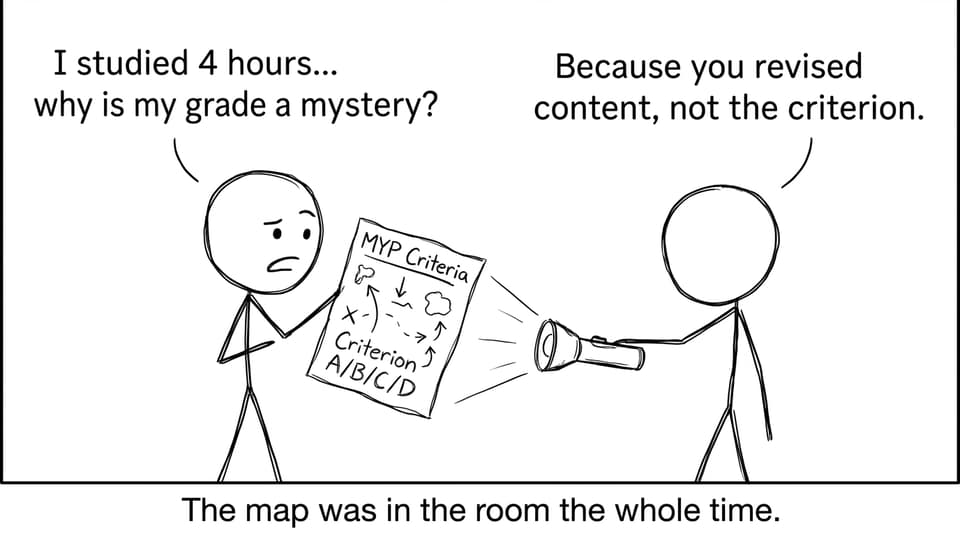
In MYP Sciences, marks don’t simply reward what you remember. They reward what you can do with scientific understanding: explain, design, process, evaluate, and reflect. Once you start seeing tasks through the lens of MYP criteria, grades stop feeling unpredictable and start feeling, oddly, fair.
The MYP criteria in one calm checklist
Before you write a single sentence, run this fast MYP checklist:
-
Which MYP criterion is this task assessing: A, B, C, or D?
-
What would “top-band” look like in one line?
-
What evidence do I need: a scientific explanation, a method justification, processed data, or balanced impact?
-
Where will I use keywords, units, labels, and scientific terminology?
If you want the wider grading picture, keep these two pages open while you revise: How Are MYP Students Graded? Criteria Explained and the Middle Years Programme (MYP) hub.
Criterion A (MYP): Knowing and understanding
Criterion A in MYP Science is where students assume they’ll shine, and still lose marks.
You score well here when you explain concepts clearly and apply them to the situation given, using accurate scientific language.
Real example (photosynthesis)
Weak (lists facts): “Photosynthesis is when plants make glucose and oxygen.”
Stronger (applies and explains): “If light intensity increases, the rate of photosynthesis rises because more photons drive the light-dependent reactions, until another factor (like CO₂) becomes limiting. In this setup, the bubbles per minute would increase then plateau.”
The difference is small on the page, but huge in MYP marking: application beats definition.
To train this quickly, do short, targeted prompts in the RevisionDojo Questionbank, then use AI Chat to ask: “Which sentence shows application, not recall?”
Criterion B (MYP): Inquiring and designing
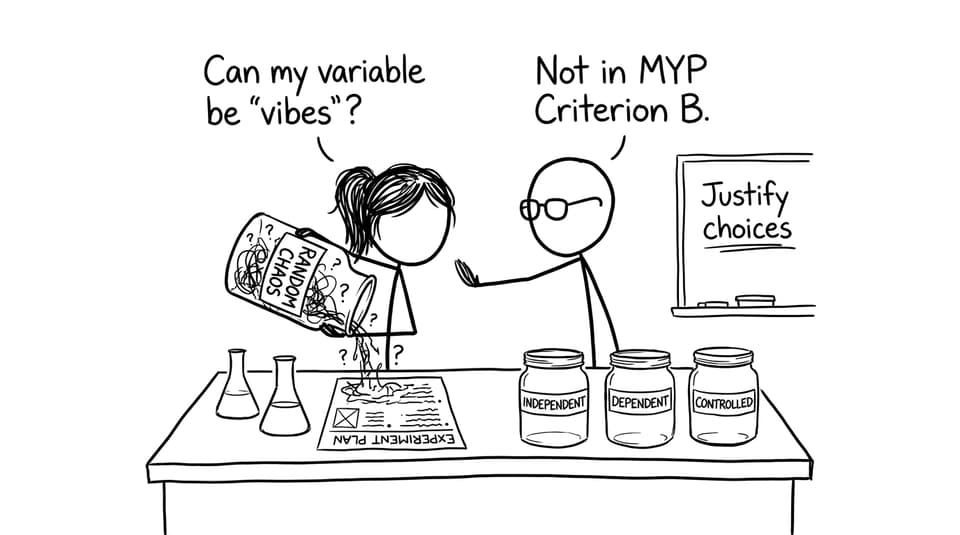
Criterion B is the MYP skill of building a fair test on paper.
High marks come from naming variables and justifying choices: why this range, why this measurement tool, why these controls, why repeats.
Real example (enzyme activity)
Prompt: “Design an investigation to test how temperature affects catalase activity.”
A top-band MYP response typically includes:
-
IV: temperature (with a realistic range, e.g., 10°C to 60°C)
-
DV: oxygen volume produced per minute (or foam height, etc.)
-
Controls: pH, enzyme concentration, substrate volume, reaction time
-
Justification: why those controls matter, and how you keep them constant
-
Reliability: repeats, averaging, and consistent timing
If you want a quick pattern library of what usually goes wrong, read The Biggest Mistakes in MYP Science Investigations.
Criterion C (MYP): Processing and evaluating
Criterion C is where MYP Science becomes less about “doing the lab” and more about “thinking like a skeptic.”
You’re rewarded for clean data presentation and honest evaluation: trends, anomalies, uncertainty, limitations, and improvements.
Real example (cooling curve)
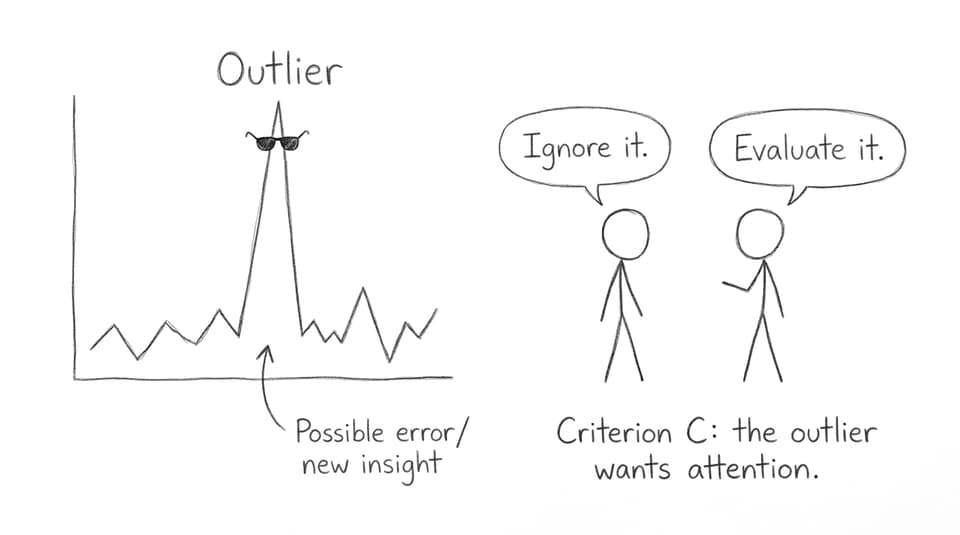
You collect temperature data every minute. Your graph mostly decreases smoothly, but minute 6 spikes up.
A strong MYP Criterion C move is not to hide it. It’s to interpret it:
-
Identify the anomaly with data: “At minute 6, temperature increased from 54°C to 57°C.”
-
Give plausible reasons: probe moved, reading delay, uneven stirring, external heat source.
-
Explain impact: “This reduces confidence in the exact rate of cooling but the overall downward trend remains.”
-
Propose improvements: clamp the probe, stir consistently, insulate the beaker, increase repeats.
If graphing is your weak spot, build confidence using skills-style notes like Graphical Techniques (IB Chemistry) and visual study advice from Visual IB Study Materials: Diagrams, Charts, and Graphics. The subjects differ, but the graph logic is the same.
Criterion D (MYP): Reflecting on the impacts of science
Criterion D is the MYP reminder that science lives in the real world, with trade-offs.
High-level responses are specific, balanced, and connected to scientific ideas, notnot vague statements like “this helps society.”
Real example (renewable energy)
Instead of: “Solar energy is good for the environment.”
Aim for: “Solar panels reduce greenhouse gas emissions during electricity generation, but mining and manufacturing can create environmental impacts. There are also equity issues: installation costs can limit access, so policies may be needed to prevent clean energy from widening social gaps.”
If you want more context on how MYP sciences content and concepts connect, use MYP Sciences Curriculum Breakdown and browse All MYP Posts.
How to practise MYP science (without rewriting your whole life)
The fastest improvement comes from practising the skill being assessed.
Try this simple loop on RevisionDojo:
-
Use Study Notes to rebuild clarity fast: Study Notes
-
Drill one criterion at a time with Questionbank and track mistakes: Questionbank
-
Use Grading tools to get criterion-aware feedback on explanations and evaluations
-
Create quick Flashcards for definitions, units, and command terms you keep misusing
-
Use AI Chat to ask: “Rewrite this to hit Criterion C,” or “What would a top-band D paragraph add?”
-
When pressure matters, use Mock Exams and Predicted Papers to simulate timing and decision-making
-
For big gaps, Tutors help you stop guessing and start targeting
To turn that into a schedule, borrow structure from MYP eAssessments: 30-Day Study Plan That Works.
The shift that makes MYP science feel predictable
The turning point in MYP Science is when you stop asking, “What facts should I memorize?” and start asking, “What skill is this question rewarding?”
That single shift makes your revision calmer and your marks more consistent.
If you want an all-in-one place to practise each MYP criterion with feedback loops that actually change your next answer, start at the RevisionDojo MYP hub, then build your routine with Questionbank, Study Notes, Flashcards, AI Chat, Grading tools, Mock Exams, Predicted Papers, the Coursework Library, and Tutors when you need a steady hand.