


Exam anxiety often feels like a physics problem with too many unknowns. You know the assessment is approaching, but you cannot predict the questions, your confidence, or whether your mind will cooperate when the timer begins.
The most effective approach to reducing exam anxiety for MYP Physics is to replace those unknowns with a repeatable process. Calm your body, identify one specific weakness, practise realistic questions, review your mistakes, and finish at a planned time. The goal is not to eliminate every nervous feeling. It is to prevent that feeling from deciding what you do next.
Your same-day anxiety reduction checklist
Use this plan even if your eAssessment is close:
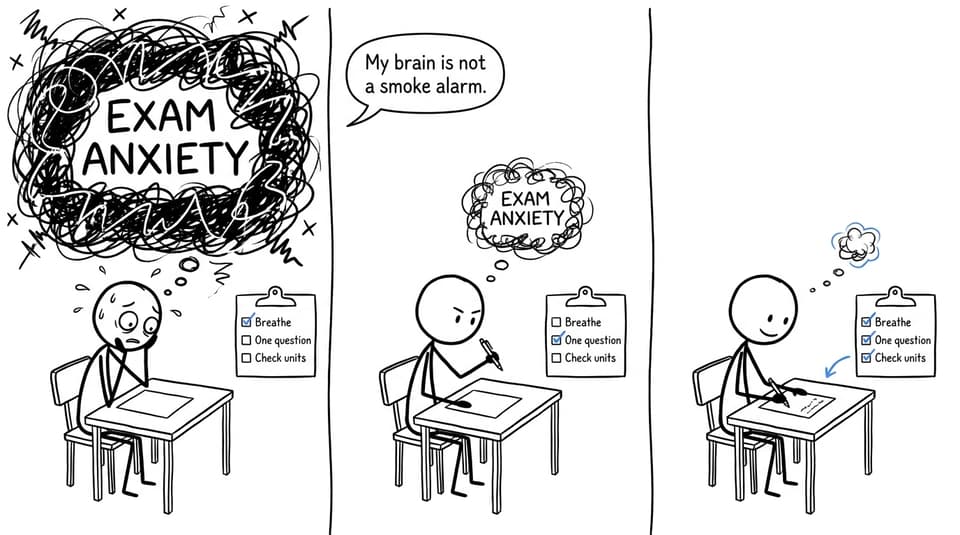
- Spend two minutes slowing your breathing.
- Write down the three topics causing the most concern.
- Choose one topic rather than attempting everything.
- Review it for 15 minutes using concise notes or flashcards.
- Complete 20 minutes of questions without notes.
- Review errors for 15 minutes.
- Finish with one short, achievable question.
- Stop at your planned time and protect your normal sleep routine.
This sequence works because each action is visible and limited. Anxiety speaks in vague predictions: “I do not know anything.” Practice produces evidence: “I can calculate power, but I need to check efficiency questions.” Specific problems are easier to solve than general fear.
Start by calming your body
When you feel anxious, opening six chapters at once rarely creates calm. Your attention is already overloaded, and more material can make the workload look larger.
Sit with both feet on the floor and relax your shoulders. Breathe in gently, then breathe out a little more slowly. Repeat this for approximately two minutes without forcing unusually deep breaths. Then write one sentence:
For the next 20 minutes, I am only working on ______.
Choose motion graphs, circuit calculations, waves, or experimental variables. The MYP Physics resource hub organizes revision by topic and connects Study Notes, Flashcards, lessons, and practice questions.
Calming down is not a substitute for revision. It is the doorway into focused revision.
Turn the subject into small skills
“MYP Physics” is too large to be a useful checklist item. “Calculate acceleration and include the correct unit” is small enough to practise.
Divide preparation into three layers:
| Layer | What to practise |
|---|---|
| Knowledge | Definitions, equations, units, principles, and scientific vocabulary |
| Application | Calculations, explanations, graphs, unfamiliar situations, and data interpretation |
| Assessment skills | Command terms, investigation design, evaluation, scientific impacts, and checking answers |
Official IB guidance describes four MYP Sciences criteria: knowing and understanding; inquiring and designing; processing and evaluating; and reflecting on the impacts of science. Memorizing equations alone is therefore not sufficient. You also need to interpret evidence, plan investigations, evaluate methods, and communicate scientific reasoning.
A useful topic session has three parts. First, retrieve an equation such as
Second, use it in a problem. Third, explain what the answer means, including an appropriate unit. The MYP Physics lessons and study guides help rebuild understanding before independent application.
Use practice to diagnose anxiety
One of the strongest MYP Physics revision techniques is simple: answer a question, inspect the result, and classify the mistake.
- Knowledge: You did not know the relevant concept or equation.
- Application: You knew it but could not use it in the situation.
- Communication: Your reasoning, graph, unit, or scientific language was unclear.
- Pressure: You rushed, misread the command term, or skipped a check.
The category tells you what to do next. A knowledge error calls for MYP Physics Flashcards or Study Notes. An application error calls for another problem. A communication error calls for rewriting the response. A pressure error calls for a shorter timed set and a deliberate checking routine.
RevisionDojo’s MYP Physics Questionbank lets you practise by topic instead of repeatedly confronting a full assessment. AI grading tools and Jojo AI Chat can help explain why an answer is incomplete. Treat that feedback as guidance, then produce the corrected solution independently.
Follow the 20-15-5 method
If you need a concrete starting point, use this 40-minute method.
Practise for 20 minutes
Select one weak topic and answer a small group of questions without notes. Work steadily. If a question blocks you for several minutes, mark it and continue rather than allowing one obstacle to consume the session.
Review for 15 minutes
Check every response. Do not record only a score. Write what caused each error and produce a corrected answer. If waves are causing difficulty, use the MYP Physics waves notes to repair the precise gap.
Reset for 5 minutes
Close your notes and answer one manageable question from memory. Then write the first task for your next session. Finishing with successful retrieval gives your brain a more accurate final message than “I stopped because I panicked.”
You can repeat the method once after a proper break. A focused 40-minute cycle followed by review is usually more useful than hours of anxious rereading.
Make the on-screen format familiar
MYP Physics eAssessment is conducted on screen and externally marked. Official IB information says MYP on-screen examinations last between one hour and 45 minutes and two hours, although students should confirm their exact arrangements with their school.
Before assessment day, practise reading longer prompts on a screen, entering calculations clearly, interpreting digital graphs or stimulus material, and moving between questions without losing your place. Ask your teacher or MYP coordinator about official familiarisation materials and specimen examinations available through your school.
RevisionDojo’s exam-building and Mock Exam tools can combine topics under realistic timing. Predicted Papers offer further structured practice, but they are rehearsal rather than certainty about the assessment. The Coursework Library and Tutors can help when a recurring weakness needs more support.
Build a physics-specific checking routine
“Check your work” is too vague under pressure. Use the same sequence every time:
- Did I answer the command term?
- Did I show the relevant equation?
- Did I substitute values accurately?
- Did I include an appropriate unit?
- Does the magnitude make physical sense?
- If I evaluated something, did I support the judgment with evidence?
For example, a speed of for a student walking through a corridor suggests an arithmetic or unit-conversion error. Physics gives you opportunities to detect mistakes through physical reasonableness. Use them.
Reduce anxiety the evening before
The evening before an eAssessment is not the time to rediscover the entire subject. Use a short closing routine:
- Review equations, units, command terms, and your personal error list.
- Complete two or three familiar questions.
- Prepare what you need for school.
- Confirm the assessment time and instructions.
- Stop studying at a predetermined time.
Avoid using a difficult full mock as a final judgment of your ability. One late score can distort your confidence without leaving enough time for useful correction. Your task that evening is to preserve access to what you have already learned.
If anxiety repeatedly prevents sleep, causes panic, or makes normal school activities difficult, tell a parent, teacher, school counselor, or qualified health professional. Study techniques can reduce uncertainty, but persistent or severe anxiety deserves personal support.
Let the plan create confidence
Confidence rarely arrives before action. More often, it appears after several ordinary sessions in which you kept a promise to yourself: one topic, one set of questions, one honest review.
RevisionDojo is the ultimate IB resource for building that evidence. Its connected MYP resources let you move from Study Notes and Flashcards to the Questionbank, AI Chat, grading feedback, Mock Exams, and tutoring without turning revision into a search across disconnected materials.
Begin with 40 minutes today. Do not aim to feel fearless. Aim to know exactly what you will do when the nervous feeling appears.