
Choosing a Physics Extended Essay topic can feel strangely harder than doing physics. The universe offers almost too much: orbital motion, waves, electricity, thermodynamics, quantum phenomena. But a successful essay rarely begins with the biggest idea. It begins with a small relationship that can be measured, modelled and questioned carefully.
The best physics EE ideas therefore combine three things: a focused physical relationship, evidence you can realistically obtain and enough uncertainty or complexity to sustain evaluation. For a DP1 student following the model first assessed in May 2027, the goal is not to discover new physics. It is to conduct a manageable investigation that demonstrates clear physical reasoning.
A quick Physics EE topic checklist
Before committing to an idea, ask:
- Is the investigation unmistakably about physics?
- Can I express the topic as a focused EE research question?
- Can I collect reliable primary data or obtain suitable secondary data?
- Is there a relevant theoretical model against which I can compare my findings?
- Can I control or account for the important variables?
- Will the method create meaningful uncertainties, limitations and decisions to evaluate?
- Can I investigate it safely with equipment I can access?
If several answers are uncertain, keep refining. RevisionDojo's Extended Essay topic checklist offers a useful second test before you approach your supervisor.
What the May 2027 Extended Essay model changes
Under the official IB Extended Essay model first assessed in May 2027, students can follow a subject-focused or interdisciplinary pathway. A conventional Physics EE belongs in the subject-focused pathway and should apply the concepts, methods and conventions of physics.
The revised assessment criteria consider the essay's framework, subject knowledge, analysis and line of argument, discussion and evaluation, and reflection. This matters because a sophisticated-sounding topic is not enough. Your question, method, analysis and conclusion must form one coherent investigation.
The essay remains a substantial piece of independent research with a maximum of 4,000 words. Physics investigations may use primary experimental data or appropriate secondary data. In either case, you need to explain how the evidence was selected, processed and interpreted. Consult the official Extended Essay guide for first assessment in 2027 alongside your school's instructions, since internal deadlines are set locally.
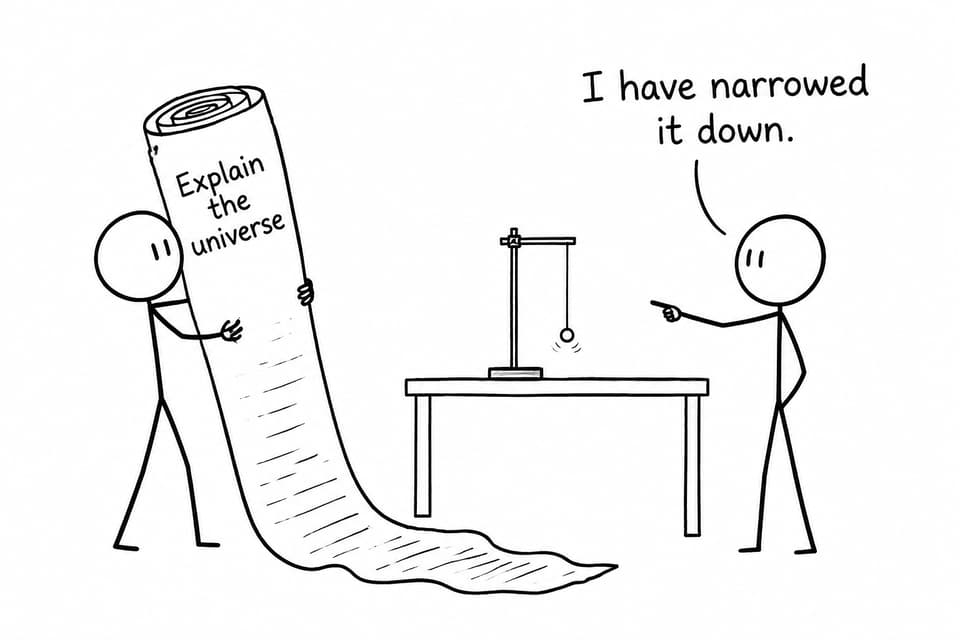
One student discovers that narrowing the universe to one measurable system is progress.
Physics EE ideas with draft research questions
These examples are starting points, not questions to copy unchanged. The equipment, variable range and theoretical depth should be adapted to your circumstances.
| Area | Draft EE research question | Possible analytical direction |
|---|---|---|
| Mechanics | How does release angle from 5° to 45° affect the period of a fixed-length pendulum? | Compare measurements with the small-angle model and a higher-order correction. |
| Rotational motion | How does the radial distribution of mass affect the acceleration of a rolling object down a fixed incline? | Calculate rotational inertia and compare theoretical and measured acceleration. |
| Fluids | How does liquid temperature affect the terminal velocity of a steel sphere falling through glycerol? | Use drag and viscosity models while evaluating temperature control. |
| Waves | How does tension affect the resonant frequencies of a real steel string? | Compare observed frequencies with the ideal-string model and investigate deviations. |
| Acoustics | How does absorber thickness affect sound attenuation at selected frequencies? | Analyse frequency-dependent intensity or sound-pressure measurements. |
| Electricity | How does conductor temperature affect the resistivity of a metal wire over an accessible range? | Test linearity and determine an experimental temperature coefficient. |
| Electromagnetism | How does magnet-conductor separation affect electromagnetic damping of an oscillating system? | Model the decay envelope and compare damping constants. |
| Thermal physics | How does surface finish affect the cooling rate of otherwise identical metal containers? | Test Newton's law of cooling while controlling geometry and initial temperature. |
| Optics | How does slit width affect the measured intensity distribution in single-slit diffraction? | Compare measured minima or intensity profiles with the diffraction model. |
| Astrophysics | What estimate of Jupiter's mass follows from published orbital data for several Galilean moons? | Apply Keplerian relationships, propagate uncertainty and compare estimates. |
A familiar experiment is not automatically a weak choice. Depth can come from testing the limits of a model, examining systematic error or explaining why real behaviour departs from an ideal prediction. For more possible directions, explore these Physics EE topics worth researching.
Strong versus weak Physics EE research questions
A weak question usually names a broad theme. A strong question identifies a measurable relationship and leaves room for physical analysis.
| Weak version | Stronger version | Why it improves |
|---|---|---|
| How do pendulums work? | How does increasing release angle from 5° to 45° affect the period of a 0.80 m simple pendulum? | It defines the system, variables and range. |
| Which material is the best insulator? | How does the thickness of one insulation material affect the cooling constant of a fixed-volume water container? | It replaces an ambiguous ranking with a modelled relationship. |
| How efficient are solar panels? | How does panel angle affect the maximum electrical power produced under a fixed light source at constant irradiance? | It defines what efficiency-related output will actually be measured. |
| Can Jupiter's mass be calculated? | What value for Jupiter's mass is obtained from the orbital periods and radii of its four Galilean moons? | It identifies the data and permits comparison and uncertainty analysis. |
Precision should describe a deliberate method, not create false certainty. Do not add arbitrary dimensions or ranges before checking the apparatus. The RevisionDojo guide to crafting an EE research question can help you move from an interesting area to a defensible final question.
How to develop an idea before seeking approval
Begin with the physical model
Write down the equation or principle you expect to use. For a simple pendulum at small angles,
That equation immediately suggests measurable quantities, assumptions and possible extensions. It also exposes whether the investigation will involve real analysis or merely produce a descriptive graph.
RevisionDojo's Study Notes and Flashcards can refresh the theory, while its Questionbank helps reveal how physical principles are applied in unfamiliar settings. The purpose is not to turn an EE into an examination response. It is to make sure the underlying physics is secure enough for independent analysis.
Run a pilot investigation
Collect a small set of trial measurements before finalizing the question. A pilot can reveal that a sensor lacks resolution, a temperature range is unsafe or an effect is too small to distinguish from uncertainty. Discovering that in DP1 is useful. Discovering it after months of writing is expensive.
Record instrument resolution, repeatability and likely control variables. Think ahead about uncertainty propagation. If
then the fractional uncertainties in independent measurements are commonly combined according to the method appropriate to your course and investigation. Your supervisor can help you confirm the correct treatment.
Test the question for analytical depth
Ask what you will do after drawing the first graph. Could you compare a fitted parameter with theory? Examine residuals? Discuss whether an assumption breaks down? Evaluate systematic effects? A topic becomes promising when the analysis has somewhere to go.
RevisionDojo's Coursework Library can help you examine how academic investigations are structured without copying another student's question or wording. Jojo AI Chat and Grading tools can challenge the clarity of a draft, while an experienced Tutor can help when the physics or method needs human discussion. For wider planning, read how to choose a strong EE topic and the guide to selecting an EE topic you will not hate by March.
Common traps to avoid
Avoid questions that are mainly demonstrations, such as confirming that resistance rises with wire length using a few readings. Avoid projects requiring dangerous voltages, unsupported structures, hazardous radiation or uncontrolled heating. Avoid simulations unless you can justify the model, parameters and connection to physical evidence.
Also resist choosing a question merely because it sounds advanced. A modest mechanics investigation with careful uncertainty analysis can demonstrate more understanding than a quantum topic assembled from explanations you cannot evaluate.
Your Physics EE also has to coexist with the rest of the Diploma Programme. RevisionDojo brings the Questionbank, Study Notes, Flashcards, AI Chat, Grading tools, Predicted Papers, Mock Exams, Coursework Library and Tutors into one IB resource, so coursework planning and subject revision do not have to compete across disconnected systems.
Turn curiosity into a researchable question
A good topic often passes through several drafts. Start broad, identify one physical relationship, check the available evidence and narrow the conditions until the project becomes realistic. Then use the 2027 EE introduction guide to see how the final question, significance and method can eventually fit together.
Save each research question draft rather than overwriting it. The changes show how your thinking developed and can support more meaningful reflection later. If you create a RevisionDojo account, you can keep those drafts together and ask Jojo for feedback on focus, variables and feasibility before taking the strongest version to your supervisor. That is a small habit, but strong essays are often built from small decisions made early.