


A report showing several numbers out of eight can feel less like feedback and more like a code. Fortunately, the code is understandable. This parents guide to MYP English Language and Literature grading explains the four assessment criteria, how criterion levels relate to a final grade, and how to help at home without becoming your child's editor.
The essential point is simple: MYP English is not graded only on grammar, vocabulary, or knowledge of a book. Students are assessed against descriptors covering analysis, organization, text production, and language use. A lower result therefore identifies a skill to strengthen, not a fixed judgment about whether a child is "good at English."
The grading system at a glance
Keep these principles in mind when reading a task sheet or report:
- There are four criteria: A, B, C, and D.
- Each criterion has a maximum achievement level of 8.
- The criteria are equally weighted when determining a final subject grade.
- Teachers use best-fit judgment against descriptors, not isolated error counts.
- Expectations change with the student's MYP year.
- Individual assignments may assess only one or two criteria.
- Reporting practices can vary, so local school documentation matters.
For a student-friendly overview, see MYP Language and Literature assessment criteria explained.
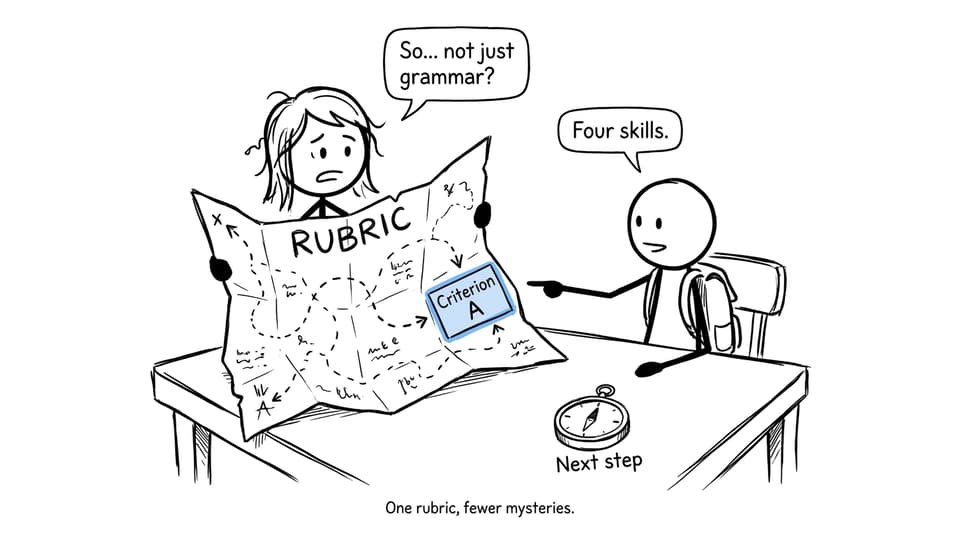
What the four MYP English criteria measure
| Criterion | What it broadly measures | A useful parent question |
|---|---|---|
| A: Analysing | Interpretation, authorial choices, evidence, and comparisons | "Where did you explain how the writer's choice creates meaning?" |
| B: Organizing | Logical development, structure, formatting, and referencing | "Can a reader follow your argument?" |
| C: Producing text | Imagination, purposeful choices, audience awareness, and relevant detail | "How does this suit its audience and purpose?" |
| D: Using language | Vocabulary, sentence control, register, grammar, spelling, and communication | "Which sentence could be clearer or more precise?" |
The labels remain consistent, but descriptors develop as students progress. Work considered strong in an earlier year may not satisfy later expectations. Compare a score with the correct year-level rubric, not a sibling's assignment or an online example from another year.
The MYP English Language and Literature curriculum expectations explain how reading, writing, speaking, viewing, and presenting fit together.
How teachers decide a criterion level
MYP assessment is criterion-related: work is judged against defined descriptors rather than ranked against classmates.
Each criterion contains achievement bands of 1-2, 3-4, 5-6, and 7-8. A score of 0 is used when work does not reach a described standard. Teachers review the available evidence and choose the descriptor that best matches it, known as best-fit judgment.
A few spelling mistakes do not automatically produce a particular Criterion D score, just as three quotations do not guarantee strong Criterion A performance. Teachers consider the quality, consistency, and independence of the demonstrated skill. Final criterion levels may also reflect a body of evidence rather than a simple average of task scores.
How scores out of 8 become a grade from 1 to 7
When the standard IB boundaries are used, the four criterion levels are added to produce a total out of 32.
| Total across criteria | Final MYP grade |
|---|---|
| 28-32 | 7 |
| 24-27 | 6 |
| 19-23 | 5 |
| 15-18 | 4 |
| 10-14 | 3 |
| 6-9 | 2 |
| 1-5 | 1 |
If a student receives A: 5, B: 6, C: 5, and D: 6, the total is 22, corresponding to a grade 5 under this table.
Not every number shown during a term is a final criterion judgment. Some may be task results, formative indicators, or school-specific progress grades. Before calculating at home, confirm what the report columns represent and how the school handles recent evidence, missed assessments, and reporting periods.
Read the pattern, not just the total
A total can hide useful information. Two students may both receive 22 out of 32 while needing different support.
Strong Criterion D scores alongside weaker Criterion A scores may suggest that a child writes accurately but summarizes instead of analysing. Strong analysis with weaker Criterion B performance can mean that insightful ideas arrive in an unclear order. A lower Criterion C result may indicate insufficient adaptation to audience, purpose, or text type.
Instead of asking, "Why wasn't this higher?" ask, "Which visible feature would move this work into the next descriptor band?" The guide to common mistakes in MYP language tasks turns broad comments into trainable skills.
Supporting a child in MYP English Language and Literature
The best help is usually small enough not to feel intrusive.
Ask for a short explanation
Invite your child to explain which criterion a current task assesses and what the highest descriptor requires. Explaining the rubric aloud reveals confusion without turning the conversation into an interrogation.
Focus on one improvement
After feedback, choose one action: strengthen a topic sentence, explain one quotation, reorganize two paragraphs, or edit for consistent register. Rewriting an entire assignment can feel punitive; improving one paragraph makes progress visible. The best revision strategies for MYP Language and Literature offer focused practice routines.
Protect ownership
Parents can discuss the task, listen to an argument, or ask whether evidence supports a claim. Avoid rewriting sentences or supplying interpretations for submission. For practical boundaries, use RevisionDojo's guide to supporting a child in the MYP and these low-pressure MYP homework tips for parents.
A calm weekly support routine
Try this 30-minute cycle once or twice a week:
- 5 minutes: identify the target criterion in plain language.
- 10 minutes: review one concept through the MYP English Study Notes.
- 10 minutes: complete one short analytical or writing prompt.
- 5 minutes: improve one sentence or paragraph using feedback.
RevisionDojo's MYP English Language and Literature resources bring this loop together. Study Notes and Flashcards build understanding, the Questionbank supports focused practice, and AI Chat and Grading tools provide guided explanations and criteria-aware feedback. Mock Exams, Predicted Papers, the Coursework Library, and Tutors offer deeper support when needed.
The goal is not to turn every evening into assessment preparation. It is to make grading language familiar enough that feedback becomes actionable. Once a child can identify the criterion, describe the missing evidence, and choose a manageable next step, the numbers become directions for growth.