Join 650k+ students breezing through the IBReady to breeze through the IB?
Paper 2 long questions have a way of making smart students feel suddenly unprepared.
You open the exam. You recognize the topic. You even remember the diagram from your notes. And then you read the command term and realize the real challenge is not knowing science; it’s building a clear argument under pressure.
That’s why this guide is focused on IB Sciences Paper 2 long-answer performance for 2025 onward: how to plan, how to structure, how to show analysis (not just facts), and how to avoid the traps that quietly drain marks.
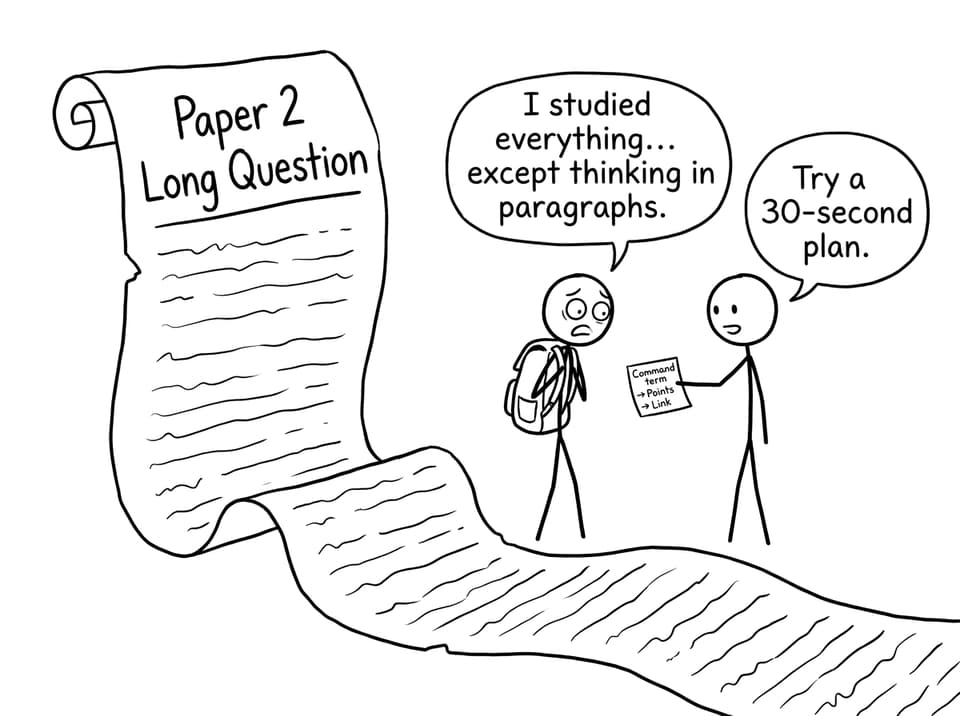
Paper 2 long question panic vs plan
Paper 2 long questions: what they’re really testing in IB Sciences
Paper 2 long responses in IB Sciences are not a memory contest. They’re a communication test built on scientific understanding.
Across Biology, Chemistry, Physics, ESS (and other Group 4 contexts), long questions tend to reward the same things:
Accurate core knowledge (definitions, processes, laws, models)
Application to a new scenario (unfamiliar context, novel data, experimental setup)
Scientific reasoning (cause and effect, linking steps, justified claims)
min read
min read
min read
min read
Evaluation (limitations, assumptions, uncertainty, alternative explanations)
For each bullet in your plan, add a quick micro-structure:
Claim: the point you’ll make
Science: the principle, equation, process, or definition behind it
Link: one sentence that ties it back to the prompt
This is how IB Sciences answers become “examiner-friendly” without becoming long.
The structure examiners can actually award marks to
Long answers score best when they are easy to mark.
That sounds obvious, but under time pressure many students write like they’re journaling: correct ideas, unclear order.
A reliable Paper 2 structure for IB Sciences
Use this template (adapt the length to marks):
Opening line: define the key term or restate what you will address
Body paragraphs: 2-4 paragraphs, one idea each
Data paragraph (if present): describe -> interpret -> link to theory
Conclusion: one sentence that answers the question directly
If the question includes data, train that skill deliberately using IB Group 4 Paper 2 Data Analysis Tips. Data is where many long responses quietly collapse.
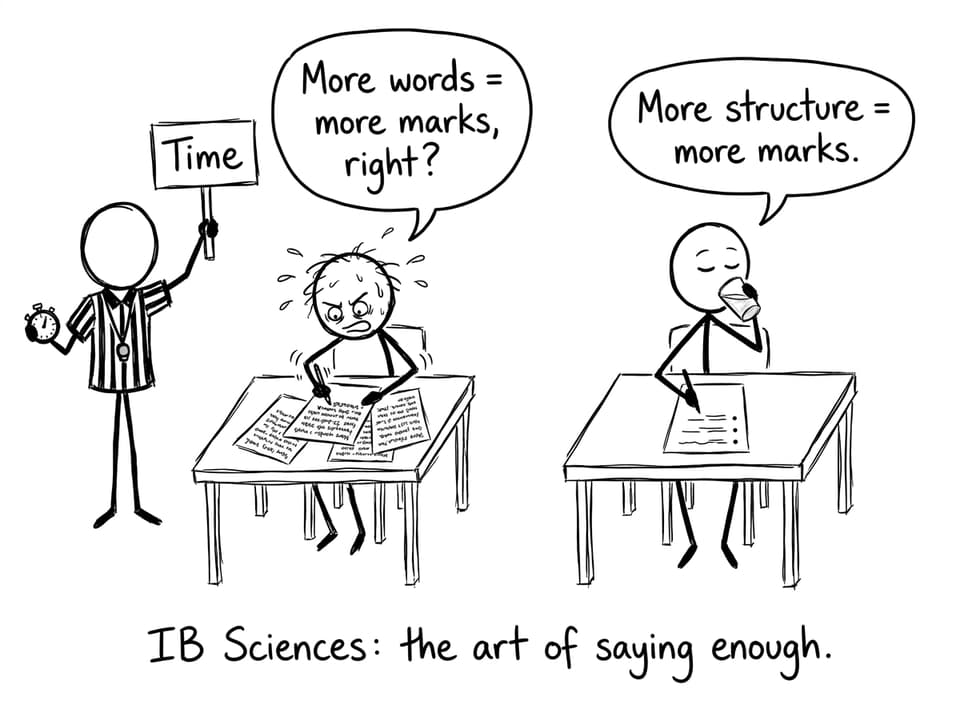
Time vs mark efficiency
The “because” rule: don’t leave claims hanging
A high-mark Paper 2 response in IB Sciences is full of causal language:
“This causes…”
“Therefore…”
“As a result…”
“Because…”
Not filler. Just visible reasoning. If you can turn a sentence into “X happens because Y,” you usually just upgraded it from recall to explanation.
Detail without waffle: how much is enough?
Students often ask how to write “more detail” without writing too much.
The trick is to write specific detail, not extra sentences.
Add the detail markers examiners love
Depending on the science, detail markers can include:
Correct units and variable definitions
A named law/model (e.g., conservation, collision theory, gene expression)
A clear mechanism (stepwise process)
A correct limitation (measurement resolution, assumption, confounding variable)
This is also where RevisionDojo’s Study Notes pay off: they’re built around the “what you need to say to earn marks” layer, not the “rewrite the textbook” layer. When you combine that with Flashcards, you keep definitions and processes ready on demand.
To build speed and accuracy before long answers, don’t ignore Paper 1 skills either. The thinking patterns transfer. Use Group 4: Paper 1A MCQ Tips as your daily warm-up.
2025 onward: long answers reward skills, not memorization
With the 2025 onward updates, a lot of students feel the goalposts moved. In practice, the same principle is now clearer: IB Sciences wants you to use science.
So in long questions, aim to show three behaviors:
Identify what matters in the scenario
Write one sentence that frames the problem:
What variables matter?
What process is being tested?
What assumption is hidden?
Apply, then evaluate
In many Paper 2 long questions, marks come in layers:
layer 1: state the correct idea
layer 2: apply it to the stimulus
layer 3: evaluate limitations or alternatives
If you stop at layer 1, your answer feels “correct but thin.”
Use uncertainty language when it fits
Especially in experimental contexts, simple evaluation phrases score well when accurate:
Closing: the calm advantage in IB Sciences Paper 2
The students who improve fastest in IB Sciences Paper 2 are rarely the ones who “learn more content.” They’re the ones who learn how to deliver their knowledge: command term first, a 30-second plan, clear paragraphs, and a final line that answers the question.
If you want that to feel automatic by 2025 onward exams, build a simple loop inside RevisionDojo: Study Notes for clarity, Flashcards for recall, Questionbank for application, AI Chat + Grading tools for feedback, and weekly Mock Exams with Predicted Papers for timing.
When Paper 2 long questions stop feeling like a surprise, they start feeling like an opportunity. That’s the goal for IB Sciences; and it’s trainable.