


The night before an IB science exam, your brain tends to bargain.
“If I just reread the notes one more time, maybe the questions will feel familiar.”
But the IB isn’t moving toward familiarity. It’s moving toward thinking.
That’s the point of the new Group 4 Paper 1B: a tighter, more explicit test of how you use science, not just whether you’ve seen the content before. If you’re preparing for Biology, Chemistry, Physics, or ESS, understanding Paper 1B early helps you revise with less panic and more purpose.
What is new Group 4 Paper 1B in IB?
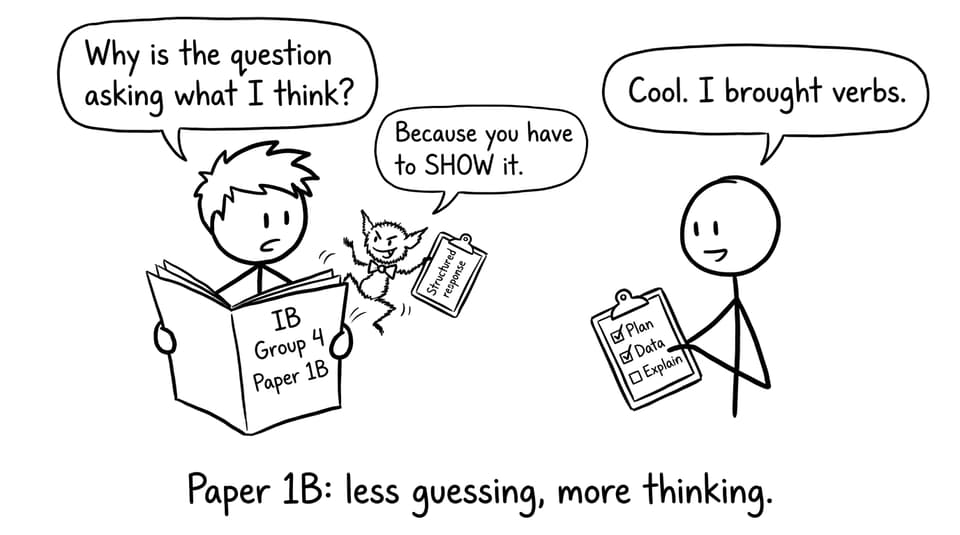
Paper 1B is a new assessment component in the IB Group 4 sciences for the updated syllabus (first assessment from 2025 for several sciences). The biggest shift is simple: Paper 1B leans into structured response questions that reward clear scientific reasoning.
Here’s the working overview students should know:
-
Format: structured response questions (written, method-based answers)
-
Time: approximately 1 hour (varies by subject/level)
-
Skills focus: analysis, interpretation, problem-solving, and conclusion-making
-
Subjects: Group 4 sciences including Biology, Chemistry, Physics, and ESS
If you want to anchor this inside your broader IB exam strategy, build around paper structure and timing across the whole course, not just one exam day. A good starting point is this guide on how to study for IB exams step-by-step.
Quick checklist: how to approach IB Paper 1B
Use this as your weekly “am I training the right thing?” check.
-
I can interpret unfamiliar data (tables, graphs, trends) without freezing.
-
I write answers that show steps (not just the final claim).
-
I use command terms correctly (analyse, explain, evaluate).
-
I practice under time pressure at least once a week.
-
I review mistakes like an examiner: “What earned marks? What didn’t?”
For pacing, borrow the habits from how to manage your time during IB Group 4 science exams.
How Paper 1B differs from older IB science assessments
Paper 1B changes what “being prepared” feels like.
Older patterns often rewarded quick recognition: you either remembered the concept or you didn’t. Paper 1B is more interested in whether you can take a concept and do something disciplined with it.
More marks for reasoning, not recall
You still need knowledge, of course. But in IB Paper 1B, marks often sit inside the explanation: identifying a trend, linking it to theory, stating an assumption, justifying a conclusion.
More writing, but in a controlled way
This is not an essay paper. It’s structured response: short, targeted answers where clarity beats length. If you tend to “write until it sounds smart,” Paper 1B is your invitation to write until it scores.
More real-world context
Expect scenarios that look like science outside the classroom: experimental setups, messy data, competing interpretations. It’s the IB saying: “Show us you can think like a scientist, not only revise like one.”
To strengthen your structured-response writing across sciences, this is worth keeping open while you practice: Paper 2 long question answer advice (IB Science 2025 onward).
How to prepare for IB Group 4 Paper 1B (without overstudying)
Paper 1B prep is less about adding hours and more about upgrading reps.
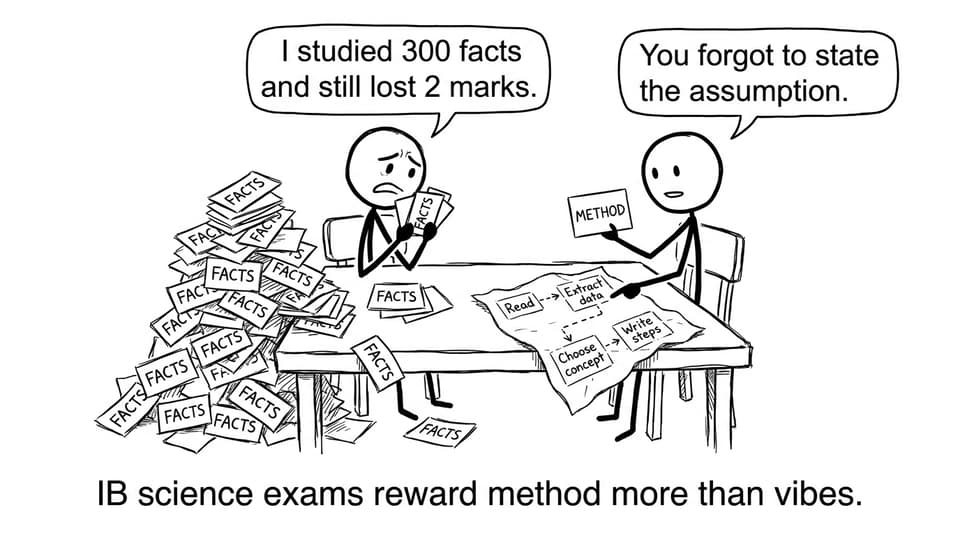
Train the “data to conclusion” loop
In Paper 1B, you’re often moving through a repeatable chain:
-
Read the prompt carefully (spot what’s being asked).
-
Extract the relevant data.
-
Choose the correct concept.
-
Apply it in steps.
-
Conclude in a sentence that matches the command term.
RevisionDojo makes this loop easier to practice because you can switch between Study Notes (concept clarity), Flashcards (quick recall), and the Questionbank (exam-style application). When you get stuck mid-step, AI Chat can help you diagnose the exact gap: concept misunderstanding, math slip, or command term confusion.
If you’re also building confidence for Paper 1A, pair this with Group 4: Paper 1A MCQ tips so you’re training both speed (1A) and method (1B).
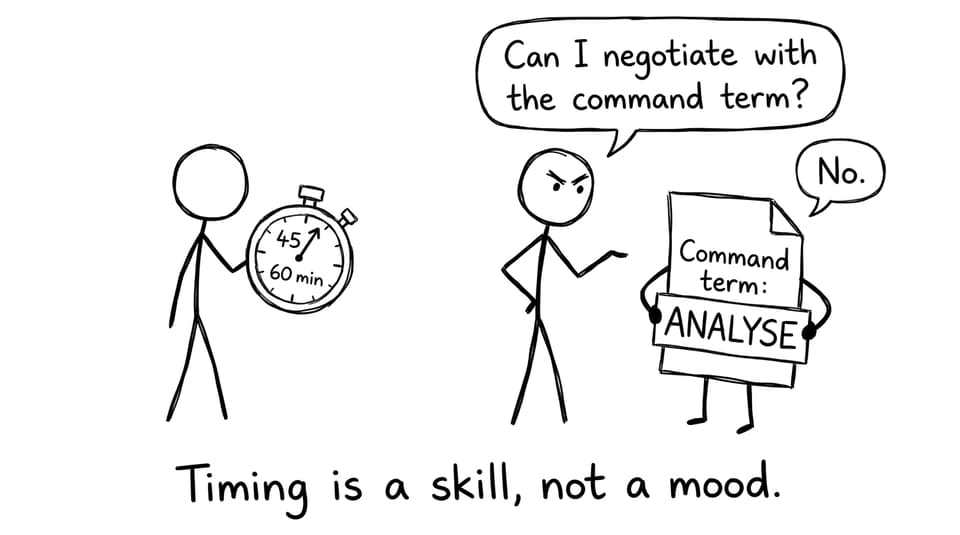
Practice under exam conditions early
The weird truth of the IB is that timing creates its own kind of knowledge. You can “know” something and still fail to show it in 55 seconds.
Use Mock Exams to simulate pressure, then review using Grading tools to see where marks leak: missing units, missing reasoning, vague conclusions. If you want extra exam-style practice that mirrors new formats, use RevisionDojo Predicted Papers to train structure and pacing.
Make your revision interdisciplinary on purpose
Paper 1B often rewards the student who can connect ideas across topics: data handling, uncertainty, scientific method, and core content.
If you’re unsure how your subject compares, explore the wider science landscape using which science should I take in IB? or tighten your schedule with how long you should spend studying each IB science subject.
Conclusion: Paper 1B is an IB signal, not a trap
The new Group 4 Paper 1B is the IB quietly saying: science is not only what you remember, it’s what you can do.
If you train the right loop, from data to concept to reasoning to conclusion, Paper 1B becomes one of the fairest papers, because it rewards clear thinking more than lucky recognition.
To prepare efficiently, make RevisionDojo your home base: drill with the Questionbank, tighten understanding with Study Notes, reinforce memory with Flashcards, get unstuck with AI Chat, and build confidence with Mock Exams, Predicted Papers, and Tutors when you need a human nudge. Your future self in the exam hall will recognise the calm that only comes from practice.