Join 650k+ students breezing through the IBReady to breeze through the IB?
Summer always starts the same way.
You promise yourself you’ll “reset.” You finally sleep. You stop thinking in command terms. And then, one random afternoon, a thought drifts in: I have IB Sciences again next year.
That moment matters. Not because you should sacrifice your break, but because a calm, realistic summer plan for IB Sciences is the difference between starting term with momentum and starting term with panic. The goal isn’t to grind. The goal is to build a system that makes future studying feel lighter.
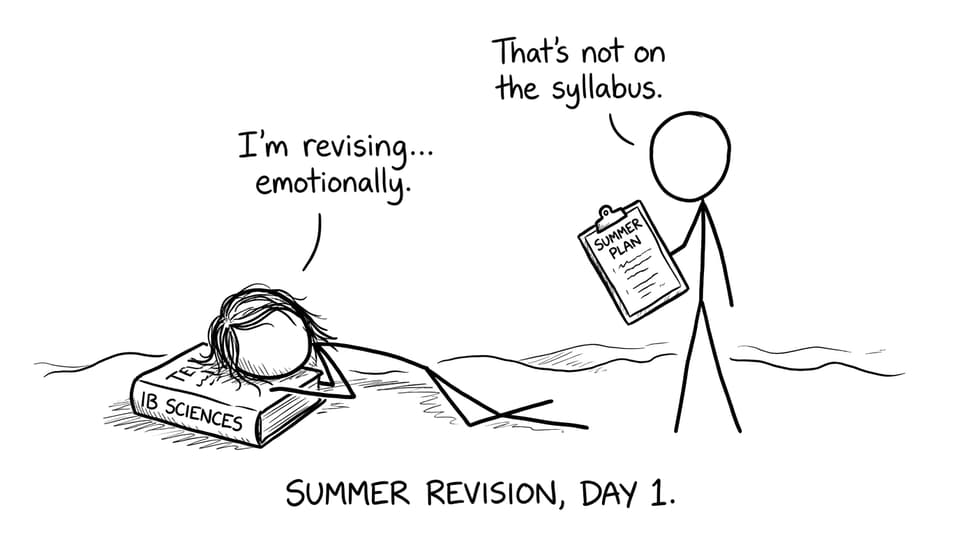
Summer revision, day 1 comic
The 20-minute checklist for IB Sciences (save this)
If you want a simple summer plan for IB Sciences, use this checklist:
Pick 2-3 high-impact topics you struggled with (not everything).
Do short, repeatable sessions: notes then recall then questions.
Build an error log (mistakes become your syllabus).
Practise data handling weekly (graphs, uncertainties, processing).
Do 1 timed mini-mock every 1-2 weeks to build stamina.
Keep coursework moving so it doesn’t haunt September.
RevisionDojo makes this loop easy because your Study Notes, Flashcards, Questionbank, , , , , , and all live in one place.
Set goals that match how IB Sciences marks are earned
Most students set summer goals like “finish the textbook.” It sounds responsible, but it doesn’t match how IB Sciences rewards marks. Exams reward: accurate terminology, clean explanations, and the ability to apply ideas to unfamiliar contexts.
Try goals like these instead:
Clarity goal: “I can explain enzymes / equilibrium / fields without checking notes.”
Application goal: “I can answer topic questions without falling for the same trap twice.”
Technique goal: “I can interpret a graph or table quickly and write what the examiner wants.”
Then pick one topic and compress it into a one-page summary or a tight set of flashcards.
Use Flashcards for daily recall
Flashcards are the quiet advantage in IB Sciences because definitions and processes must come out cleanly under time pressure. RevisionDojo’s IB Flashcards with Spaced Repetition (SRS) are designed for that daily repetition without you deciding what to review next.
Use Questionbank to turn knowledge into marks
Once you’ve refreshed a topic, move immediately to questions. That transition is where confidence is built.
“Getting ahead” in IB Sciences shouldn’t mean racing through new chapters. It should mean removing future friction.
Choose one of these:
Pre-learn a hard topic you know will cost you time later (HL extensions, math-heavy units).
Build your glossary of high-frequency terms and definitions.
Practise the question styles that repeat across topics: experimental design, multi-step calculations, and explanation questions.
If you hit a wall, use RevisionDojo’s AI Chat to unblock the concept quickly, then go back to questions while the idea is still warm.
Practise like it’s real, but in small doses
You don’t need full papers in July. But you do need occasional timed practice so September doesn’t feel like a shock.
A useful summer pattern for IB Sciences:
25 minutes timed: mixed questions from two topics
10 minutes: mark and note your mistakes
10 minutes: reattempt the two weakest questions
When you’re ready for full rehearsal later, RevisionDojo’s approach to realistic practice is explained well in IB Predicted vs Specimen Papers: What They Mean, and the platform’s Predicted Papers plus Mock Exams help you simulate pressure without guessing what to do next.
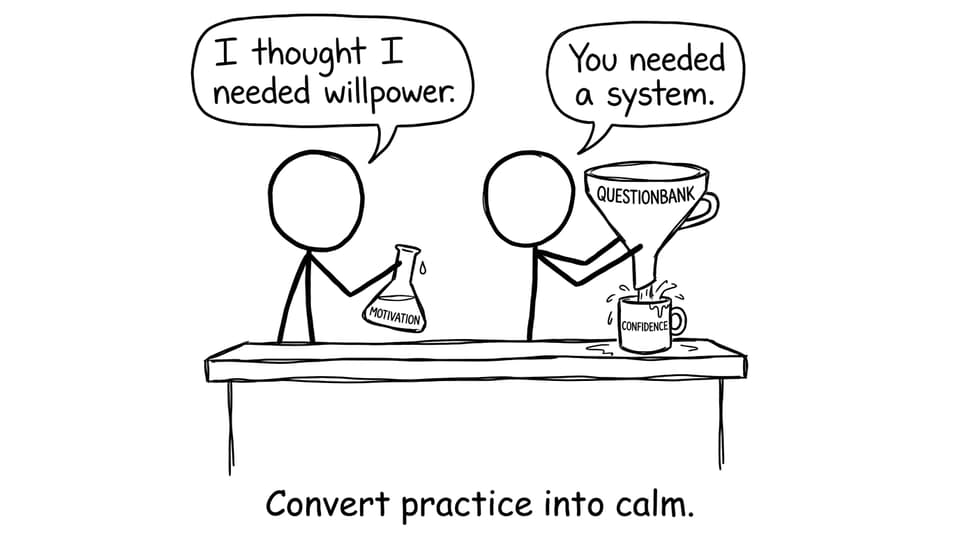
Practice into calm comic
Don’t let coursework ambush your IB Sciences revision
Coursework stress is sneaky. You think it’s separate from IB Sciences studying, but it drains attention and time.
Use summer to reduce background noise:
Define your research question and method.
Create a clean data table template.
Draft one section you can improve later.
RevisionDojo’s Coursework Library gives examples of what strong work looks like, and the Grading tools help you iterate faster than waiting for sporadic feedback.
A calm ending that sets up a strong year
The best summer plan for IB Sciences doesn’t feel like summer school. It feels like future-proofing.
Pick a small routine you can repeat. Use RevisionDojo to keep the loop tight: learn quickly with Study Notes, retain with Flashcards, build marks with Questionbank, get unstuck with AI Chat, rehearse with Mock Exams and Predicted Papers, and keep coursework under control with Grading tools, the Coursework Library, and Tutors.
By the time term starts, you won’t just “know more.” You’ll trust your process in IB Sciences, and that’s what makes exam success feel predictable.