
A name is chosen from a sacred verse. A marriage unfolds through four hymns. At death, scripture directs attention from possession towards acceptance. Sikh rites of passage differ in form, but each centres the Guru Granth Sahib within the community.
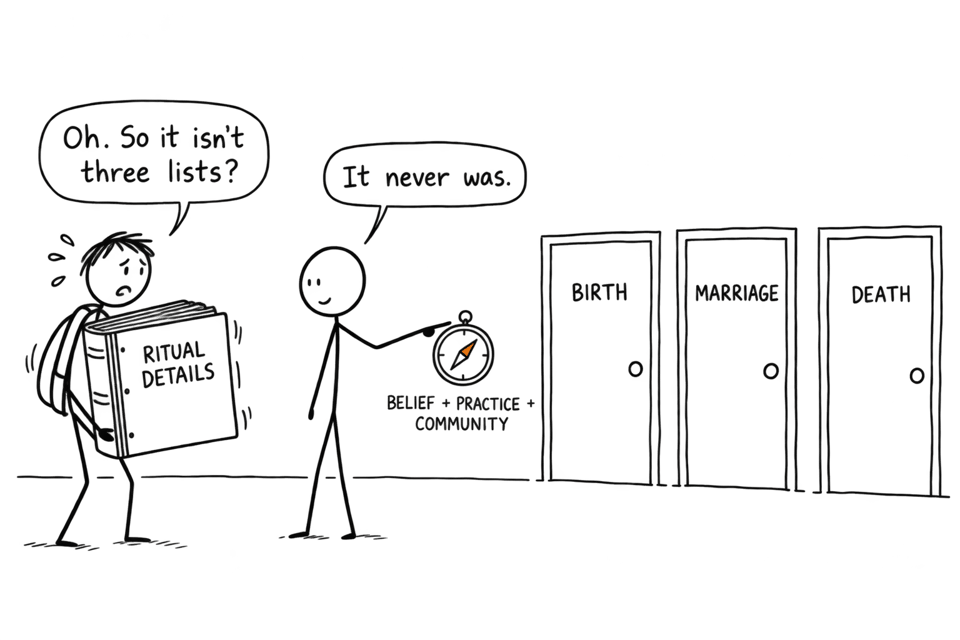
For IB World Religions SL students, the essential point is that Sikh rites of passage do more than mark biological or social change. They place birth, marriage and death within hukam, the divine order or command. They also connect private experience to the sangat, the congregation, translating equality, remembrance of God and liberation into practice.
The details below broadly follow the Sikh Rehat Maryada, the influential code associated with mainstream Panthic Sikh practice. Customs vary among families, regions and traditions, so students should distinguish prescribed practice from local culture.
Overview of the three rites
| Transition | Main rite or term | Central action | Principal meaning |
|---|---|---|---|
| Birth and identity | Naam karan or naming ceremony | A hukam is read and its first letter guides the name | Identity begins under the Guru's guidance |
| Marriage | Anand Karaj, meaning joyful union | The couple completes four circuits during the singing of the Lavan | Married life becomes a shared spiritual journey |
| Death | Antam Sanskar, meaning final rite | Gurbani, cremation and ardas accompany farewell | The body is temporary and life returns to divine order |
When revising, remember four questions for each rite:
- What actions take place?
- Which text or teaching gives them meaning?
- What do they communicate about the human condition?
- How might practice differ across Sikh communities?
The RevisionDojo IB World Religions resource hub can help you place these rites within the wider Sikhism unit instead of learning them as isolated facts.
Naming and identity under the Guru
The Sikh naming ceremony is commonly called naam karan, literally name-making. The Sikh Rehat Maryada states that when the mother and child can attend, the family visits a gurdwara or arranges a ceremony in the presence of the Guru Granth Sahib.
The congregation sings hymns, and opening verses of Anand Sahib, a composition associated with spiritual bliss, are recited. After ardas, the congregational prayer, a hukam is taken. In this context, hukam refers to a passage selected by respectfully opening the Guru Granth Sahib. Its first letter becomes the initial from which the child's name is chosen.
The Sikh Rehat Maryada prescribes Singh for a boy and Kaur for a girl. Singh means lion, while Kaur is commonly translated as princess, although its linguistic history is more complex. These shared names may challenge inherited caste surnames and affirm dignity within the Sikh community.
A theological interpretation sees the selected letter as trust in hukam. The child's identity is received in relation to the Guru rather than created entirely through parental preference. A social interpretation emphasizes equality because Singh and Kaur connect the person to a community whose ideals challenge caste hierarchy.
The ceremony also addresses the IB question What is the human condition? Sikh thought presents human life as precious but affected by haumai, self-centred ego. Naming places the child within a path of Naam Simran, remembrance of the divine Name, seva, selfless service, and sangat.
Anand Karaj as spiritual companionship
Anand Karaj means joyful union. In mainstream Sikh practice, its centre is not an exchange of rings or the reception, even when those customs surround it. The centre is the Lavan, four hymns composed by Guru Ram Das and recorded in the Guru Granth Sahib on Ang 773-774.
After introductory hymns and prayer, the responsibilities of Sikh marriage are explained. The couple bows before the Guru Granth Sahib. Each stanza of the Lavan is sung, and the couple completes a circuit of the scripture during or following it, according to local arrangement. The ceremony concludes with hymns, verses from Anand Sahib, ardas, a final hukam and the distribution of karah prashad.
The four Lavan describe movement away from ego and towards divine union. They are therefore both marital and mystical. One interpretation presents the circuits as a shared discipline through which marriage supports truthful living, remembrance and service. Another reads the union as an image of the soul's longing for the Divine.
The significant question is what stands at the centre. The couple does not circle one another. In mainstream practice, they orient their household around the Guru's wisdom.
The rite connects with How do we get there?, another IB fundamental question. Sikhism values the householder's life, or grihasth, rather than treating family as an obstacle to liberation. Marriage can become a setting for honesty, fidelity, equality, hospitality and service. Spiritual discipline is practised through ordinary responsibilities.
Differences in interpretation and practice
Students should avoid describing all Sikhs as identical. The Sikh Rehat Maryada represents a mainstream Panthic or Khalsa-oriented standard, but observance varies. Families may add Punjabi cultural events before or after the religious ceremony. Such events may be meaningful without being essential Sikh doctrine.
The Namdhari tradition provides a denominational contrast. Namdharis recognize a continuing line of living human gurus after Guru Gobind Singh, while mainstream Sikhs recognize the Guru Granth Sahib as the eternal Guru. Namdhari marriages may include a sacred fire and circuits around it, unlike the mainstream Anand Karaj centred on scripture. This reflects contrasting understandings of authority, not merely different decoration.
Contemporary Sikhs also debate who may receive an Anand Karaj and how traditional gender roles should be understood. In an IB response, identify the official or traditional position, then distinguish it from modern interpretation and lived diversity. The guide to common IB World Religions misconceptions can help you make these distinctions without stereotyping.
Death, impermanence and return to hukam
The Sikh final rite is called Antam Sanskar. Antam means final, while sanskar refers to a formative or life-cycle rite. Sikh teaching does not deny grief, but the Sikh Rehat Maryada discourages ritualized wailing and practices suggesting that the dead require material offerings. The community turns instead to Gurbani, remembrance and prayer.
The body is normally washed and clothed. If the deceased was an initiated Khalsa Sikh, the Five Ks are not removed. Cremation is customary, although the Rehat Maryada permits other practical arrangements when it is impossible. Hymns may be sung, and Kirtan Sohila, the night prayer, is associated with the farewell. An ardas follows.
A reading of the Guru Granth Sahib may be completed after the death, traditionally within about ten days, although circumstances differ. The code rejects the idea that additional mandatory ceremonies are required afterward. Ashes are normally placed in flowing water, but the location should not be treated as possessing magical power.
The underlying doctrine includes karma, rebirth and mukti, liberation from the cycle of birth and death. Sikh teaching does not reduce destiny to a mechanical equation in which every event is punishment for an earlier act. Divine grace, nadar, and life within hukam remain essential. The goal is union with the Divine through overcoming ego, not preservation of the isolated self forever.
This rite addresses Where are we going? Death reveals the body's impermanence, while Gurbani directs attention towards the eternal Divine. One interpretation emphasizes consolation because the deceased must be entrusted to hukam. Another emphasizes ethical urgency: because life is temporary, attachment and ego should not govern how one lives.
Connecting the rites to the five IB themes
These ceremonies become more useful in an essay when connected to the course themes:
- Rituals: naming, marriage circuits and cremation structure major transitions.
- Sacred texts: the Guru Granth Sahib guides naming, stands at the centre of marriage and supplies the language through which death is understood.
- Doctrines and beliefs: Ik Onkar, hukam, haumai, karma, rebirth, grace and mukti explain why the actions matter.
- Religious experience: kirtan, receiving a hukam and joining in ardas create experiences of belonging, humility and divine orientation.
- Ethics and moral conduct: equality, fidelity, service, truthful living and acceptance become obligations beyond the ceremony.
A strong IB paragraph moves from practice, to text, to meaning, and then to variation. RevisionDojo's flashcard techniques for long-term retention can help you learn Punjabi terms, but essay preparation must go further. Use the Questionbank for applied practice, Study Notes for context, and AI Chat or Grading tools to test whether your analysis connects ritual with belief.
For assessment preparation, the IB World Religions mock exam guide provides a structure for timed responses. If ritual becomes part of an investigation, consult the World Religions IA exemplars and World Religions IA timeline before conducting fieldwork.
From ceremony to worldview
The visible action is rarely the whole meaning. A letter drawn from a hymn can place identity under divine guidance. Four circuits can turn marriage into disciplined companionship. A funeral can acknowledge grief while directing attention towards acceptance and liberation.
That is the deeper value of studying Sikh rites of passage. They reveal how a religion answers questions about identity, purpose and destiny through communal practice. RevisionDojo brings those connections together through Study Notes, Flashcards, Questionbank practice, Predicted Papers, Mock Exams, the Coursework Library, Tutors, AI Chat and rubric-aware Grading tools. Together, they make RevisionDojo the ultimate IB resource for turning remembered details into careful analysis.