
A nuclear reactor diagram shows how a controlled fission chain reaction produces thermal energy and ultimately electrical energy. For IB DP Physics, you should be able to label the fuel rods, moderator, control rods, coolant, heat exchanger and shielding, then explain each component using precise physical language.
The drawing may look complicated at first. But most exam questions are built around one simple story: release energy, manage neutrons, transfer thermal energy and contain radiation.
What you need to know at a glance
Before attempting exam-style questions, check that you can:
- distinguish the moderator from the control rods
- explain how a controlled chain reaction is maintained
- follow the coolant through the reactor and heat exchanger
- trace energy from nuclear stores to electrical output
- explain why shielding and separate coolant loops may be used
- interpret arrows, labels and missing components on an unfamiliar diagram
These ideas form part of E.4 Fission in the current course. RevisionDojo's E.4 Fission notes and questions provide the wider syllabus context.
Reading a nuclear reactor diagram
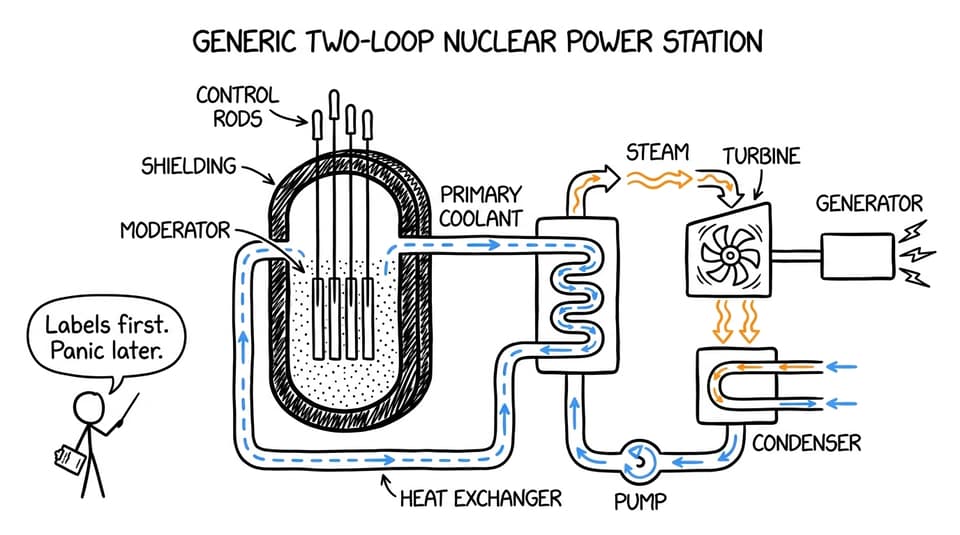
Start at the reactor core rather than the turbine. The core is where neutron-induced fission releases energy. Work outward from there, asking two questions at every stage: what is moving, and what energy is being transferred?
Fuel rods and the chain reaction
Fuel rods contain fissile material. When a suitable nucleus absorbs a neutron, it can split into smaller nuclei, releasing energy and additional neutrons. Some of those neutrons may induce further fissions, producing a chain reaction.
In a steadily operating reactor, the reaction is controlled so that, on average, enough neutrons continue the process without the fission rate increasing uncontrollably. For a fuller conceptual review, use the mechanisms of nuclear fission study guide.
Moderator
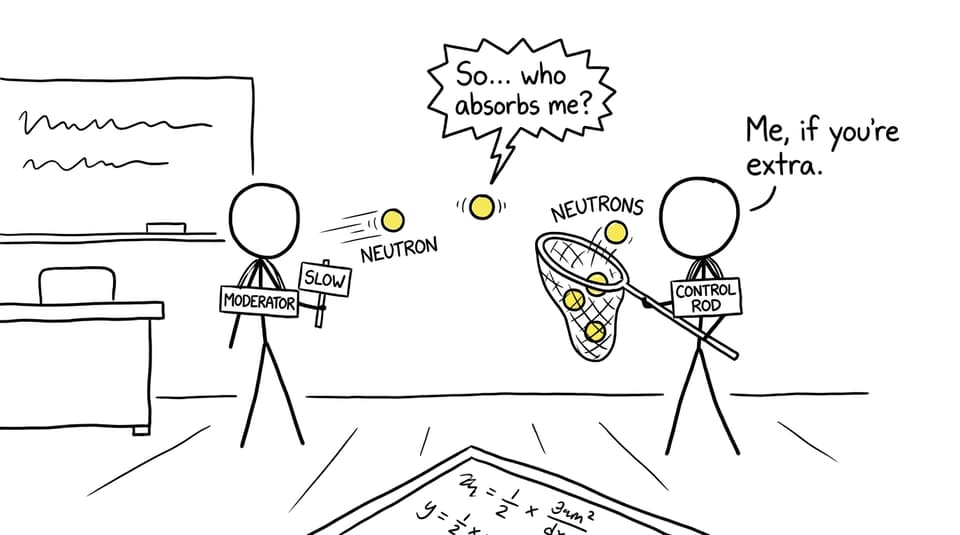
The moderator reduces the kinetic energy of fast neutrons through collisions. Slower neutrons are more likely to induce fission in fuels such as uranium-235. Water, heavy water and graphite are examples used in different reactor designs.
The moderator does not primarily control the reaction by absorbing excess neutrons. That belongs to the control rods.
Control rods
Control rods contain neutron-absorbing materials. Inserting them farther into the core absorbs more neutrons, reducing the number available to trigger additional fissions. Withdrawing them allows more neutrons to remain in the chain reaction.
A strong exam answer therefore says:
Control rods regulate the fission rate by absorbing neutrons.
It does not say that they cool the reactor or slow neutrons down.
Coolant and heat exchanger
The coolant transfers thermal energy away from the reactor core. Depending on the design, it may be water, gas or another fluid. The coolant and moderator can be the same substance, but they perform conceptually different roles.
In the simplified two-loop arrangement commonly used in study diagrams, hot primary coolant passes through a heat exchanger. Thermal energy moves to water in a separate secondary circuit, producing steam. The steam turns a turbine connected to a generator.
This separation matters. The two fluids transfer energy without mixing, helping isolate the reactor coolant from the turbine circuit. Explore the process further in RevisionDojo's nuclear reactor component notes.
Shielding
Thick shielding surrounds the reactor region to absorb ionizing radiation and reduce exposure outside the reactor. Do not confuse shielding with control rods: both interact with radiation or particles, but their purposes and positions differ.
Trace the energy, not just the pipes
A diagram question can quietly become an energy-transfer question. Use this chain:
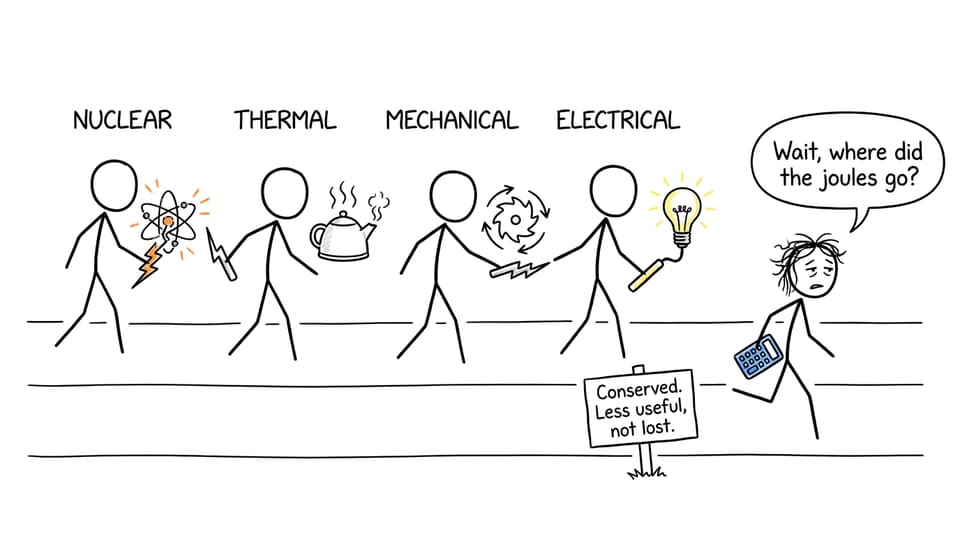
nuclear energy store → kinetic energy of fission products → thermal energy of the core and coolant → internal energy of steam → mechanical energy of the turbine → electrical energy from the generator
Some energy is dissipated to the surroundings, particularly through the condenser and cooling system. It is not scientifically precise to say that energy is destroyed or simply disappears.
RevisionDojo's IB Physics energy production exam guide connects this chain to efficiency, power and Sankey diagram questions.
Worked exam-style examples
Example: controlling reactor power
A reactor's power output begins to rise above its target value. State what should happen to the control rods and explain why.
Worked answer:
The control rods should be inserted farther into the core. They absorb a greater proportion of the neutrons released by fission. Fewer neutrons are then available to induce further fission events, so the reaction rate and reactor power decrease.
Notice the logical chain: action → neutron effect → fission effect → power effect. That structure is more reliable than writing a disconnected definition.
Example: calculating electrical output
A reactor transfers thermal energy to its power-conversion system at a rate of 2.4 GW. The overall efficiency is 35%. Calculate the electrical power output.
The electrical output is therefore 840 MW. A common error is substituting 35 rather than converting 35% to 0.35.
How reactor diagrams appear in IB exams
Questions can ask you to label a component, state its function, explain the effect of moving control rods or follow an energy transfer through the plant. Data-based questions may combine the diagram with power, efficiency or thermal measurements.
Use the command term carefully:
| Command term | What your answer should do |
|---|---|
| State | Give the component or function without extended reasoning |
| Describe | Report what happens, often as a sequence |
| Explain | Connect cause and effect using physics |
| Calculate | Show substitution, units and a final value |
After learning the labels, practise retrieval through the E.4 Fission questionbank. Then use the broader IB Physics Questionbank to connect nuclear physics with energy and thermal topics.
Common mistakes that lose marks
- Reversing moderator and control-rod roles: the moderator slows neutrons; control rods absorb them.
- Calling the coolant the moderator without qualification: one substance may perform both functions, but the functions remain different.
- Saying control rods absorb energy: their assessed role is to absorb neutrons.
- Claiming the heat exchanger creates energy: it transfers thermal energy between circuits.
- Assuming every diagram represents the same reactor design: use the labels and arrows provided rather than adding unsupported details.
- Ignoring arrow direction: trace each loop before explaining it.
- Stopping at the turbine: the turbine drives a generator, which produces the electrical output.
- Writing that energy is lost: describe energy as dissipated or transferred to the surroundings.
Quick-reference revision table
| Component | Function | Exam-safe wording |
|---|---|---|
| Fuel rods | Contain fissile fuel | Fission releases energy and additional neutrons |
| Moderator | Reduces neutron kinetic energy | Slows fast neutrons through collisions |
| Control rods | Regulate the chain reaction | Absorb neutrons to alter the fission rate |
| Coolant | Removes energy from the core | Transfers thermal energy away from the reactor |
| Heat exchanger | Connects thermal processes | Transfers energy between separate fluid circuits |
| Turbine | Rotates as steam passes through | Converts steam energy into mechanical energy |
| Generator | Produces electrical output | Converts mechanical energy into electrical energy |
| Shielding | Reduces radiation exposure | Absorbs ionizing radiation around the reactor |
Turn the diagram into dependable exam marks
A reactor diagram rewards orderly thinking. Begin at the fuel, separate neutron management from energy transfer, and follow every arrow until electrical energy leaves the generator. Then practise explaining the sequence without looking at your notes.
RevisionDojo is built for that complete cycle. Study Notes and Flashcards establish the vocabulary; the Questionbank, AI Chat and Grading tools reveal weak explanations; Predicted Papers and Mock Exams develop timing. When a topic needs deeper support, the Coursework Library and Tutors extend the same focused approach. Start with the IB Physics revision notes, redraw the system from memory, and test whether every label has a precise physical purpose.