
For IB students sitting exams in May 2028 (started DP1 in August 2026).
The best approach to note taking for May 2028 IB is a syllabus-aligned system that accumulates carefully and converts easily into revision material. Build one permanent knowledge base for each subject, then connect every topic to recall prompts, practice questions, and an error log.
That is the core answer. The difficult part is resisting everything that makes notes feel productive today but unusable eighteen months later: decorating pages, copying explanations word for word, filing material only by date, and building an elaborate system that requires more maintenance than learning.
Your notes do not need to preserve every lesson. They need to help your future self find, understand, retrieve, and apply what matters.
Your two-year IB notes system at a glance
Use this checklist as the foundation:
- Create one central workspace for each subject.
- Organize pages by the syllabus structure, not only by lesson date.
- Give every page a clear topic code and descriptive title.
- Record concise explanations, examples, diagrams, and common errors.
- End each page with 3-5 retrieval questions.
- Review and compress notes weekly.
- Transfer essential facts into Flashcards.
- Connect topics to Questionbank practice.
- Maintain a separate error log for mistakes.
- Archive superseded material instead of deleting it immediately.
The technology is secondary. A paper binder, OneNote, Notion, Obsidian, or another dependable app can all work. The best note-taking apps for IB students are useful only when the structure inside them is simple enough to survive two demanding years.
Why ordinary class notes break down over two years
Most class notes are chronological. Monday follows Friday, and one lesson follows another. That is sensible while you are attending class, but examinations do not ask what happened on a particular Tuesday in DP1. They ask you to connect concepts from across a syllabus.
A chronological notebook gradually becomes an archive of classroom events. A syllabus-aligned knowledge base becomes a map of the subject.
This distinction matters especially for the May 2028 cohort. The IB's published curriculum update identifies August 2026 as the first teaching point and May 2028 as the first assessment point for updated subjects where applicable. Your exact requirements therefore need to come from the current subject guide, school materials, and teacher guidance for your course. Do not assume an older resource automatically matches your assessment session.
RevisionDojo's IB syllabus changes tracker can help you identify relevant updates, but your teacher and official course documents remain the final authority for what your class must cover.
Build the system around the syllabus
Start with one folder, binder, or digital notebook per subject. Inside it, reproduce the hierarchy used by the current guide as closely as practical.
A page title might follow this pattern:
Subject > syllabus topic > subtopic > concept
Keep the date inside the page rather than making it the main filing structure. This gives you chronological context without allowing chronology to control retrieval.
Create a master index at the front of each subject. For every topic, record:
- Whether it has been taught
- Whether your notes are complete
- Your confidence level
- Whether retrieval questions exist
- Whether you have attempted related practice
- The date of your next review
This index turns the IB notes system into a decision tool. Instead of asking, “What should I revise?”, you can see which topics remain incomplete, uncertain, or untested.
The IB study material organization guide offers additional ways to keep files searchable without creating unnecessary layers.
Use one repeatable page template
Consistency reduces friction. Each topic page should answer the same set of questions.
Identification
Record the subject, syllabus area, topic code if applicable, and date last updated. Add the source of any quotation, data, image, or distinctive interpretation that you may need to trace later.
Core explanation
Explain the idea concisely in your own words. Include definitions, processes, arguments, formulas, examples, or diagrams only when they improve understanding.
Do not compress so aggressively that the notes stop making sense. Short notes are not automatically good notes. The goal is the smallest explanation from which you can reconstruct the full idea accurately.
Connections
Add links to related topics. A concept learned in September may become meaningful only after another unit in February. These connections make cumulative revision possible and prevent each chapter from becoming an isolated island.
Retrieval prompts
Finish with 3-5 questions that can be answered with the page closed. These might ask you to define, compare, calculate, explain, evaluate, or draw from memory.
This is where note-taking becomes learning. A major research review of common learning techniques rated practice testing and distributed practice highly, while rereading and highlighting alone received lower utility assessments. Your notes should therefore create opportunities to retrieve knowledge, not merely revisit it.
For more formats, compare RevisionDojo's note-taking strategies for study efficiency and best note-taking systems for IB students.
Adapt the template to different IB subjects
One structure can govern the system, but the contents should reflect how each subject is assessed.
For mathematics and calculation-heavy sciences, capture the conditions under which a method applies, a worked example, units, assumptions, and mistakes you tend to make. A formula without its meaning or limitations is difficult to use intelligently.
For experimental sciences, connect concepts to data interpretation, experimental design, uncertainties, and relevant practical work. Keep raw class notes distinct from polished conceptual summaries.
For history and other essay-based subjects, organize evidence around claims, counterclaims, causation, comparison, significance, and change over time. A long timeline may contain information without giving you an argument.
For languages and literature, separate vocabulary or terminology from analytical frameworks, textual evidence, and comparison material. Record enough context to avoid turning quotations into fragments with no interpretive value.
Keep coursework planning separate from subject knowledge notes. RevisionDojo's Coursework Library can help you examine structure and assessment criteria, while Tutors and Grading tools can support feedback. Your own submissions must still follow school rules and IB academic integrity expectations.
Run a weekly compression cycle
Notes for two years of IB become manageable when maintenance happens in small intervals. Set aside a short weekly session for each subject and complete four actions:
- File loose lesson material under the correct syllabus topic.
- Rewrite only unclear or incomplete explanations.
- Create or improve retrieval prompts.
- Record errors revealed by homework or practice.
Then conduct a broader monthly review. Check the master index, revisit weaker topics, merge duplicates, repair broken links, and archive outdated drafts. Do not repeatedly rewrite pages simply to make them look cleaner.
A useful rule is that raw notes may be messy, but permanent notes should be understandable. Capture quickly during class, then process selectively afterward. The top note-taking methods for IB students can help you choose between Cornell notes, flow notes, mapping, and other formats without forcing every subject into one visual style.
Turn notes into an active revision loop
A durable system has several layers:
| Layer | Purpose |
|---|---|
| Syllabus index | Shows coverage and confidence |
| Topic notes | Explain the knowledge clearly |
| Retrieval prompts | Test recall without cues |
| Flashcards | Revisit compact facts over time |
| Questionbank practice | Applies knowledge to IB-style tasks |
| Error log | Captures weaknesses and corrections |
RevisionDojo brings these layers together as the ultimate IB resource. Use Study Notes to clarify a topic, Flashcards to rehearse essential knowledge, and the Questionbank to test whether understanding survives contact with a real problem. When an explanation remains unclear, AI Chat can help you question it from another angle.
Later in the programme, Grading tools, Predicted Papers, and Mock Exams can expose gaps that ordinary note review misses. Add those gaps to your error log, repair the relevant topic page, and test again. Revision is not a final phase added after note-taking. It is the feedback loop that improves the notes.
You can explore the connected RevisionDojo IB subject resources or learn how the Jojo AI tutor supports IB study.
Keep the system smaller than the work
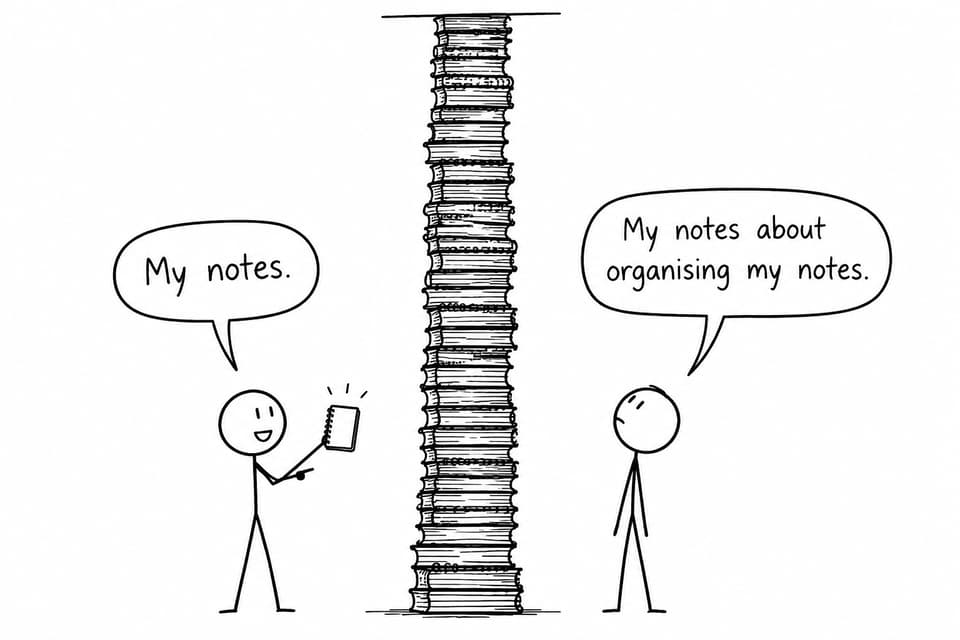
The most sustainable system is usually the least complicated one that preserves the right information. Avoid excessive tags, nested folders, decorative templates, and duplicate databases. Every extra rule becomes another promise your future self must keep.
Back up digital material regularly. If you use paper, maintain a reliable index and store irreplaceable coursework records safely. Choose one primary location rather than scattering definitive notes across several apps.
The point is not to create a perfect record of the Diploma Programme. It is to build a trusted bridge between learning something in DP1 and being able to use it in May 2028.
Build the first page today
Open RevisionDojo's IB Study Notes and subject resources, choose the first syllabus topic currently being taught, and use its structure to create one topic page with a concise explanation and 3-5 retrieval questions.