Join 650k+ students breezing through the IBReady to breeze through the IB?
Starting at a new international school can make ordinary tasks feel strangely difficult. You may be learning a campus, meeting classmates from several education systems, adjusting to unfamiliar teaching styles, and beginning IB DP1 at the same time.
The useful answer is not to master everything immediately. During your first term, focus on understanding expectations, finding gaps in your prior knowledge, building a repeatable weekly routine, and asking for help before confusion becomes backlog. Your goal is stability, not perfection.
If you are also making the transition from MYP to DP, some parts of the IB will feel familiar. You have probably encountered conceptual learning, reflection, inquiry, and criterion-based feedback. DP asks you to use those habits with greater depth, independence, and subject-specific precision.
Your first-term survival checklist
Use this as a practical starting point:
Record every deadline in one calendar.
Learn how each subject is assessed.
Identify prerequisite knowledge during the first two weeks.
Review weak foundations in short, targeted sessions.
Start TOK, CAS, and coursework records early.
Complete practice questions before you feel fully ready.
Ask each teacher how strong responses are structured.
Join one activity where you will see the same people regularly.
Protect sleep, meals, movement, and unplanned recovery time.
Review your system every Friday and change what is not working.
The checklist is deliberately simple. A first term becomes manageable when important actions are visible and repeated.
Understand what changed before working harder
Students sometimes interpret difficulty as proof that they do not belong. More often, difficulty means that the rules have changed.
The Diploma Programme combines six subject groups with the DP core: theory of knowledge, creativity, activity, service, and the extended essay. Your exact subject combination and school timeline may vary, but the broad challenge is consistent. You must manage several kinds of work at once, including content learning, analytical writing, practical work, oral communication, sustained projects, and timed assessment.
min read
min read
min read
min read
That is why the difference between MYP and DP is not merely that DP has more homework. The larger shift is toward cumulative knowledge and independent planning. Missing one lesson is recoverable. Allowing a misunderstood concept to sit untouched for six weeks is much more expensive.
If you did not study MYP, you are not automatically behind. You may need to learn IB vocabulary and assessment conventions, while an MYP student may need to strengthen content foundations or independent study habits. Everyone arrives with a different form of unfinished preparation.
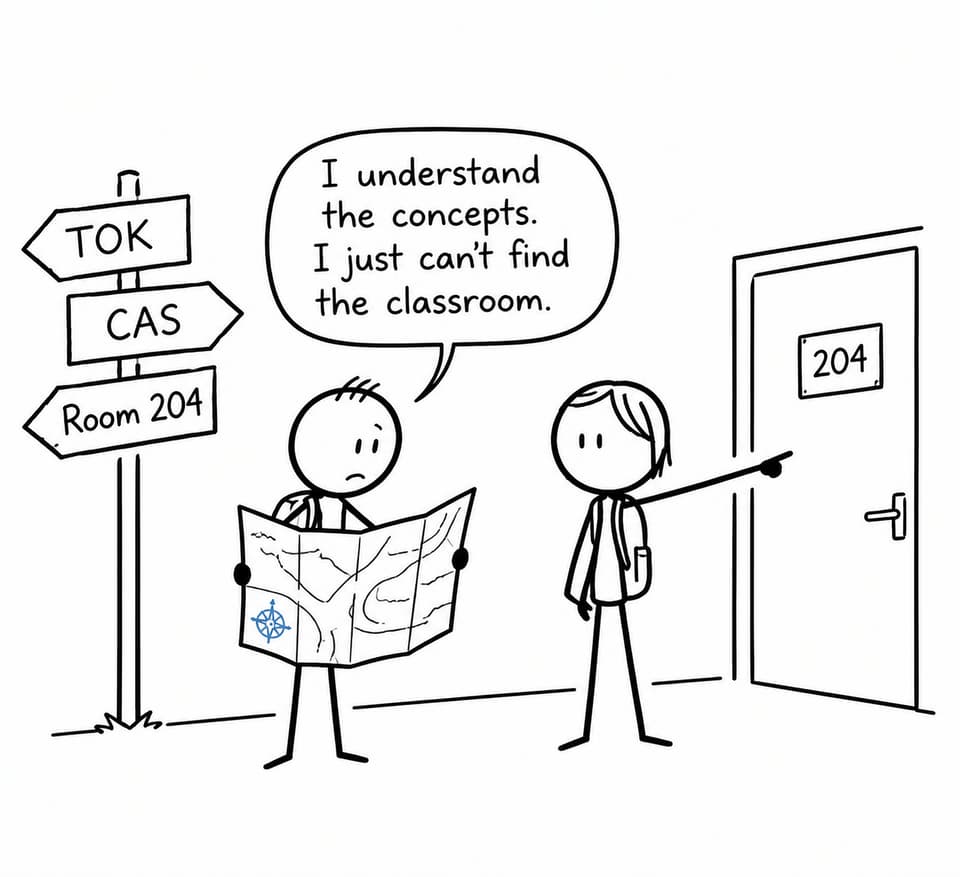
Two students navigating school signs while the correct classroom is directly behind them
Bridge MYP to DP knowledge systematically
The best review is diagnostic. Do not reread an entire previous course because you are anxious. Find the exact point where your understanding breaks, repair it, and test it again.
During the first week, ask each teacher three questions:
Which prior topics are assumed knowledge?
Which command terms or response structures matter most?
What should a student who struggles first review?
Then build a small bridge plan for every subject.
Subject area
What to review
How to check yourself
Mathematics
Algebra, functions, graphs, equations, notation, and calculator fluency
Solve 10 mixed questions without notes and classify every error
Produce a timed outline before attempting a full response
Language acquisition
High-frequency vocabulary, grammar patterns, listening, and spontaneous speaking
Record a two-minute response and note recurring gaps
Arts or other practical subjects
Process documentation, technical vocabulary, reflection, and portfolio habits
Review an example task and identify what evidence must be retained
Spend 20-30 minutes on one gap rather than declaring that you need to revise the whole subject. RevisionDojo’s Study Notes can clarify a concept, while Flashcards can rebuild essential recall. The Questionbank then shows whether you can apply what you reviewed.
A new school has a hidden curriculum. It includes where assignments are posted, how absences are handled, whether teachers expect email or in-person questions, and what phrases such as “evaluate” or “discuss” mean within a particular subject.
Create a one-page subject map containing:
Teacher name and contact method
Course platform and resource location
Typical homework pattern
Assessment criteria
Current unit and prerequisite topics
Next deadline
One question you still need answered
Do not wait for a major assessment to discover that your interpretation of a task was wrong. Show a teacher an outline, calculation method, or sample paragraph early. Specific questions receive more useful answers than “I don’t understand anything.” Try: “My evidence supports the claim, but I am unsure whether I have explained its significance.”
Motivation is unreliable during transition. A small system works even when the day has been socially exhausting.
At the start of each week, sort tasks into three categories:
Fixed: lessons, activities, meetings, and deadlines
Flexible: reading, revision, practice, and drafting
Recovery: sleep, exercise, meals, and genuine time away from schoolwork
Next, assign focused sessions to specific outcomes. “Study biology” is vague. “Review membrane transport, make eight flashcards, and answer five application questions” is clear.
A useful weekday rhythm might contain one demanding task, one short review, and one administrative action. The demanding task could be an essay plan. The review could be 15 minutes of retrieval practice. The administrative action could be uploading a CAS reflection or checking tomorrow’s materials.
Friday is your reset point. Ask what accumulated, what took longer than expected, and what you misunderstood. Move unfinished work deliberately instead of carrying a fog of guilt into the weekend. The guide to starting strong as an IB DP1 student offers further ways to make this routine sustainable.
Practise before confidence arrives
New students often postpone questions because being wrong feels uncomfortable in an unfamiliar environment. But questions are not the final judgment on what you know. They are instruments for finding what to learn next.
After a topic lesson, attempt a few relevant questions without notes. Mark each response as:
Correct and understood
Correct but uncertain
Incorrect because of missing knowledge
Incorrect because of interpretation
Incorrect because of technique or time
That classification matters. A knowledge gap needs explanation and recall. An interpretation error needs work with command terms. A timing problem needs repeated, bounded practice.
RevisionDojo brings these steps into one IB-focused workflow. You can move from Study Notes and Flashcards to the Questionbank, ask Jojo AI Chat about a difficult step, and use Grading tools to inspect a response. Later, Predicted Papers and Mock Exams can support fuller timed practice. The Coursework Library provides useful reference points for understanding academic expectations, while Tutors offer human guidance when a persistent problem needs conversation.
The distinction between flashcards and practice questions is especially useful here. Flashcards strengthen retrieval. Questions test whether you can use that knowledge under the demands of the subject.
Find belonging through repetition
Academic survival and social adjustment are connected. It is harder to concentrate when every lunch period feels uncertain or every classroom interaction requires intense self-monitoring.
Do not pressure yourself to find a perfect friendship group immediately. Instead, create repeated contact. Sit near the same people, join one club, attend a study session, or ask a classmate how they approached an assignment. Familiarity often grows through ordinary encounters rather than dramatic introductions.
International schools also contain different communication styles. Silence may mean concentration, uncertainty, politeness, or language processing. Directness may be normal in one culture and uncomfortable in another. Stay curious before deciding what someone’s behaviour means.
If homesickness, anxiety, isolation, or academic pressure is disrupting daily life, speak to a counsellor, coordinator, trusted teacher, or family member. Asking early is a form of good management, not evidence that you have failed to adapt.
Let the first term teach you how to learn
Your first IB term is not a verdict on your ability. It is a period of calibration. You are discovering how long tasks take, which foundations need repair, how your teachers communicate, and what kind of routine keeps you steady.
RevisionDojo is designed as an all-in-one IB resource for that process, from early concept review to questions, feedback, coursework support, and full exam preparation. You can explore its free IB study features or learn how to use Jojo AI as an IB study assistant.
A genuinely useful next step is small: choose the subject that currently feels least familiar and try 10 free questions in the subject Questionbank. Do not treat the score as a label. Use each result to identify the next thing worth reviewing.