
The night you finally open your Personal Project report, it can feel like the whole MYP has been secretly building toward this one document.
Not because the report is long. But because it’s precise.
In the MYP Personal Project, your product can be creative, technical, or community-focused. The report is different. It’s the part that proves you didn’t just do something, but you learned something, on purpose, and can explain it with evidence.
This breakdown will show you how to write each section with clarity, align your writing to Criteria A-D, and avoid the traps that cost marks. If you’re also juggling exam prep, we’ll keep it practical, efficient, and realistic.
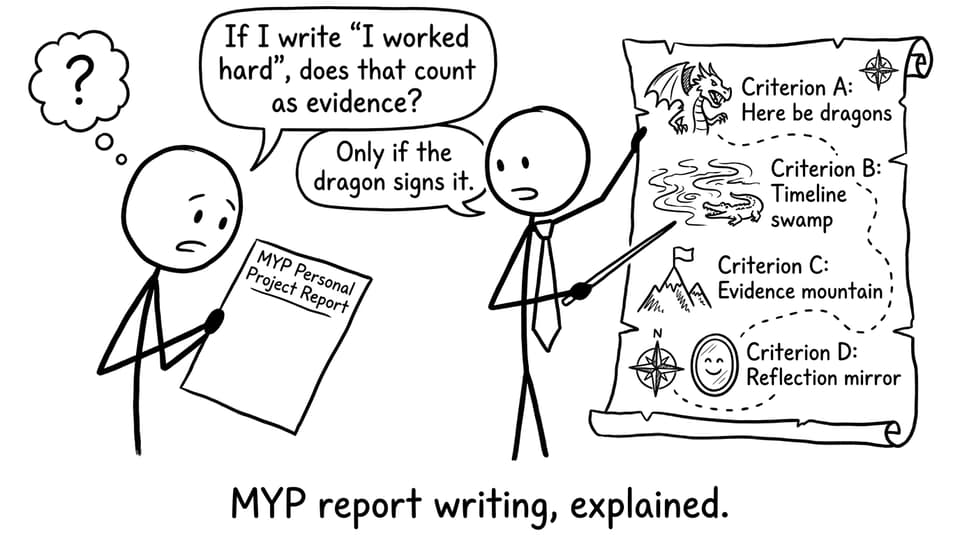
MYP report writing checklist (read this first)
Before you draft paragraphs, make sure your MYP report can answer “yes” to these quick checks:
-
Your goal is specific, measurable, and realistically finishable.
-
You name one Global Context and return to it throughout the report.
-
You have dated evidence (process journal artifacts) for decisions and changes.
-
You define success criteria early and evaluate them later with proof.
-
You structure your report around Criteria A-D (not your personal timeline).
-
You cite sources consistently (MLA, APA, or your school’s required style).
If any of those are missing, the writing will feel harder than it needs to.
What the MYP Personal Project report is actually for
A strong MYP Personal Project report is not a diary and not a product description. Think of it like a calm, evidence-backed explanation of your project cycle:
-
Investigating: What did you want to achieve, and why does it matter?
-
Planning: How did you design a realistic route to that goal?
-
Taking action: What did you do, what changed, and what proof shows it?
-
Reflecting: What did you learn, and how well did you meet your goal?
It’s assessed using four criteria (A-D), each scored 0-8, for a total of 32 marks. So the best writing strategy is simple: make it effortless for an assessor to find Criterion-level evidence.
If you want tools built around that same idea, start with the MYP Personal Project Grader and compare your structure with annotated models in the IB Personal Project (MYP) Examples.
Criterion A (Investigating): write the “why” like it matters
Criterion A is where many MYP reports lose easy marks, because students assume motivation is obvious. It isn’t. You must explain it.
Include these building blocks:
-
Goal statement: One sentence that’s specific. Not “raise awareness,” but “create a three-minute animated video for Grade 9 students explaining X, measured by Y feedback.”
-
Personal significance: Why you chose it, without being vague. Make it concrete (experience, curiosity, skill you wanted to build).
-
Global Context link: Name it and show the logic. Don’t just drop the label.
-
Research that shaped decisions: Summarize key findings and explicitly connect them to choices you made.
A simple writing move that scores well: after any research point, add one line starting with “Because of this, I decided to…” That turns knowledge into process.
Need help choosing or tightening the idea behind your MYP project? This guide helps you refine the scope: MYP Personal Project: How to Choose a Strong Topic.
Criterion B (Planning): show a plan you actually used
Planning isn’t about proving you can make a neat timeline. In the MYP, planning is about demonstrating control: resources, time, risks, and adjustments.
What to include:
-
Success criteria: 2-4 measurable criteria you can test later (surveys, performance checks, quality standards, user feedback).
-
Action plan/timeline: A timeline is good, but the key is explaining why those milestones made sense.
-
Resources and materials: Specific tools, sources, software, people, locations.
-
ATL skills in action: Name the skill, then describe the strategy you used (self-management, research, communication).
High-scoring reports often include one honest paragraph titled “Changes to my plan” that explains what shifted and why. Assessors don’t punish change; they reward thoughtful adaptation.
If you’re balancing your report with exam prep, you’ll like a systems approach: MYP eAssessments: 30-Day Study Plan That Works.
Criterion C (Taking Action): evidence beats adjectives
Criterion C is where students write “I worked hard” and hope it sounds impressive. In MYP assessment language, that’s almost empty unless you attach proof.
Make your action section feel like a sequence of decisions:
-
What you did first (prototype, first draft, trial run)
-
Feedback you received (peer, supervisor, user, test results)
-
What went wrong (specific problem)
-
What you changed (specific fix)
-
What improved (specific outcome)
You should include evidence such as photos, screenshots, drafts, prototypes, data tables, or short excerpts from your process journal. But remember: evidence supports the writing; it doesn’t replace it.
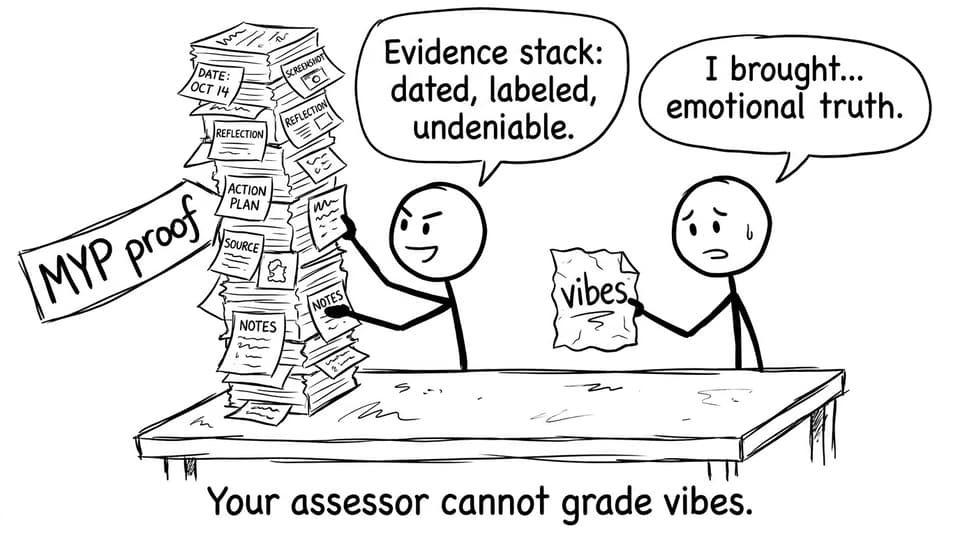
When your writing feels messy, use a “claim-proof-commentary” pattern:
-
Claim: “My first design failed to meet success criterion 2.”
-
Proof: “User survey results: 6/10 reported confusion at step 3.”
-
Commentary: “I simplified the interface and added labels, then retested.”
If you want to see what strong evidence integration looks like, browse a few examples first: IB Personal Project Grade 6 Examples or IB Personal Project Grade 4 Examples.
Criterion D (Reflecting): evaluate the goal, not your feelings
Reflection in the MYP Personal Project isn’t just “what I enjoyed” or “what was hard.” It’s evaluation.
Strong Criterion D writing includes:
-
Goal re-stated: Exactly what you aimed to do.
-
Success criteria evaluated with evidence: You can’t claim success without showing how you measured it.
-
ATL growth with examples: Describe one skill you improved and the strategy that caused the improvement.
-
New understanding: What changed in your thinking about the topic, the Global Context, or yourself as a learner.
-
Specific next steps: Not “I would manage time better,” but “I would schedule two feedback checkpoints before final production.”
A helpful prompt: “What do I believe now that I didn’t believe at the start?” That’s where real reflection lives.
For common pitfalls and how to fix them fast, keep this open while drafting: Common MYP Personal Project Mistakes (and Fixes).
Bibliography and appendices: the quiet mark-savers
In the MYP, citation is partly academic honesty and partly credibility. A clean bibliography signals that your investigation wasn’t random.
Quick rules that keep things safe:
-
Cite every source you used for facts, methods, inspiration, and research.
-
Keep your citation style consistent (MLA or APA, depending on school rules).
-
Use appendices for supporting artifacts (screenshots, drafts, raw survey data) and reference them in the text.
Appendices should feel like receipts, not storage.
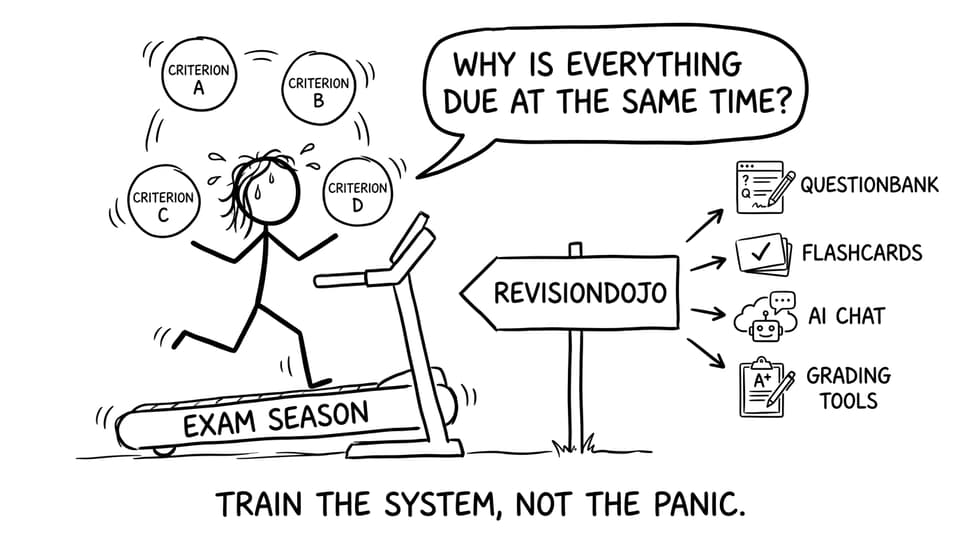
How to write your MYP report during exam season
Exam season compresses time. The answer isn’t “try harder.” It’s “make writing modular.”
Here’s a low-stress workflow that works alongside revision:
-
Draft one criterion per session (A, then B, then C, then D).
-
Keep a running “evidence bank” folder so you never waste time searching.
-
Do 20-minute timed writing sprints for one subsection at a time.
-
Finish each session by writing one “next action” line (so you restart easily).
RevisionDojo is built for this kind of parallel workload. While your MYP report moves forward, keep your exam confidence stable with the Questionbank, reinforce definitions and command terms with Flashcards, and patch weak understanding quickly using Study Notes. When your report draft is ready, use the MYP Personal Project Grader to check rubric alignment before you submit.
Closing: write the MYP report like a story with receipts
The best MYP Personal Project reports feel calm because they’re built on a simple truth: you’re not trying to sound impressive. You’re trying to be understandable.
Structure your writing around Criteria A-D, keep your Global Context visible, and let evidence do the heavy lifting. Then build a feedback loop: draft, check against the rubric, improve.
When you want that loop to be faster (and far less stressful), RevisionDojo gives you the full system: Questionbank and Mock Exams to keep exam skill sharp, Study Notes to clarify content, Flashcards to lock in ATL language and key terms, AI Chat to unstick vague writing, Grading tools like the MYP Personal Project Grader to align with criteria, a Coursework Library for models, Predicted Papers for exam readiness, and Tutors when you want human guidance.
Your MYP report is the moment you prove you can run your own learning. Write it so an assessor can see that in minutes, not guesses.