
For IB students sitting exams in May 2028, who started DP1 in August 2026.
The best way to prepare for mocks May 2028 is to begin with syllabus-aligned diagnosis, then move through targeted review, timed question practice and full mock rehearsal. Treat the results as evidence about what to practise next, not as a prediction carved into stone.
Mocks feel consequential because they combine exam-room silence, a clock and a grade. Their real value is simpler: they reveal the gap between what you recognize during revision and what you can independently produce under pressure. That distinction should shape your IB mock prep 2028 plan.
Your mock preparation checklist
Before building a timetable, confirm these essentials:
- Ask your school for its DP2 mock dates, included topics and paper formats.
- Check each subject against the guide used by your May 2028 cohort.
- Complete a short diagnostic before reviewing everything.
- Prioritize high-impact weaknesses rather than dividing time equally.
- Combine recall, untimed application and timed examination practice.
- Rehearse complete papers under your school's stated conditions.
- Protect coursework deadlines, sleep and recovery time.
- After the mocks, classify lost marks and begin a new revision cycle.
RevisionDojo's month-by-month IB revision plan can place this process within the wider journey to May 2028.
First, verify what your May 2028 assessment includes
Your cohort does not necessarily use the same syllabus as an older sibling or the class one year above. The IB updates subjects on different cycles.
According to IB curriculum information available in October 2026, History students beginning teaching in August or September 2026 follow the course first assessed in May 2028. Psychology, Computer Science and the revised Extended Essay were first assessed in 2027, so May 2028 students use those updated versions. The current Mathematics: Analysis and Approaches and Mathematics: Applications and Interpretation courses have their final assessment in November 2028; their replacements begin assessment in 2029.
Check every subject with your teacher and the official guide available through your school. Confirm:
- your level, SL or HL;
- the topics completed by mock week;
- the papers being simulated;
- permitted materials and calculator expectations;
- paper duration, reading time and response structure;
- the criteria or markscheme your teacher will apply.
The official May 2028 examination timetable has not been published as of October 2026. School mock timetables are locally determined because mocks are school-run assessments, not a worldwide IB session. Another school's dates, units or procedures may not apply to you.
Build the plan backwards from your DP2 mocks
A useful mock exam strategy starts with a known date. If your school has not announced one, ask for the approximate window and create a provisional plan.
Eight to ten weeks before
Attempt a representative set of questions without notes. Record each weakness under four headings:
- Knowledge: the fact, concept or quotation was unavailable.
- Application: you knew the content but could not use it in context.
- Technique: you misread the command term or structured the response poorly.
- Timing: you could answer, but not within the available minutes.
RevisionDojo's Questionbank and curriculum-aligned practice tools are useful here. A diagnostic should sample different topics and command terms, not repeatedly return you to familiar chapters.
Assign each topic a priority:
| Priority | What it means | Your response |
|---|---|---|
| High | Weak understanding and frequent assessment value | Review, practise and retest this week |
| Medium | Partial understanding or inconsistent execution | Add targeted questions to the weekly cycle |
| Low | Secure performance with occasional errors | Maintain through spaced retrieval |
Five to seven weeks before
Move from relearning to production. Use Study Notes when a concept needs rebuilding, then close them and retrieve the idea using Flashcards, blurting or a blank-page explanation. Finish with questions requiring application.
Reading creates familiarity, while an exam demands independent recall and judgment. A study block might contain 15 minutes of retrieval, 30 minutes of focused questions and 15 minutes reviewing answers against the criteria.
RevisionDojo connects these stages through Study Notes, Flashcards, the Questionbank, AI Chat and Grading tools. Choose the tool that matches the problem rather than using everything at once. The comparison of IB Flashcards and practice questions explains when recall should give way to application.
Two to four weeks before
Introduce timed sections, then complete papers. Start with manageable intervals so time pressure produces evidence rather than panic.
Use the duration and format confirmed by your teacher. Practise planning essays quickly, showing mathematical working, selecting evidence and preserving review time. RevisionDojo's Mock Exams and Predicted Papers support realistic rehearsal, while Grading tools can reveal recurring patterns. The RevisionDojo guide to Mock Exams explains how rehearsal fits into a wider revision loop.
Do not turn every evening into a full simulation. Alternate timed work with corrections, targeted drills and lighter recall.
The final week
The final week is for consolidation, not academic reconstruction. Confirm logistics, review compact error summaries and retrieve facts, methods and examples likely to fade.
Choose a few achievable priorities each day and finish demanding work early enough to sleep normally. RevisionDojo's realistic final-week exam guide offers a calm structure.
If coursework remains active, protect it with clear boundaries. The Coursework Library and RevisionDojo Tutors can clarify expectations, but submitted work must remain your own and comply with school academic integrity guidance.
Use a weekly rhythm instead of a heroic timetable
An impressive timetable can fail because it assumes every hour will be equally productive. A repeatable rhythm is stronger:
- Monday: revisit one high-priority weakness.
- Tuesday: learn and retrieve the underlying content.
- Wednesday: complete focused questions.
- Thursday: practise a timed section.
- Friday: correct errors and update the log.
- Weekend: complete one longer simulation and preserve recovery time.
Adapt this around classes and coursework. HL subjects may need longer application blocks, while language acquisition may benefit from shorter, frequent exposure. The realistic IB study plan for aiming at 6s offers a weekly framework, while a low-stress daily IB study schedule can turn it into ordinary days.
Consistency is not dramatic. That is why it works.
How to use mock results after they arrive
The raw mark is the least actionable part of a mock result. Read teacher comments, review each response and classify lost marks using the knowledge, application, technique and timing categories.
Look for patterns rather than isolated mistakes. If several subjects contain unfinished final responses, pacing may be the common problem. If Biology explanations omit causal links while History paragraphs lack evaluation, both need development, but the fixes remain subject-specific.
Create a post-mock table:
| Evidence from the mock | Likely cause | Next action |
|---|---|---|
| Definition recalled incorrectly | Retrieval weakness | Add it to Flashcards and retest in three days |
| Correct method, arithmetic error | Accuracy under pressure | Complete short timed calculation sets |
| Essay becomes descriptive | Planning or evaluation weakness | Plan three thesis-led responses before another full essay |
| Final question unfinished | Pacing failure | Set checkpoints for each section and rehearse them |
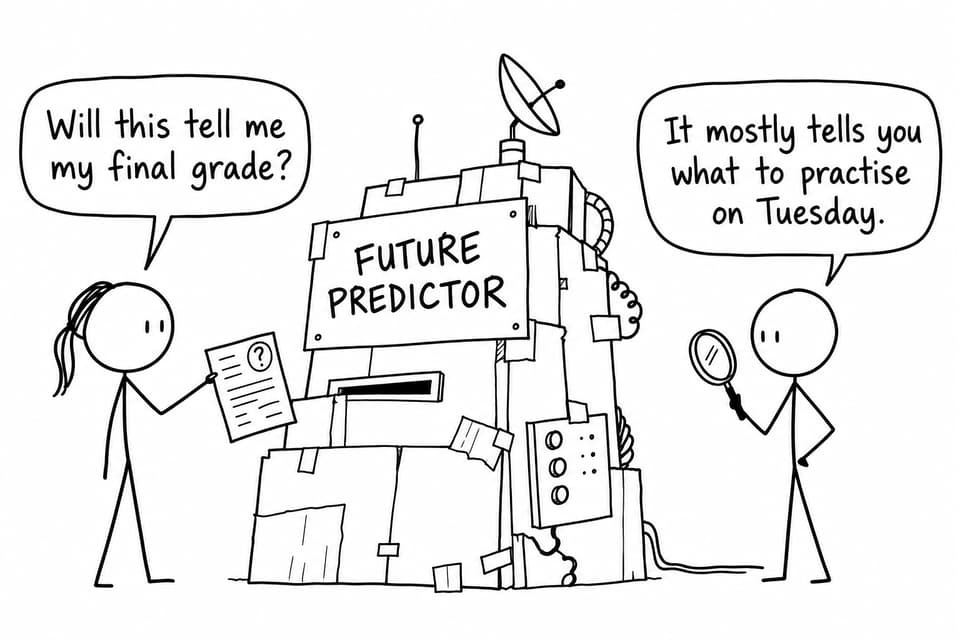
Ask your teacher how the school calculated the reported grade. Grade boundaries can vary by session and subject, so an internal mock conversion is not a guaranteed May 2028 outcome. The IB defines a predicted grade as a teacher's expectation based on evidence of student work and knowledge of IB standards. One mock may contribute evidence, but it is not the entire picture.
Then begin another cycle: correct, practise and retest. AI Chat can explain a stubborn concept, Grading tools can support response analysis, and a Tutor can help when repeated independent attempts are not resolving the issue. RevisionDojo works as the ultimate IB resource because its tools connect diagnosis with the next practical action.
Make the mock smaller and the feedback larger
Mocks May 2028 matter because they create clear evidence while there is still time to use it. A calm plan verifies the syllabus, works backwards from school dates, alternates recall with application and treats correction as seriously as completion.
Your next step is specific: open RevisionDojo's Questionbank, choose your weakest subject topic and complete 10 mixed questions without notes. Record each error as knowledge, application, technique or timing.