


The countdown begins, and something strange happens. A topic you understood perfectly yesterday suddenly feels unfamiliar. The problem is rarely knowledge alone. Exams also test retrieval, pacing, judgment, and the ability to think clearly while a clock quietly removes your options.
So, does RevisionDojo have IB mock exams? Yes. RevisionDojo lets IB students run timed simulations in Exam Mode or generate custom tests by subject, paper, topic, and question count. Online responses can receive immediate, mark-scheme-aligned feedback from Jojo AI, while results can be compared with relevant IB grade boundaries to estimate a grade from 1 to 7.
That distinction matters. A useful mock should not merely produce a score. It should reveal where marks disappear and show you what to do next.
RevisionDojo mock exams at a glance
Here is the practical overview:
- Use RevisionDojo Exam Mode for timed, online exam simulations.
- Use the IB Test Builder to select a subject, paper, topics, and number of questions.
- Complete a generated test online for immediate Jojo AI feedback or download the test and mark scheme for printing.
- Review marks by question and topic instead of focusing only on the total.
- Compare representative scores with the correct historical boundaries using the IB Grade Calculator.
- Repair weaknesses through targeted Questionbank practice, Study Notes, Flashcards, and AI Chat.
- Retest under similar conditions to confirm that the weakness has actually improved.
In short, RevisionDojo supports both full-paper simulation and smaller diagnostic tests. The right choice depends on whether you are training broad exam performance or repairing a specific weakness.
How mock exam generation works
RevisionDojo offers two related routes: Exam Mode and Test Builder. They solve different problems.
Exam Mode builds performance under pressure
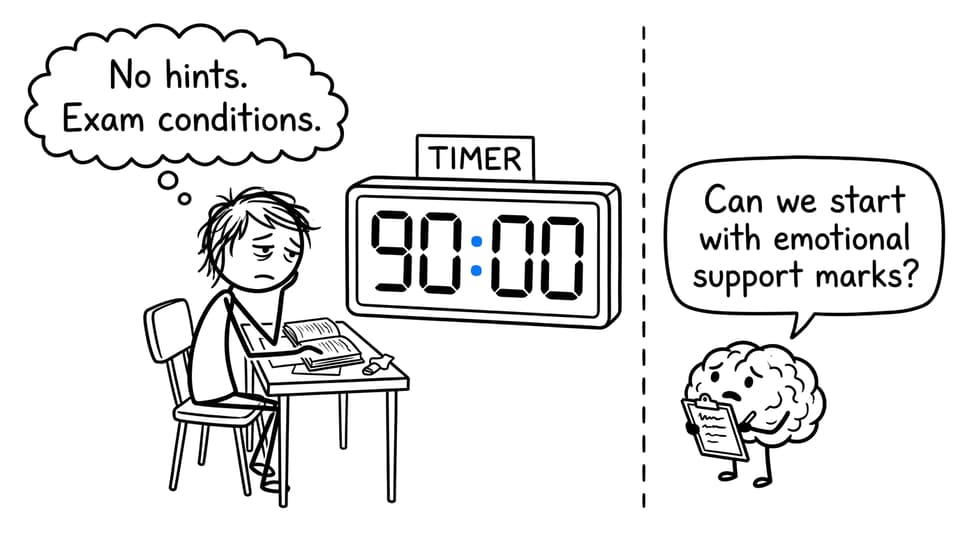
Exam Mode is designed for realistic timed practice. You select the relevant subject and paper, set the appropriate duration, complete the questions without assistance, and submit your work for grading.
The timer is not a decorative feature. Untimed practice can tell you whether you know how to solve a problem. Timed practice reveals whether you can recognize the method, execute it, check it, and move on quickly enough. That is why a student can perform well in the IB Questionbank yet still struggle with a complete paper.
Before beginning, confirm your current course, level, paper structure, permitted materials, and duration with your teacher or the applicable IB subject documentation. Assessment formats can change between syllabus cycles, so a familiar timer from an older paper may not match your examination session.
Test Builder creates targeted IB practice tests
A full mock is sometimes too broad. If your Biology data analysis or Economics evaluation is weak, sitting an entire paper may spend an hour confirming something you already knew.
RevisionDojo's Test Builder lets you choose:
- the IB subject and level available on the platform
- the relevant paper type
- specific topics
- the number of questions
- online or printable delivery
This makes the tool useful for both short diagnostics and longer simulations. You might generate a focused 25-minute test after reviewing one chapter, then create a mixed-topic paper later in the week. The guide to creating custom IB exams explains how topic selection can turn general revision into deliberate practice.
A generated paper can be completed online for fast feedback. Alternatively, it can be printed with its corresponding mark scheme, which is useful when you want to reproduce handwritten conditions or have a teacher supervise the sitting.
How RevisionDojo grades a mock exam
Generation creates the test. Grading creates the lesson.
For online work, Jojo AI evaluates responses in line with the relevant mark scheme and reports where marks were awarded or missed. The Jojo AI study assistant can grade written responses and diagrams, while Exam Mode provides breakdowns by question and topic.
A typical workflow looks like this:
- You submit an answer in Exam Mode or an online custom test.
- Jojo AI compares the response with the mark-scheme requirements.
- The platform assigns marks and explains relevant omissions or errors.
- Results are organized by question and topic.
- You use that evidence to select the next revision task.
This is more useful than seeing only a red cross. Consider a six-mark response that earns three marks. The reason could be missing knowledge, weak structure, an ignored command term, incomplete working, or poor use of evidence. Those problems may produce the same score, but they require different repairs.
AI grading should still be treated as revision feedback rather than an official IB award. Extended responses can involve judgment, and your school remains the appropriate source for formal assessment decisions. Where a result surprises you, compare the explanation with the mark scheme and discuss the response with your teacher or a RevisionDojo Tutor.
How grading maps to IB grade boundaries
Marks and grades are related, but they are not the same thing. Marks show how much credit a response earned against a mark scheme. Grade boundaries convert aggregated, weighted assessment marks into an IB subject grade from 1 to 7.
RevisionDojo's process can therefore be understood in two stages:
| Stage | What happens |
|---|---|
| Marking | Your responses receive raw marks based on the applicable mark scheme. |
| Grade estimation | A representative total is compared with boundaries for the relevant subject, level, session, and variant where available. |
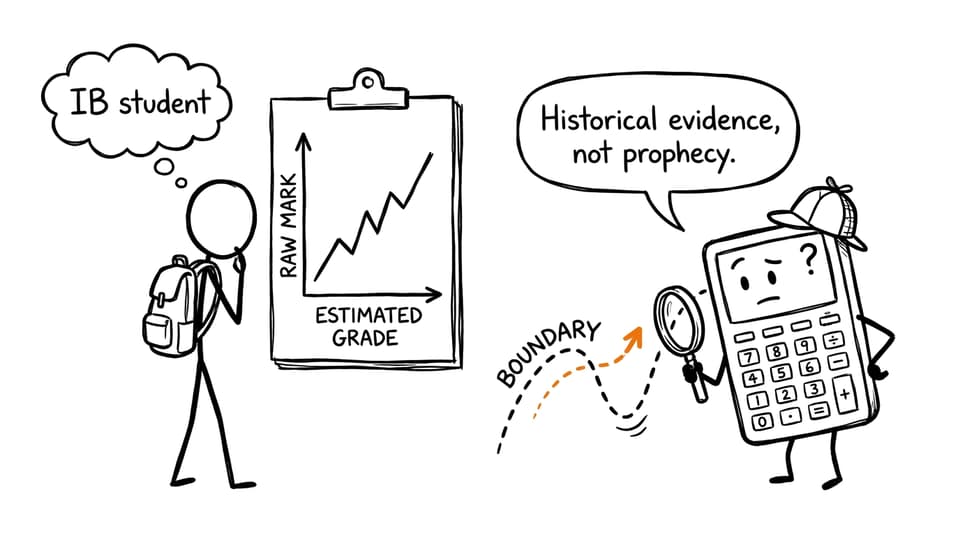
The RevisionDojo grade-boundary database provides boundaries across examination sessions, while the Grade Calculator can turn practice results into an indicative subject grade and diploma estimate.
However, that output is an estimate, not a guaranteed future result. The IB sets final boundaries through a process involving candidate work, grade descriptors, statistical evidence, and examiner judgment. Boundaries may therefore differ by session, subject, level, syllabus, and examination variant.
To make your estimate more meaningful:
- use the correct subject and level
- check that the paper matches your syllabus
- apply the appropriate component weighting
- compare several relevant sessions rather than choosing the easiest boundary
- use scores from timed, independent attempts
- interpret multiple mocks as a range rather than treating one result as destiny
Suppose a mock covers only one examination component. Its percentage should not automatically be treated as your final subject percentage because subjects can combine examination papers and internally assessed work with different weights. The guide to how IB grade boundaries affect scores provides more context on this distinction.
The calmest approach is to aim above the historical boundary range for your target grade. A boundary is a threshold, not a revision target. Building a mark buffer protects you from paper variation, avoidable mistakes, and the fact that future boundaries are unknown before results are awarded.
How to use RevisionDojo IB practice tests effectively
A mock score is a photograph. Improvement comes from what you do after it.
Establish a clean baseline
Choose the correct paper and reproduce the expected conditions as closely as practical. Remove notes, silence notifications, use only permitted materials, and stop when time expires. If your final examination will be handwritten, include handwritten practice rather than doing everything on a keyboard.
Record not only your mark but also where you were when time ran out. An unfinished answer may reflect a pacing problem rather than a content gap.
Classify every meaningful lost mark
Use a simple error log with five categories:
- Knowledge: You did not know or recall the required content.
- Method: You knew the topic but could not execute the process.
- Interpretation: You misunderstood the data, prompt, or context.
- Command term: You answered a different task from the one requested.
- Timing: You rushed, overinvested in one question, or left work incomplete.
This turns a disappointing number into a set of manageable decisions. The broader guide to using IB mock exams effectively develops this diagnostic approach further.
Repair the specific weakness
RevisionDojo works best as a connected system. Use Study Notes when the problem is understanding. Turn fragile definitions or formulas into spaced-repetition Flashcards. Use AI Chat when one step remains unclear. Then move into the Questionbank and filter for the exact topic or question style that cost marks.
Predicted Papers can provide another full-paper rehearsal, while Grading tools and the Coursework Library support criterion-based work outside written examinations. If a recurring problem resists self-study, Tutors can add human explanation and strategy.
Retest instead of merely rereading
Rereading an explanation feels productive because it removes confusion. But recognition is not the same as independent performance.
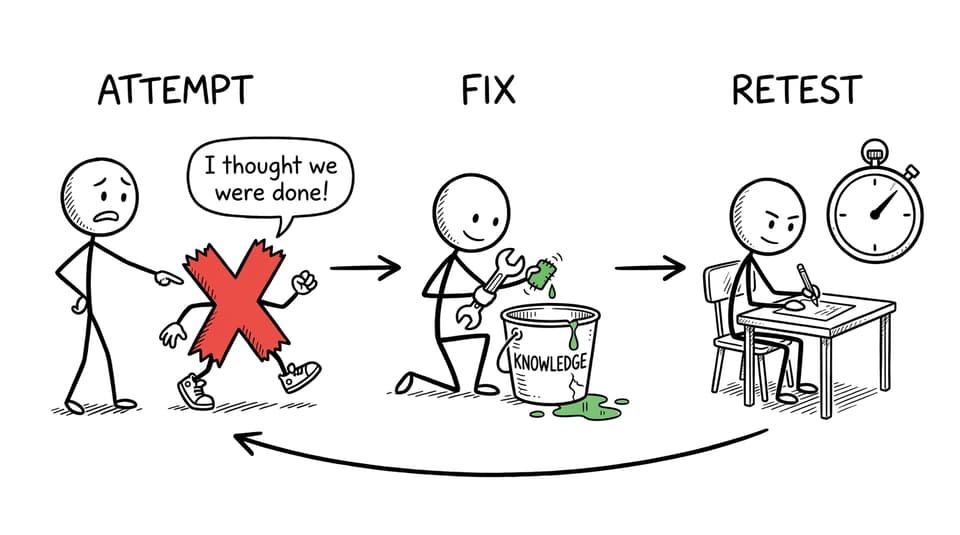
After repairing a weakness, attempt a fresh question without notes. Then test the same skill under time several days later. If accuracy and speed improve, the intervention worked. If not, the weakness needs another cycle.
A practical weekly mock exam routine
Most students do not need a full simulation every day. Full papers create useful evidence, but they also consume time and energy. A balanced week might look like this:
| Session | Purpose |
|---|---|
| One timed paper or substantial section | Test pacing, stamina, and mixed-topic performance. |
| Two targeted Questionbank sessions | Repair the largest sources of lost marks. |
| Short daily Flashcard reviews | Strengthen definitions, formulas, and processes. |
| One custom Test Builder set | Check whether the repaired weaknesses have improved. |
| One review session | Update the error log and choose the next paper-level target. |
As the examination approaches, you can gradually increase realism while reducing support. Early practice may involve short topic-based sets. Later practice should include mixed questions, exact timing, and complete papers where appropriate.
The goal is not to collect mock scores. It is to make each score less surprising than the last.
Turn your next mock into useful evidence
RevisionDojo does have IB mock exams, but the larger value is the feedback loop around them. Exam Mode creates pressure. Test Builder creates precision. Jojo AI provides immediate, mark-scheme-aligned grading. Grade-boundary tools help translate representative marks into a cautious estimate. The Questionbank, Study Notes, Flashcards, AI Chat, Predicted Papers, Grading tools, Coursework Library, and Tutors help you act on what the mock reveals.
Begin with one paper, not your entire diploma. Sit it honestly. Review every lost mark without drama. Then build a smaller test around the weaknesses that matter most.
That is how mock exams become more than rehearsal. They become a map.