


The final week before IB exams should not look like seven consecutive all-nighters. It should look controlled: a small number of timed tasks, targeted repair, active recall, reliable sleep, and enough empty space to arrive at each examination able to think.
That matters especially for November-session students. The official November 2026 IB examination schedule runs from 23 October to 13 November, although your personal timetable depends on your subjects, level, school, and exam zone. Confirm every reporting time with your coordinator rather than relying only on a calendar found online.
If your school calls September-to-November the fall term, the last stretch can feel abrupt. Coursework, classes, and revision seem to overlap until suddenly the examinations are real. The solution is not to do everything. It is to decide what still deserves your attention.
The final-week checklist
A realistic final week before exams includes:
- Your confirmed timetable, exam zone, reporting times, and transport plan
- One final full rehearsal for a priority paper, completed early in the week
- Short, targeted practice based on an existing error log
- Daily closed-book recall for formulas, definitions, evidence, quotations, or processes
- A fixed stopping time each evening
- Familiar meals, hydration, movement, and consistent sleep
- Equipment packed at least one day early
- No unnecessary new resources or elaborate revision systems
RevisionDojo’s November 2026 exam schedule and study plan can help you map the full session. Then reduce it to the only schedule that matters now: your own.
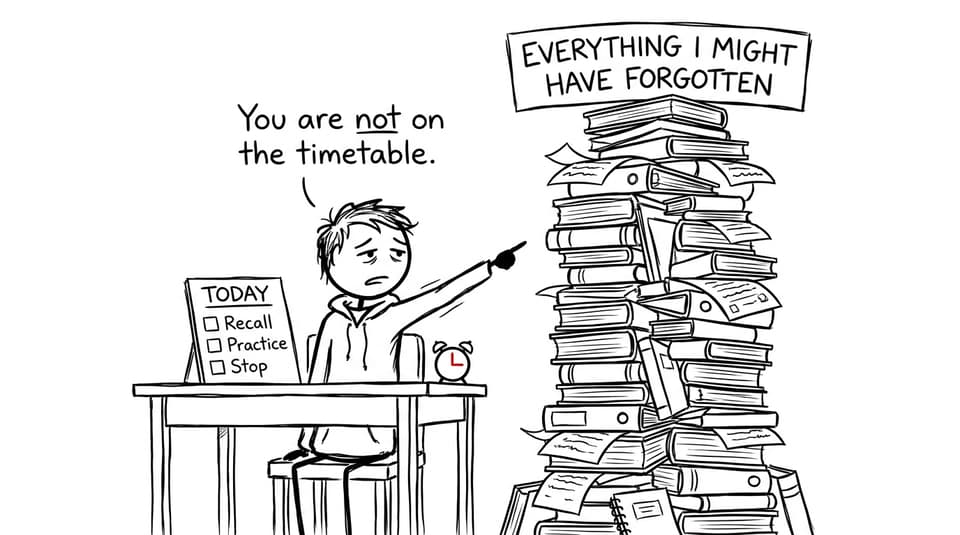
Think in rolling seven-day windows
The November session spans several weeks. That means there is no single universal final week.
You have a rolling seven-day window before each paper. A Biology examination near the beginning of the session may deserve priority while Mathematics remains in maintenance mode. Once Biology is complete, the balance changes. Your revision plan should move with the timetable rather than treating all six subjects equally every day.
Start by marking three kinds of dates:
- Paper dates: every individual paper, not merely each subject
- Pressure blocks: consecutive examination days, double sessions, or demanding writing days
- Recovery gaps: periods in which you can rest, review, and redirect attention
The guide to planning final IB revision with the official timetable explains how to identify these blocks. Students facing dense combinations can also use the November hardest exam days survival plan to rehearse the sequence rather than each paper in isolation.
A realistic seven-day plan
This template assumes that your first examination is on Day 0. Adjust the subjects and workload around school attendance, health, access arrangements, and the papers that follow.
| Day | Main job | Sensible workload |
|---|---|---|
| Day -7 | Final substantial rehearsal | One timed paper or extended section, followed by honest marking |
| Day -6 | Diagnose and repair | Review errors, revisit 2-3 weak areas, then reattempt selected questions |
| Day -5 | Practise the next priority | One timed section plus a short recall session for another subject |
| Day -4 | Tighten technique | Work on command terms, essay structure, calculator use, units, or pacing |
| Day -3 | Reduce volume | Use mixed questions, flashcards, and your error log; confirm logistics |
| Day -2 | Build confidence | Complete a short closed-book set and review only the mistakes that recur |
| Day -1 | Stabilize | Light recall, equipment check, familiar routine, and an early finish |
| Day 0 | Execute | Brief warm-up if useful, then follow the plan you have rehearsed |
A normal study day might contain 2-4 focused blocks of 40-60 minutes, separated by proper breaks. A student still attending classes may need fewer. More time is not automatically better when fatigue makes marking careless and recall unreliable.
The useful unit is not an hour. It is a completed loop: attempt, mark, diagnose, repair, and retest. The realistic IB exam revision timetable provides a broader framework for building that loop before the final week arrives.
Shift from coverage to evidence
Earlier in the September-to-November window, broad content review makes sense. In the final week, your own performance should determine the agenda.
Do not write “revise Chemistry” on your plan. Write “correct equilibrium explanations,” “retest organic pathways,” or “complete a timed calculation set without notes.” Specific tasks have a finish line. Vague tasks expand until they consume the evening.
This is where RevisionDojo becomes especially useful. Use IB Study Notes, Flashcards, and Questionbank resources as a connected sequence:
- Open Study Notes only for the precise concept exposed by practice.
- Use AI Chat when one explanation or method remains unclear.
- Complete a small Questionbank set without support.
- Check the response with Grading tools where appropriate.
- Turn recurring misses into Flashcards or short error rules.
Use Predicted Papers and Mock Exams for realistic timing early in the week, not as nightly endurance tests. If one stubborn weakness could materially affect several questions, a focused session with a Tutor may be more valuable than hours of unguided rereading. The Coursework Library should usually stay closed now because final-week attention belongs to examinations, assuming required coursework has already been submitted.
You can review the platform’s IB study features and exam tools before the final stretch, then choose only the tools that solve an identified problem.
Protect the evening before an examination
The evening before a paper is not your final chance to become a different student. It is your chance to avoid interfering with the preparation you have already completed.
Set a stopping time. Pack permitted equipment, identification, water, and anything your school has instructed you to bring. Check transport and alarms. Review one compact page of formulas, prompts, or error rules if that settles you, but do not open an untouched unit at 10 p.m.
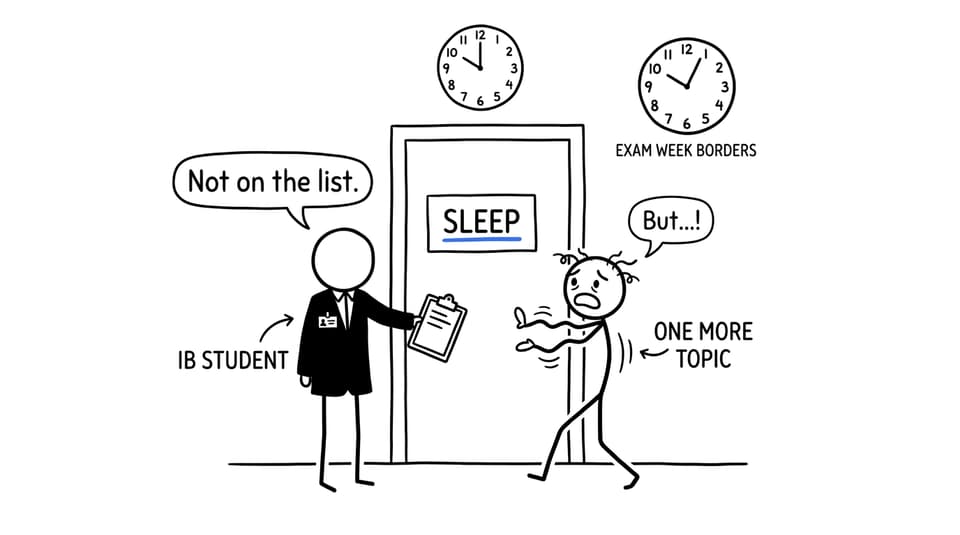
Sleep is not time stolen from revision. It supports attention and memory, while exhaustion makes familiar questions feel unfamiliar. Keep bedtime and wake time close to the routine required by your actual examination session.
If anxiety makes stopping difficult, write tomorrow’s first action on paper. A clear next step gives the mind somewhere to put unfinished thoughts.
Handle the hours between papers carefully
After an examination, avoid conducting a long public investigation into every answer. You cannot recover marks from a completed paper, but you can lose focus for the next one.
Take a brief reset. Eat, drink, walk, and let the adrenaline settle. If you have another paper that day, use only a compact recall resource. Flashcards, formula triggers, essay plans, or a short vocabulary list are more suitable than a full simulation.
For examinations on later days, spend one short block identifying the next priority, then return to the rolling plan. RevisionDojo’s countdown guide to effective IB studying offers a simple structure for keeping these sessions focused.
What not to do in the final week
Avoid the behaviours that create the feeling of work without improving execution:
- Rewriting an entire notebook
- Downloading several new study systems
- Completing full simulations late every night
- Comparing daily hours with friends
- Giving equal time to every subject regardless of exam order
- Studying an obscure topic while ignoring a repeated high-value error
- Sacrificing sleep to protect an unrealistic plan
A plan should be revised when reality changes. If you are unwell, severely sleep-deprived, or unable to function normally, reduce the load and speak to a parent, teacher, coordinator, or appropriate health professional. Discipline includes knowing when the original schedule no longer makes sense.
Finish with a smaller plan
A realistic final week before exams looks almost ordinary from the outside. The work is narrower. The evenings are quieter. Each task has a reason.
That restraint is not a lack of ambition. It is what happens when preparation stops being about covering everything and starts being about performing what you know.
RevisionDojo can be the single home base for that shift. Its Questionbank, Study Notes, Flashcards, AI Chat, Grading tools, Predicted Papers, Mock Exams, Coursework Library, and Tutors reduce the need to search across disconnected resources. Use the month-by-month IB revision plan throughout the fall term, then let the final week become what it should be: a calm rehearsal for work already done.