
Choosing a Mathematics Extended Essay topic can feel harder than doing the mathematics. A broad field is exciting because everything seems possible. It is also dangerous for exactly the same reason.
The best math EE ideas are not necessarily the most advanced. They give you a focused mathematical object to investigate, a method you can explain, and enough room to analyse results rather than report them. Under the Extended Essay model first assessed in May 2027, that focus matters from the research question through to the final evaluation.
Below are 15 starting points, examples of stronger questions, and a practical method for testing whether an idea is workable. Treat each question as a model to adapt, not a title to copy.
A quick Math EE topic checklist
Before committing to an idea, ask whether you can answer yes to most of these questions:
- Is there a specific model, theorem, algorithm, object, or relationship to investigate?
- Does the question require analysis rather than textbook explanation?
- Can I understand and communicate the central mathematics?
- Is the scope realistic for an essay of up to 4,000 words?
- Can I access credible secondary literature?
- Can I evaluate assumptions, limitations, or alternative methods?
- Does mathematics remain central if the context comes from another subject?
- Am I interested enough to refine the work over several months?
The official mathematics guidance for the Extended Essay first assessed in 2027 describes theoretical, practical, and statistical approaches. It also makes secondary research mandatory, including a review of relevant literature. A Math EE is therefore more than an extended calculation or large data project.
What the new Extended Essay model rewards
The revised model applies from first assessment in May 2027. According to the IB's official Extended Essay update, assessment covers five areas: framework for the essay, knowledge and understanding, analysis and line of argument, discussion and evaluation, and reflection.
For mathematics, those areas create several practical priorities:
- State a focused research question and keep returning to it.
- Explain the mathematics instead of hiding behind software output.
- Build a logical argument from definitions, methods, and results.
- Discuss what the findings mean.
- Evaluate assumptions and limitations honestly.
- Reflect on how your choices changed as your understanding developed.
You are not expected to discover a new theorem. A strong essay can compare established methods, explain mathematics that is new to you, or apply familiar ideas to an unfamiliar situation. RevisionDojo's complete Mathematics Extended Essay guide explains how these elements fit together.
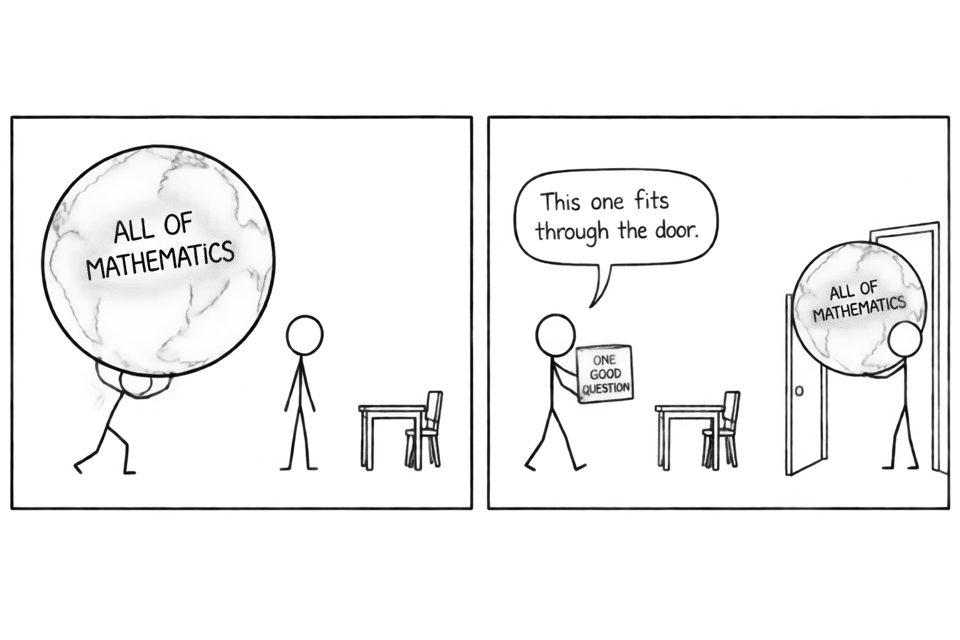
An ambitious subject becomes manageable when the question fits the essay.
Pure mathematics EE ideas
Pure mathematics suits students who enjoy definitions, proofs, patterns, and abstract structures. The challenge is creating an investigation rather than summarizing established theory.
Fibonacci numbers and modular patterns
Possible question: To what extent can Pisano periods for selected moduli be predicted from the prime factorization of the modulus?
Define Fibonacci sequences modulo , calculate periods, and compare selected prime and composite cases. Limiting the moduli keeps the investigation manageable.
Continued fractions and approximation
Possible question: How does the continued-fraction expansion of selected irrational numbers affect the accuracy of their rational approximations?
Derive convergents and compare errors such as
Choose a small group of irrational numbers with meaningfully different structures.
Fractal dimensions
Possible question: How accurately does box-counting estimate the dimensions of the Koch curve and Sierpiński triangle at finite iterations?
Compare theoretical dimensions with estimates obtained using different box sizes. Evaluation can explain why finite approximations depart from limiting values.
Graph colouring
Possible question: How do greedy colouring algorithms compare when applied to interval graphs under different vertex orderings?
Define the graph class, make the algorithms transparent, and compare the number of colours used. Avoid surveying every available colouring method.
Complex numbers and transformations
Possible question: How can Möbius transformations be used to map selected lines and circles in the complex plane?
Combine algebraic derivation with geometric interpretation. Explain why the transformations behave as they do rather than presenting a gallery of generated images.
Students interested in proof-heavy work can explore additional Math AA EE topics worth researching.
Applied mathematics EE ideas
An applied topic begins with a real situation but must remain a mathematics essay. The context supplies the problem. Mathematics supplies the argument.
Projectile motion with drag
Possible question: How does incorporating linear air resistance change the launch angle that maximizes projectile range under fixed initial conditions?
Compare the elementary no-drag model with a differential-equation model. State assumptions, control parameters, and explain any numerical method used.
Shortest-path algorithms
Possible question: How do Dijkstra's and A* algorithms compare on simplified grid networks as obstacle density changes?
Define efficiency through visited nodes, path length, computational steps, or another justified measure. Simulations may support the argument, but they cannot replace an explanation of the algorithms.
Queueing models
Possible question: To what extent can an queue model waiting times at a selected school service point?
Use ethical, manageable data collection and examine whether the arrival and service assumptions hold. Differences between the model and reality provide material for evaluation.
Music and Fourier analysis
Possible question: How effectively can truncated Fourier series represent the waveforms of three sustained musical notes?
Compare approximation error as the number of terms changes. Keep the focus on Fourier methods rather than the history or psychology of music.
Optimizing packaging
Possible question: Which dimensions minimize the material required for a closed cylindrical container of fixed volume when seam allowances are included?
A realistic constraint makes the familiar surface-area problem more interesting. Derive the objective function, justify constraints, and test sensitivity to assumptions.
Statistics and modelling EE ideas
Statistics creates a common trap: collecting a large dataset and treating the graphs as an investigation. A strong statistical essay justifies model choice, tests assumptions, and interprets uncertainty.
Elo ratings and prediction
Possible question: How does changing the Elo -factor affect predictive accuracy in a defined set of chess results?
Limit the dataset and define accuracy before testing, perhaps through log loss, classification accuracy, or another suitable measure.
Population growth models
Possible question: Which model, logistic or Gompertz, better represents a defined population dataset over a fixed period?
Fit both models, compare residuals and error measures, and discuss why a better numerical fit may not provide a better explanation.
Markov chains and board games
Possible question: How accurately can an absorbing Markov chain estimate the expected duration of a simplified board game?
A limited state space lets you explain transition matrices and expected values without being buried by hundreds of states.
Sports ranking systems
Possible question: How sensitive are team rankings to the damping factor in a PageRank-based model of one defined competition?
This introduces matrices, eigenvectors, and sensitivity analysis. Use a compact competition and justify what each directed edge represents.
Regression under outliers
Possible question: How does the presence of controlled outliers affect ordinary least-squares and least-absolute-deviation regression?
Generate transparent datasets, vary the number or position of outliers, and compare parameter error. This establishes what changes and how it will be measured.
For further data-centered possibilities, consider these Math AI EE topics worth researching.
Strong versus weak EE research questions
A topic names a territory. A research question defines the journey through it.
| Weak question | Stronger direction | Why it is stronger |
|---|---|---|
| How is calculus used in architecture? | How does a catenary model compare with a parabolic model for one specified arch profile? | It identifies models, an object, and a comparison. |
| What is the Fibonacci sequence? | How do Pisano periods vary for a defined set of prime and composite moduli? | It moves from explanation to investigation. |
| Can mathematics predict football? | How does a Poisson model perform when estimating score frequencies in one defined league and season? | It limits the data and establishes a testable model. |
| What is the best encryption method? | How does key length affect the computational workload of a specified elementary encryption algorithm? | It replaces an undefined superlative with measurable variables. |
| How are fractals found in nature? | How sensitive is a box-counting estimate of one coastline's dimension to map scale? | It makes the method and limitation visible. |
A useful starting formula is:
How or to what extent does [method or variable] affect, explain, approximate, or compare [specific mathematical object] under [defined conditions]?
Use these research question planning tips to sharpen the wording. Expect it to change after preliminary reading. The guide to revising an Extended Essay research question can help you decide when refinement is necessary.
How to test an idea before committing
Spend one week trying to disprove the suitability of your favourite idea.
First, find 3-5 credible secondary sources. Look for textbooks, scholarly articles, university resources, or authoritative references explaining the mathematics you plan to use. Start with RevisionDojo's guide to finding reliable Extended Essay sources.
Next, complete one sample calculation or derivation. If software produces the answer, check whether you can explain what it is doing mathematically. Then sketch a possible argument from definitions to findings and evaluation.
Finally, show the question and method to your supervisor. Ask whether the mathematics is substantial, comprehensible, and appropriately scoped. Review these Extended Essay mistakes to avoid before investing months in the project.
RevisionDojo can support the process without doing the thinking for you. The Coursework Library demonstrates effective academic structures, while Study Notes and Flashcards can close gaps in prerequisite knowledge. Questionbank, Grading tools, Predicted Papers, Mock Exams, AI Chat, and Tutors help protect your wider subject revision time while the essay develops.
Keep 2-3 research question drafts and record what changed. You can ask Jojo AI to challenge the scope, identify undefined terms, or suggest questions for your supervisor. It should not choose the topic or write the argument. Its value lies in showing where your plan remains vague.
The aim is not to begin with a perfect question. It is to begin with one precise enough to test, then become more exact as your mathematical understanding grows.