
The lytic cycle is a viral replication pathway in which a virus enters a host cell, uses the host’s resources to produce viral nucleic acid and proteins, assembles new virions, and causes the cell to lyse, releasing them. In IB Biology HL, you should explain this process using bacteriophage lambda and E. coli.
The definition is short. The difficulty comes from explaining the sequence precisely without confusing attachment with entry, replication with assembly, or the lytic pathway with the lysogenic pathway.
This guide turns that sequence into an exam-ready story.
What IB Biology students need to know
The current IB DP Biology syllabus places viruses in A2.3 Viruses, an HL-only topic. For A2.3.3, students should understand the phases of viral replication and use bacteriophage lambda as the example.
Your revision checklist is:
- Define the cycle in terms of viral replication and host-cell lysis.
- Recall the sequence: attachment, entry, biosynthesis, assembly, and release.
- Explain why viruses depend on host cells.
- Apply the sequence to bacteriophage lambda infecting E. coli.
- Distinguish the lytic and lysogenic pathways.
- Use precise biological vocabulary in extended answers.
Start with the RevisionDojo A2.3 Viruses study hub, which connects Study Notes, questions, flashcards, lessons, and videos for this syllabus section. If the underlying characteristics of viruses feel uncertain, review the structural features common to viruses before learning the cycle.
The lytic cycle step by step
Imagine the host cell not as a willing partner but as a factory whose production instructions have been replaced. The virus brings genetic information, but it depends on the host for resources and molecular machinery.
Attachment to a specific host cell
Bacteriophage lambda attaches to receptors on the surface of an E. coli cell. This attachment is specific because viral attachment proteins interact with compatible molecules on the host surface.
That specificity matters. A virus cannot necessarily infect every cell it encounters. In an exam answer, write that the phage attaches to a specific receptor, rather than simply saying it “lands on the bacterium.”
Entry of viral DNA
The phage introduces its DNA into the bacterial cytoplasm. The protein capsid remains outside the host cell.
This is a frequent source of lost marks: do not claim that the whole bacteriophage enters the bacterium. With the bacteriophage example, the key event is the entry or injection of viral genetic material.
Biosynthesis of viral components
The viral DNA redirects the host cell’s activity. Viral DNA is replicated, while viral genes are expressed to produce proteins such as capsid components and enzymes.
Viruses rely on the host for energy, raw materials, ribosomes, and other cellular processes. The host therefore produces multiple copies of viral nucleic acid and viral proteins instead of continuing only its normal cellular activity.
Assembly of new virions
Newly produced components are assembled into complete virus particles called virions. DNA is packaged into phage heads, and the remaining structural components are joined together.
Replication and assembly are not synonyms. Replication produces copies of genetic material; protein synthesis produces viral polypeptides; assembly combines these materials into complete particles.
Lysis and release
Viral proteins damage the bacterial cell envelope. The host cell lyses, releasing newly assembled bacteriophages, which may infect other susceptible cells.
Lysis is not merely the virus “leaving.” It is the rupture and destruction of the host cell. That consequence gives the pathway its name.
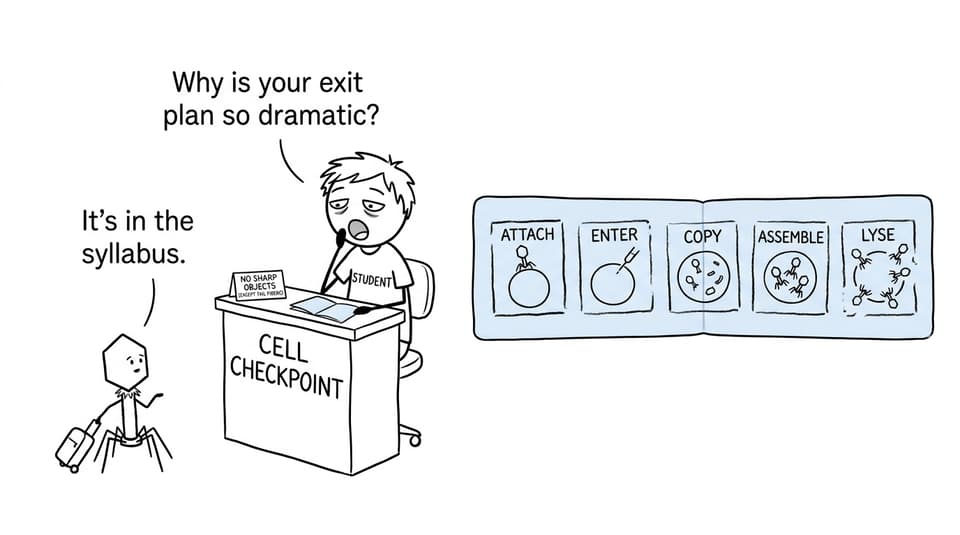
A useful recall chain is attach, enter, copy, assemble, lyse. Once you remember the order, expand each verb with the correct biological detail.
For a visual explanation alongside these notes, use the RevisionDojo A2.3 Viruses video lessons.
Lytic versus lysogenic infection
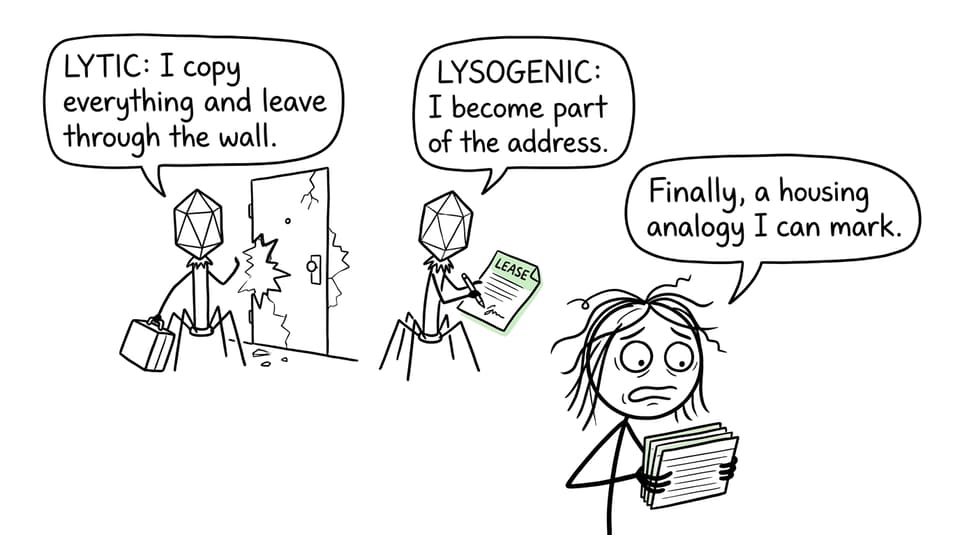
Bacteriophage lambda is especially useful because it can follow either pathway. The decisive distinction concerns what happens to viral DNA and whether new virions are produced immediately.
| Feature | Lytic pathway | Lysogenic pathway |
|---|---|---|
| Viral DNA | Remains separate while being replicated | Integrates into the host chromosome as a prophage |
| Virion production | Occurs during the active infection | Delayed while prophage genes remain largely inactive |
| Host cell | Lysed to release virions | Initially remains alive and divides |
| Viral inheritance | New particles infect other cells | Prophage is copied with host DNA and inherited by daughter cells |
| Later change | Ends with release | Can be induced to enter active replication |
The lysogenic pathway is not permanent dormancy. Following induction, prophage DNA can leave the bacterial chromosome and proceed toward active viral production and lysis. RevisionDojo’s lysogenic cycle notes help you practise this comparison directly.
How the topic appears in IB exam questions
Questions may ask you to outline, describe, explain, or compare. These command terms require different levels of development.
- Outline: give a brief sequence containing the main events.
- Describe: state what happens at each relevant stage.
- Explain: connect events through causes, mechanisms, or consequences.
- Compare and contrast: identify explicit similarities and differences.
A process question rewards ordered biological statements. Writing everything you remember about viruses is less effective than following the cycle from attachment to release.
Worked exam-style example
Question: Explain the replication of bacteriophage lambda through the lytic pathway. [5]
Model response:
Bacteriophage lambda attaches to a specific receptor on an E. coli cell. Viral DNA enters the bacterial cytoplasm while the capsid remains outside. The viral DNA redirects host-cell processes so that viral DNA and proteins are produced. These components assemble into complete virions. Viral proteins damage the bacterial cell envelope, causing lysis and releasing new bacteriophages.
Why is this effective? It identifies the organism, preserves the correct order, separates biosynthesis from assembly, and connects lysis with release. It also avoids unnecessary details that might introduce errors.
After learning the sequence, test it through the A2.3 Viruses Questionbank. RevisionDojo’s Questionbank and grading tools make the most useful feedback loop possible: answer, inspect the missing detail, rewrite, and retest.
Common mistakes and misconceptions
Saying viruses reproduce independently
Viruses lack the cellular machinery needed for independent reproduction. State that they depend on a host cell for functions including energy supply and protein synthesis.
Putting the entire phage inside the bacterium
For the bacteriophage example, viral DNA enters while the capsid stays outside. Drawings should show this distinction clearly.
Combining replication and assembly
First, viral nucleic acid and proteins are produced. Then those components are assembled into virions. Keep these stages separate in both diagrams and prose.
Claiming viral DNA always integrates
Integration into the host chromosome characterizes the lysogenic pathway. During active lytic replication, viral DNA is used to produce new viral material without first becoming a prophage.
Ending the answer at assembly
An assembled virion still needs to leave the cell. Complete the account with damage to the bacterial cell envelope, lysis, and release.
Using vague verbs
Words such as “takes over” can help you remember the idea, but they need biological support. Explain what that means: viral genes are expressed, viral DNA is copied, viral proteins are synthesized, and new particles are assembled.
Quick-reference revision table
| Stage | What happens | High-value wording |
|---|---|---|
| Attachment | Phage binds to the bacterial surface | Specific host-cell receptor |
| Entry | Viral DNA enters the cytoplasm | Capsid remains outside |
| Biosynthesis | Viral DNA and proteins are produced | Host resources and machinery |
| Assembly | Components form complete particles | Mature virions |
| Release | Cell envelope is damaged and the cell bursts | Lysis releases bacteriophages |
Do not only reread this table. Cover the middle column and reconstruct it aloud, then draw the sequence from memory. Use IB Biology Flashcards for active recall and the broader IB Biology topic-by-topic revision guide to build a repeatable learn-test-correct routine.
Turn knowledge into marks
A process becomes manageable when every stage has a distinct job. Attachment establishes specificity. Entry delivers information. Biosynthesis produces components. Assembly creates virions. Lysis releases them.
RevisionDojo brings that progression into one revision system: Study Notes and videos build understanding; Flashcards strengthen recall; the Questionbank and AI Chat expose weak explanations; grading tools improve written answers; and Predicted Papers and Mock Exams develop timing. The Coursework Library and Tutors are there when broader Biology support is needed.
Your next step is simple: close the guide, draw the five stages, and explain each one without looking. Then use RevisionDojo’s Biology Predicted Papers to practise carrying accurate knowledge into exam conditions.