
For M28 students: IB exams in May 2028, started DP1 in August 2026.
Yes, feeling lost in IB economics by week three is normal. It does not mean you chose the wrong subject or lack the ability to succeed.
Economics introduces a new language, unfamiliar diagrams, abstract models, and a particular style of written explanation almost simultaneously. You may understand each word in isolation yet struggle to connect them when your teacher asks why a demand curve shifts or how scarcity leads to choice.
That gap can feel larger than it is. Usually, you do not need to relearn the entire course. You need to locate one or two missing foundations, repair them deliberately, and practise turning ideas into short chains of reasoning.
A quick diagnosis before you start
Ask yourself which statement sounds most familiar:
- I recognise definitions but cannot explain them without my notes.
- I understand a diagram when the teacher draws it, but cannot recreate it.
- I confuse a movement along a curve with a shift of the curve.
- I know the answer mentally, but my written explanation becomes vague.
- I follow individual lessons but cannot see how the topics connect.
- I understand theory but cannot apply it to a real situation.
Each problem requires a slightly different response. “Study harder” is too vague. A useful catch-up plan begins by identifying what is actually broken.
Why early IB Economics confusion is common
The opening weeks can appear simple. Scarcity, choice, and opportunity cost sound like ordinary words. Demand and supply may look like two lines crossing on a graph.
But those apparently simple ideas carry much of the course. The current IB Economics framework uses concepts including scarcity, choice, efficiency, equity, sustainability, change, interdependence, intervention, and economic well-being. These concepts later connect microeconomics, macroeconomics, and the global economy.
The difficulty is not merely remembering what scarcity means. It is learning to reason from it:
Limited resources create scarcity, scarcity requires choices, and choices involve opportunity costs.
That is an economic chain. If one link remains uncertain, later explanations become unstable.
IB Economics also asks you to move between four forms of understanding:
| Form | What you need to do |
|---|---|
| Definition | State a concept precisely |
| Diagram | Represent the relationship correctly |
| Explanation | Show a logical chain of cause and effect |
| Application | Connect the model to a specific situation |
A student can be strong in one form and weak in another. That is why rereading a textbook sometimes creates familiarity without creating confidence.
The foundation gaps that usually cause the problem
Economic vocabulary is still approximate
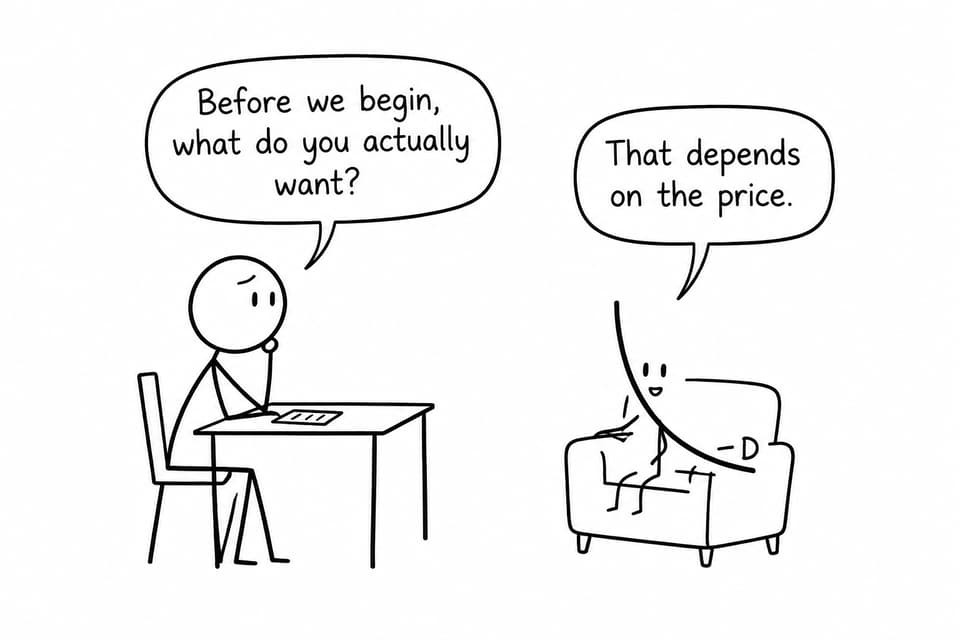
Words such as demand, supply, scarcity, shortage, and quantity demanded have precise meanings. In normal conversation, people may use “demand” to mean popularity. In economics, demand describes consumers’ willingness and ability to purchase a good or service at different prices over a given period.
Approximate definitions create approximate explanations. Build a small active vocabulary list rather than copying an entire chapter. The IB Economics glossary is useful when you need to check whether your wording is precise.
Cause and effect are being memorised, not understood
You may remember that higher income can increase demand for a normal good. The deeper question is why.
A strong explanation makes every step visible: consumer income rises, purchasing power increases, consumers become willing and able to buy more at each price, and the demand curve shifts right. Writing the arrows between ideas exposes missing logic.
Diagram rules have not become automatic
Students who do not understand IB Economics often treat diagrams as illustrations added after the explanation. They are actually part of the reasoning.
For every basic market diagram, practise:
- labelling both axes;
- naming each curve;
- distinguishing the original and new curve;
- marking the original and new equilibrium;
- showing the direction of change;
- explaining what caused the change.
Start with the IB Economics guide to supply and demand, then check the common demand and supply mistakes. A shift and a movement along a curve are not interchangeable.
You are trying to evaluate before you can explain
Evaluation matters, but it rests on accurate theory. If you are still learning equilibrium, immediately asking whether a government intervention is effective may create unnecessary cognitive overload.
Use this order:
- Define the concept.
- Draw the model.
- Explain the mechanism.
- Apply it to a context.
- Consider limitations, stakeholders, or alternative outcomes.
You are not avoiding sophistication. You are building toward it in the right sequence.
A three-week catch-up routine for DP1
This plan requires about 30-40 focused minutes on five days each week. Your classroom work continues alongside it.
Week one: rebuild the language
Focus on scarcity, choice, opportunity cost, the factors of production, positive and normative statements, and the basic meaning of demand and supply.
Each day:
- read one focused section from the IB Economics Study Notes;
- close the notes and write three definitions from memory;
- explain one relationship aloud without looking;
- create five Flashcards for terms you could not recall precisely;
- finish by writing one unanswered question.
Do not copy pages of notes. Retrieval is more revealing than transcription. If your explanation breaks down, use Jojo AI as an IB study assistant to ask about that exact missing link, then explain it again in your own words.
Week two: make diagrams routine
Focus on demand, supply, shifts, movements along curves, shortages, surpluses, and competitive market equilibrium.
Draw one diagram from memory each day. Then annotate it with a short causal chain. For example:
Production costs rise → supply decreases → the supply curve shifts left → equilibrium price rises and equilibrium quantity falls.
Use the market equilibrium explanation to check the adjustment process. Redraw incorrect diagrams immediately. The correction matters more than producing a perfect first attempt.
Week three: turn knowledge into answers
Now combine definitions, diagrams, and explanations. Complete a small set of targeted questions from the IB Economics Questionbank, rather than jumping into a full timed assessment.
For every response, check three things:
- Did I answer the command term?
- Did I show each causal link?
- Does my diagram match my written explanation?
RevisionDojo’s Grading tools can help identify where an answer becomes unclear. The goal is not to collect a score in week three of DP1. It is to learn what a complete economics answer looks like.
What not to worry about yet
If you are an IB Economics DP1 student struggling in the opening weeks, you do not need to master the entire assessment system immediately. Predicted Papers and Mock Exams become more valuable after you have covered enough content to use them meaningfully. The Coursework Library and Tutors can support later coursework and persistent misunderstandings, but they should not replace daily retrieval and diagram practice.
You also do not need to compare your speed with classmates who studied economics before the IB. Early familiarity is not the same as durable understanding. A student who learns to define, diagram, explain, and apply carefully is building a method that can carry through the course.
When to ask for additional help
Speak to your teacher sooner rather than later if you cannot identify what the current lesson is about, cannot complete basic class tasks even with notes, or remain confused after following the catch-up routine for several sessions.
Bring a specific question. “I do not understand economics” is difficult to solve. “I understand a fall in quantity demanded, but I cannot tell when the entire demand curve should shift” gives your teacher something concrete to diagnose.
Feeling lost is information, not a verdict. It tells you that the connections have not formed yet. Your next step is specific: open the RevisionDojo IB Economics Study Notes, read the section on scarcity, choice, and opportunity cost, then close it and write the full causal chain from memory.