



The lesson the IB teaches first: pressure reveals your system
The first time it hits, it feels personal.
You sit down to revise for the IB and realize the problem is not "content." It's the shape of your days. Six subjects. Different paper styles. Coursework deadlines. The quiet guilt of not doing enough. And then the strange truth: plenty of students work hard and still don't improve.
That's when the IB teaches its first lesson that school rarely says out loud: results come from systems, not intentions.
School often rewards being present, completing tasks, and sounding confident. The IB rewards something colder and kinder: evidence. Evidence that you can retrieve knowledge on demand. Evidence that you can write to a rubric. Evidence that you can perform under timed conditions.
This post is a map of the lessons the IB teaches that most classrooms never name clearly, and how to practice those lessons deliberately before exams.
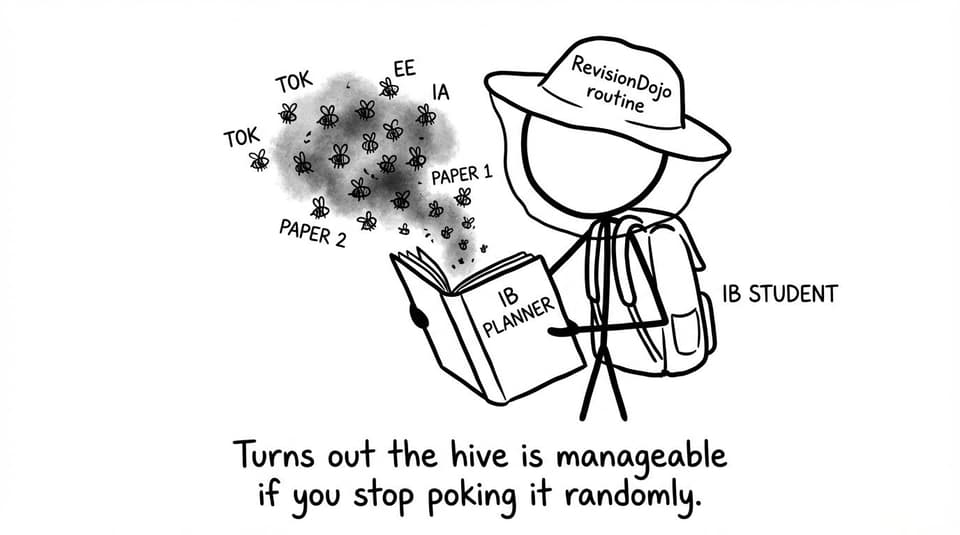
Quick checklist: the hidden IB skills to train (not just "revise")
If you want a fast overview before the deeper stories, here are the lessons the IB quietly teaches:
- Build a feedback loop (practice, mark, fix, repeat)
- Decode command terms like a translator
- Think in criteria, not vibes
- Use time as a budget (minutes per mark)
- Learn to be wrong without collapsing
- Separate "understanding" from "performance"
- Turn stress into a routine, not a mood
RevisionDojo is built around those skills, with Study Notes, Flashcards, a Questionbank, AI Chat, Grading tools, Predicted Papers, Mock Exams, a Coursework Library, and Tutors that make the loop faster and clearer.
To see the full IB ecosystem in one place, start here: International Baccalaureate (IB) hub and the RevisionDojo IB landing page.
The IB teaches you that confidence is built by feedback, not hype
Most students try to feel confident before they practice.
The IB flips that. It makes confidence a byproduct. When you answer 20 questions, mark them, understand the patterns in your mistakes, and return two days later to do it again, your brain stops guessing. It has receipts.
That's why high scorers use a feedback loop:
- Clarify one concept quickly
- Apply it immediately
- Get mark-scheme-aligned feedback
- Log the error pattern
- Retest under time
On RevisionDojo, this is the default workflow: use Study Notes when you're stuck, then immediately switch into the Questionbank for exam-style practice. If you want a clear process, borrow the structure from How to Study for IB Exams: Step-by-Step Guide.
And if you need an early push into realistic practice, Countdown to IB Exams: A Guide to Effective Studying is a steady timeline you can copy.
The IB teaches you that "studying" and "training" are different sports
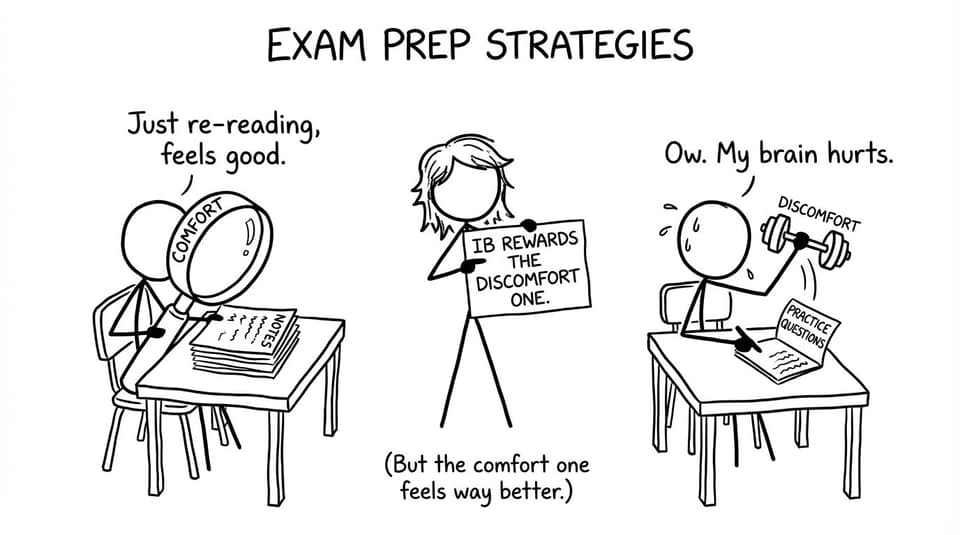
School often treats studying like reading until you recognize the page.
The IB treats studying like training until you can perform. Recognition is comfortable. Performance is slightly uncomfortable. That discomfort is the signal you're building the skill.
This is why a lot of IB revision looks productive but doesn't move marks: rewriting notes, highlighting, watching the tenth explanation of the same topic.
Real IB training is closer to this:
- 10 minutes of Flashcards (retrieval)
- 40 minutes of topic-specific questions (application)
- 10 minutes of mistake review (correction)
RevisionDojo makes that routine easy because the tools connect: Flashcards for daily recall, Questionbank for exam-shaped practice, and AI Chat (Jojo AI) when you need a fast explanation without losing momentum.
If you want to lean into memory the right way, read: IB Flashcard System: Active Recall for Better Memory.
The IB teaches you to think in verbs (command terms), not topics
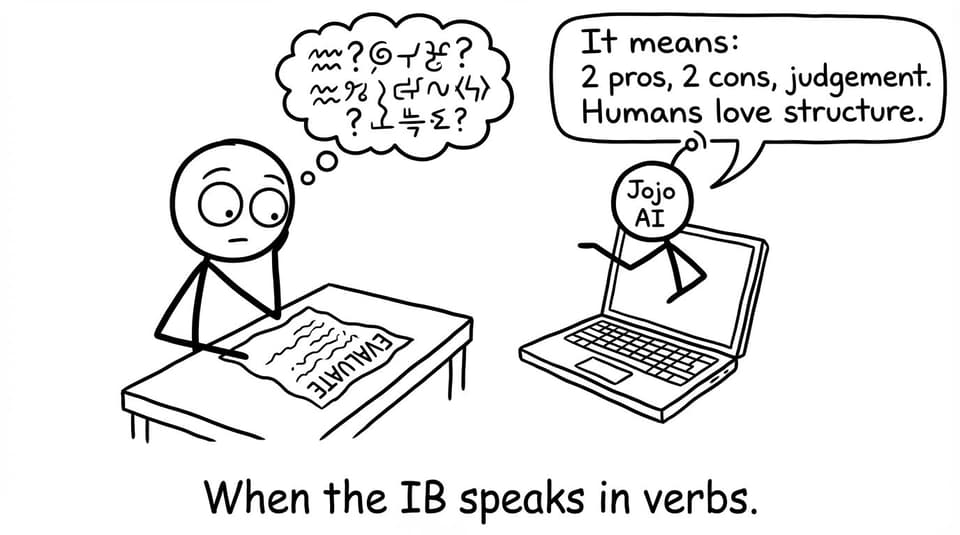
In the IB, the command term is the steering wheel.
Two students can know the same content and get different grades because one answers the verb and the other answers the topic. School rarely drills this explicitly, which is why it feels like the exam is "unfair." It's not unfair. It's specific.
Examples of what the IB is really asking:
- Define: name the thing, precisely
- Explain: cause, mechanism, consequence
- Analyse: break into parts and show relationships
- Evaluate: balanced judgement with criteria
When you practice, build templates for common verbs. In RevisionDojo, you can do a question, then ask AI Chat: "Did I actually evaluate, or did I just describe?" That small moment of honesty is how your writing becomes exam-shaped.
For exam-week execution, keep this nearby: IB Exam Day Checklist: The Ultimate Guide.
The IB teaches you that time is a budget, not a feeling
School lets you linger.
The IB measures you.
That's why "I understand it" is not enough. You need: "I can do it in the time the paper allows." Timing is not a personality trait. It's a trained habit.
A useful mental shift:
- Don't ask: "Can I solve this?"
- Ask: "Can I solve this at exam speed, without panic?"
The fastest way to build this is timed exposure:
- Short timed sets (15-25 minutes)
- Timed sections (30-60 minutes)
- Full Mock Exams when you're ready
RevisionDojo supports both the stamina part and the feedback part: timed practice, mark-scheme alignment, and quick diagnostics that tell you what to fix next.
To run this properly, follow: How to Run Timed IB Mock Exams in RevisionDojo (Exam Mode + Test Builder).
And if you want exam realism without guessing, use Predicted Papers for your subject, like Math AI Predicted Papers.
The IB teaches you to be wrong without turning it into identity
One of the hardest hidden lessons of the IB is emotional.
You will be wrong a lot on the way to being good.
School often treats mistakes as something to avoid: red pen, silence, move on. The IB punishes that avoidance, because avoidance keeps your gaps invisible until the exam.
The better IB habit is to build a mistake log that is calm and clinical:
- What did I do?
- Why did I do it?
- What rule would prevent it next time?
RevisionDojo's Grading tools help here because feedback becomes specific, not vague. For coursework-related stress that leaks into exam season, the Coursework Grader can reduce uncertainty fast: IB Coursework Grader and Professional IB Coursework Review: Expert-Level AI Assessment.
The IB teaches you that burnout is usually a planning problem first
Burnout isn't always caused by "too much work."
In the IB, burnout often comes from undefined work. When everything feels urgent, your brain can't prioritize. It just panics.
A calmer approach:
- Pick one paper as your current target
- Pick one topic inside that paper
- Do one measurable session (questions + review)
If you're struggling to stay steady, borrow this: How to Stay Sane During IB Exam Season. If anxiety is the main issue, this helps you turn fear into routine: How to Beat IB Exam Anxiety (Without Burning Out).
The IB teaches you that "all-in-one" matters because decision fatigue is real
The IB is not just hard because of content.
It's hard because you make too many decisions: what to revise, which resources to trust, whether you're improving, how to fix a weakness, whether your coursework is on track.
An all-in-one system reduces decision fatigue. That is not a luxury in IB season; it is performance support.
RevisionDojo's value is the connected loop:
- Study Notes to learn clearly (without rewriting marathons)
- Flashcards to keep recall alive daily
- Questionbank to train exam technique by topic
- AI Chat to unblock confusion fast
- Mock Exams and Predicted Papers to simulate pressure
- Grading tools plus the Coursework Library to keep coursework stress contained
- Tutors when you need a human to raise the bar and stabilize the plan
To see how the "core trio" fits together, bookmark: Notes + Flashcards + Question Bank (Free).
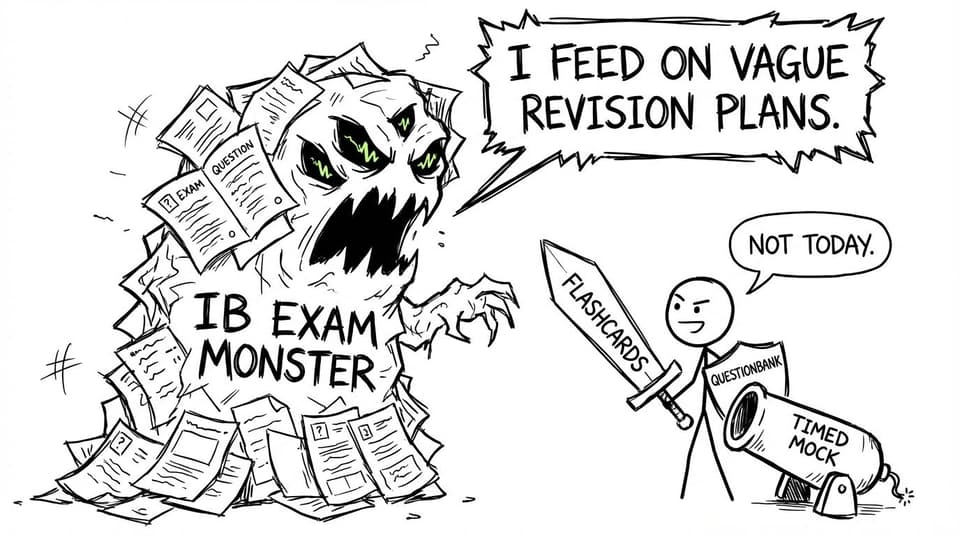
Closing: let the IB make you dangerous (in a calm way)
The IB teaches lessons that don't show up on a syllabus.
It teaches you that confidence is built by feedback. That time is a budget. That verbs matter more than vibes. That being wrong is not a character flaw, it's a training rep.
If you want your final stretch to feel clearer, build your routine around a loop you can repeat: Study Notes for clarity, Flashcards for daily recall, Questionbank practice for technique, AI Chat for fast explanations, and weekly Mock Exams or Predicted Papers for realism. That is what the IB rewards.
When you're ready, make the loop simple and connected inside RevisionDojo: start with the RevisionDojo App: The Smarter Way to Prep for IB Exams and the main RevisionDojo platform, then train the IB the way it actually grades.