



When you picture IB exam day, you probably imagine the big things: formulas, essay plans, definitions you've repeated so often they feel like background music.
What most students forget is that the biggest marks are often lost to small, ordinary failures: the wrong calculator batteries, a missing candidate number, arriving with the right knowledge but the wrong rhythm.
That's why an IB exam day checklist matters. Not because you're unprepared, but because you're human. And humans do strangely predictable things under pressure: we misread questions we understood yesterday, we forget pens we used an hour ago, we spend ten minutes proving we're smart on a two-mark question.
This guide is built to prevent that.
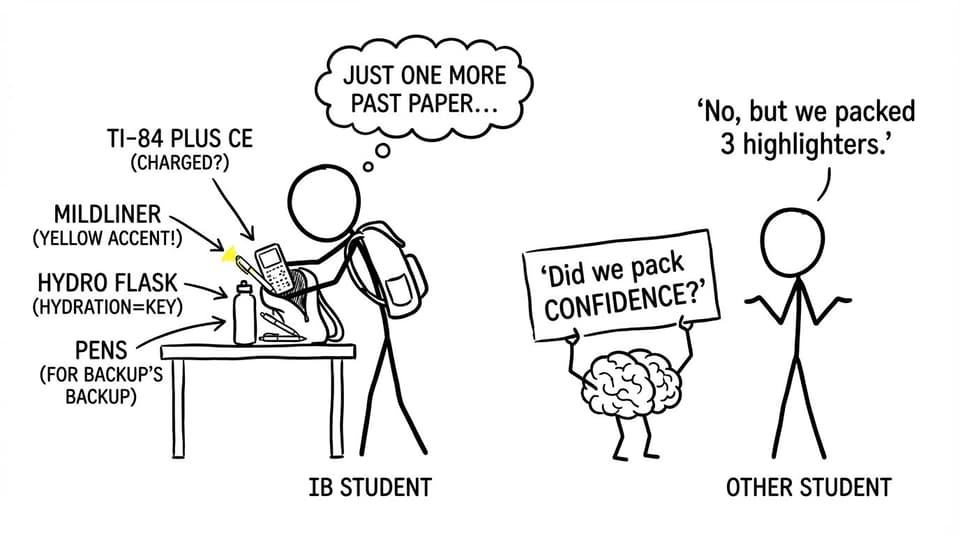
The quick IB exam day checklist (copy/paste)
Use this as your fast scan before you leave.
Before you leave home
- ID + exam entry details (whatever your school requires)
- Pens (2+ black/blue), pencil, eraser, sharpener, ruler
- Calculator (if allowed) + spare batteries (or fully charged)
- Approved subject materials (data booklet, case study insert, etc. if provided/required)
- Water bottle (label removed if your school requires it)
- Snack for after (or between papers)
- Hoodie/layer (exam halls are unpredictable)
Arrival
- Get there early enough to sit, breathe, and stop rushing
- Bathroom now, not later
- Read the front cover instructions like they're worth marks (because they are)
During the paper
- First 3 minutes: scan the whole paper and mark your order
- Track time in chunks (not vibes)
- Answer the command term, not the topic you wish you were asked
- If stuck: move on, mark it, return later
After
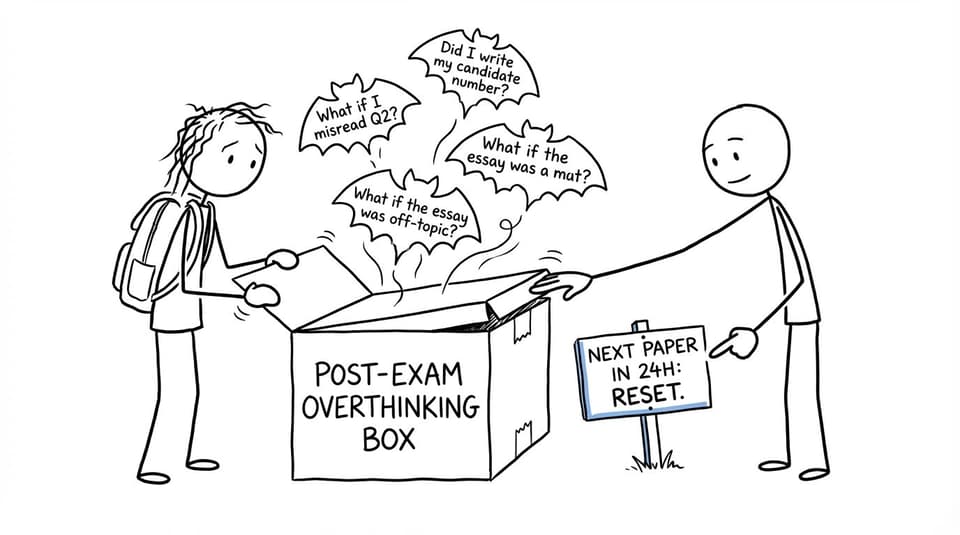
- Don't do hallway postmortems
- Log one lesson, then reset for the next IB paper
If you want the bigger system behind this checklist, pair it with RevisionDojo's workflows for IB practice: How to Study for IB Exams: Step-by-Step Guide.
The night before: make tomorrow boring
A good IB exam day begins the night before, and the goal is not inspiration. The goal is boring reliability.
Here's the principle: you don't want to spend exam-morning willpower on decisions you could have made at 9:00 p.m.
Pack your "no-thinking" bag
Pack as if morning-you is a distracted stranger.
- Put every item in the same pocket every time.
- Put your calculator where you can see it.
- Put spare pens where you can reach them quietly.
If you need a calm plan for the evening, use: What to Do the Night Before a Big Exam.
Do a short "confidence review" (not a cram)
Your IB brain consolidates more than it invents the night before.
- 20-40 minutes of Flashcards or summaries.
- 10-20 minutes of a few easy questions to feel fluent.
- Stop before you start bargaining with time.
On RevisionDojo, this is where Study Notes and Flashcards work best together: read one small section, then immediately quiz it.
- Use Interactive Flashcards for fast active recall.
- Pull targeted practice from the Questionbank to keep your recall exam-shaped.
Morning of the IB exam: protect your pace
Most exam-day stress is not fear. It's time pressure you didn't notice until it became panic.
So your morning job is simple: protect pace.
Eat and hydrate like a professional (not a gambler)
- Eat something familiar.
- Avoid the "new breakfast experiment."
- Sip water. Don't flood yourself and create a bathroom emergency at minute 37.
Arrive early enough to become calm in the room
There's a difference between arriving "on time" and arriving "ready."
Aim to be seated early enough that your breathing slows down before the first instruction.
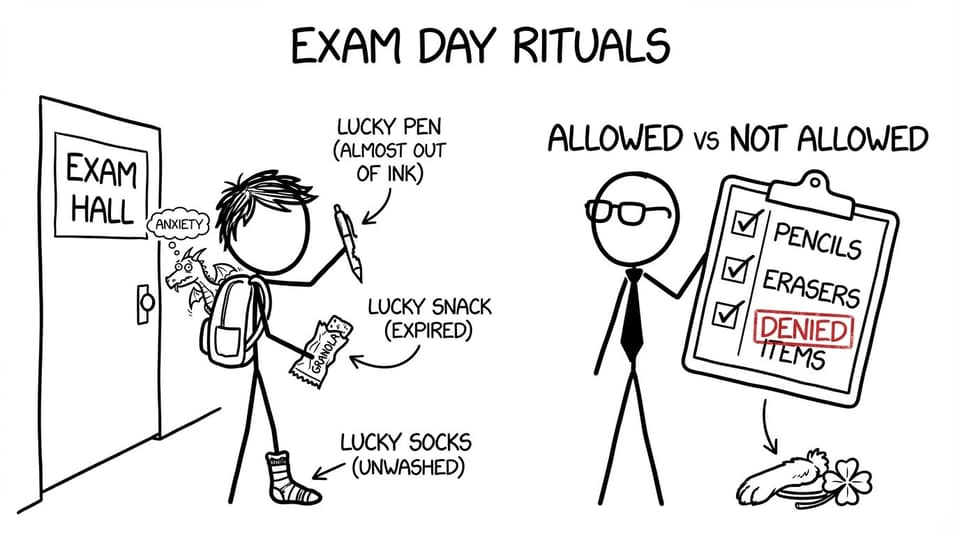
In the exam hall: your first 5 minutes decide your whole paper
The first five minutes of an IB exam are a doorway. Walk through it slowly.
Read the cover like it's part of the mark scheme
This sounds obvious. Under pressure, it's rare.
Check:
- Total marks and time
- Required number of questions
- Any choice structure (answer 2 of 3, etc.)
- Calculator rules or materials allowed
Do the "map first, then march" method
- Scan all questions.
- Circle the ones that are easiest to start.
- Star the ones that are high-mark and in your best topics.
- Choose an order that protects momentum.
Momentum matters in IB papers because confidence is a resource. Spend it wisely.
Timing strategy: treat time like a budget, not a feeling
A lot of IB students lose marks with full knowledge because they donate time to the wrong places.
Use a simple time budget
- Convert exam time into "minutes per mark" as a rough guide.
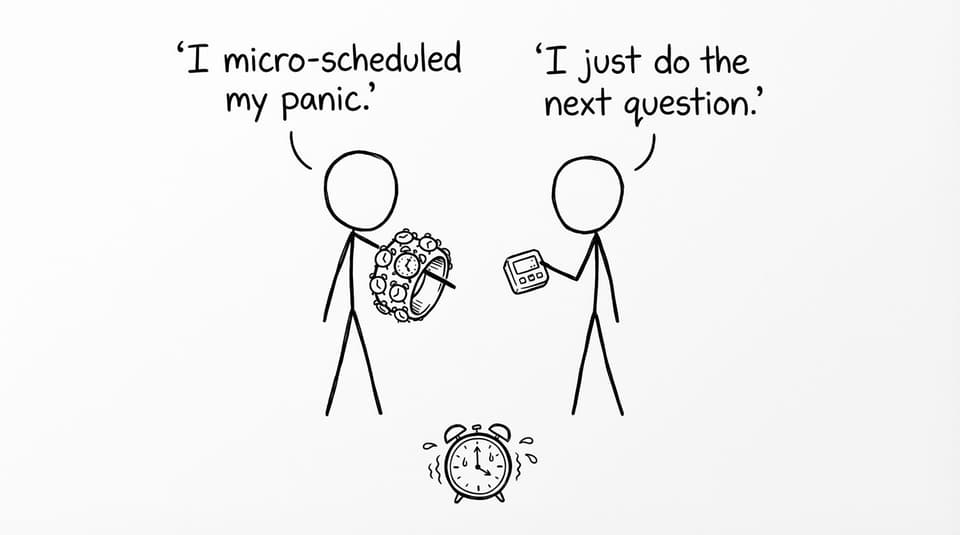
- Check your watch/timer at planned checkpoints (not constantly).
The "stuck protocol" (memorize this)
If you're stuck:
- Re-read the command term.
- Write something small that earns partial credit (definition, equation, diagram label).
- Move on.
- Return later if time.
You're not abandoning the question. You're refusing to let it steal marks from the rest of the paper.
The "command term trap": answer what IB asked, not what you know
This is one of the quietest reasons strong students drop grades.
In the IB, command terms are the exam's steering wheel.
- Define is not explain.
- Explain is not evaluate.
- Discuss is not "say everything you remember."
Practical habit:
- Underline the command term.
- Write a mini-plan in the margin: "2 pros + 2 cons + judgement," or "cause -> mechanism -> consequence."
On RevisionDojo, building this skill is easiest when practice questions are paired with feedback. That's why students use the Questionbank plus Jojo AI's instant grading and explanations as a daily loop.
Materials checklist: what to bring (and what not to risk)
Your IB exam day checklist should be boringly consistent.
The essentials
- 2-3 pens (black/blue)
- Pencil, eraser, ruler
- Calculator + batteries (if applicable)
- Approved materials (subject-specific)
- Water
- Simple snack for after
The "don't be heroic" items
- Spare glasses/contacts if you use them
- A simple watch (if allowed by your school)
- A light layer
What to avoid
- Anything that could trigger a rules conversation at the door
- Anything noisy, distracting, or unfamiliar
Between papers: don't do the postmortem
After an IB exam, people gather in small circles and trade uncertainties like they're trying to complete a set.
It feels productive. It rarely is.
Here's the more useful method:
- Write down one lesson (timing, command term, content gap).
- Then stop.
Your next paper deserves a clean mind, not a brain full of alternate endings.
If you're in a heavy exam period, build your recovery routines into your revision plan: How to Revise for IB Exams: A Month-by-Month Revision Plan.
How RevisionDojo turns your checklist into a system
A checklist is a guardrail. A system is what makes the guardrail unnecessary over time.
RevisionDojo is built around the full IB loop:
- Study Notes to make concepts clear quickly
- Flashcards for spaced repetition and daily recall
- Questionbank to turn understanding into exam performance
- AI Chat (Jojo AI) to explain tricky steps and generate targeted practice
- Grading tools to get mark-scheme-aligned feedback on answers (and coursework drafts)
- Predicted Papers and Mock Exams to make exam day feel familiar
- Coursework Library to see what strong work looks like
- Tutors for when you need a human to untangle a persistent knot
If you want everything in one place, start here: RevisionDojo for IB.
And if you're building your daily toolkit from scratch, this is the cleanest setup: Notes + Flashcards + Question Bank (Free).
Final reminder: the calm student usually wins
Your IB grades will come from knowledge, yes, but also from steadiness: packing early, arriving with time, reading carefully, moving on when stuck, and refusing the post-exam panic circle.
Use this IB exam day checklist as your anchor. Then build the deeper habit loop behind it: Notes for clarity, Flashcards for recall, Questionbank for exam technique, AI Chat for fast fixes, and realistic Mock Exams and Predicted Papers so the real day feels like another practice run.
If you want that whole system in one place, start with RevisionDojo and make your next IB exam day feel simple on purpose.