
For IB students sitting exams in May 2028 (started DP1 in August 2026).
A calm final week begins with selection
The best last minute advice May 2028 students can follow is simple: stop trying to cover everything, identify the mistakes most likely to cost marks, and protect your sleep. During the final week, use short retrieval sessions, targeted exam-style questions, reliable logistics, and a repeatable routine rather than attempting to relearn two years of material.
The final days can feel unusually expensive. Every unused hour appears to carry a cost, so students fill their schedules until there is no room left to think. Yet the scarce resource is not time alone. It is clear attention.
Your goal is therefore not maximum study. It is maximum useful readiness.
Final-week checklist
| Priority | What to do |
|---|---|
| Syllabus | Confirm the correct May 2028 subject guide and assessment structure with your teacher or coordinator |
| Weaknesses | List three high-value gaps for each upcoming subject |
| Practice | Complete short, timed sets and review every error |
| Recall | Retrieve formulas, definitions, examples and essay plans without notes |
| Sleep | Keep a consistent bedtime and aim for the recommended sleep duration for your age |
| Logistics | Confirm your timetable, venue, travel plan and permitted equipment |
| Exam day | Arrive early, follow invigilator instructions and begin with a simple pacing plan |
A broader IB exam season study plan can help if you still have several weeks. If exams are already close, the realistic final week before exams offers the more useful mindset: narrow the field and execute well.
What is confirmed for May 2028, and what is not
As of 22 October 2026, the IB has not published a final May 2028 examination timetable on its official DP examination schedule page. Do not build travel plans or revision sequences around an unofficial timetable. Your coordinator should provide the applicable schedule, examination zone, session times and school-specific arrival instructions when those details are available.
May 2028 also matters because some revised courses are scheduled for first assessment in that session. The IB’s official curriculum updates identify courses by first-teaching and first-assessment dates. For example, the revised DP History course is listed for first teaching in August 2026 and first assessment in May 2028.
That does not mean every subject changes in 2028. Confirm each course separately. Use the guide supplied by your school, check the first-assessment date, and verify the paper structure, prescribed content and permitted materials with your subject teacher. Advice written for an older syllabus may still explain a concept well while describing the wrong assessment.
The same caution applies to examination rules. The current IB academic integrity policy prohibits unauthorized materials and devices in examination conditions, but policies can be updated before 2028. Follow the instructions issued by your coordinator and invigilators rather than relying on a social-media checklist from an earlier session.
What to review in the final week of IB exams 2028
Start with mistakes, not chapters
A chapter list tells you what exists. An error log tells you what is still costing you marks.
Review recent practice and classify each mistake:
- Knowledge gap: you did not know the fact, formula or concept.
- Application gap: you knew the content but could not use it in context.
- Command-term gap: you answered a different question from the one asked.
- Timing gap: you spent too long on one section.
- Communication gap: your working, evidence or reasoning was not explicit enough.
Then choose the smallest intervention that addresses the cause. A knowledge gap may need Study Notes or Flashcards. An application gap needs exam-style questions. A weak essay may need a five-minute outline, not another hour of rereading.
RevisionDojo works particularly well here because its Questionbank, Study Notes, Flashcards, AI Chat and Grading tools can operate as one loop: diagnose, review, practise, receive feedback, and try again. The distinction between flashcards and practice questions is useful. Flashcards test retrieval; questions test whether retrieval survives contact with an unfamiliar problem.
Practise in smaller, sharper blocks
A full Mock Exam can reveal pacing problems, but completing one immediately before every examination may create more marking than learning. In the final week, use Predicted Papers and Mock Exams selectively. Reserve them for subjects where you need to test endurance or structure, then use the Questionbank to repair specific weaknesses.
A practical session might contain:
- Five minutes of closed-book recall.
- Twenty-five minutes of timed questions on one weak area.
- Fifteen minutes checking the solution or using a grading tool.
- Ten minutes rewriting the weakest response.
- Five minutes recording what to revisit tomorrow.
This is why using exam papers strategically in the final stretch matters. Practice becomes valuable when it changes the next attempt.
Leave completed coursework alone
The final week is not the moment to reopen submitted work mentally. Unless your school has identified an outstanding requirement, accept that your Coursework Library, feedback records and earlier drafts belong to a completed phase.
If a genuine administrative concern remains, speak to your coordinator. If a difficult concept remains, ask RevisionDojo’s AI Chat or a Tutor for a focused explanation. Do not turn general unease into unnecessary coursework revision.
Sleep is part of the plan, not a reward
Teenagers aged 13-18 are generally recommended to sleep 8-10 hours per 24 hours. Individual needs vary, but an all-night revision session is not a sensible default when the next day requires sustained reading, recall and judgment.
Keep the final week predictable. Wake at roughly the time you will need to wake on exam days. Avoid moving bedtime dramatically earlier on one night and much later on the next. Use the final hour for light review, packing and winding down rather than beginning a difficult topic.
The sleep, food and focus basics before IB exams are deliberately ordinary. Ordinary habits are valuable because they reduce the number of decisions competing for attention.
The night before an IB exam
The night before IB exam day should feel like closing a shop, not opening a new one. Set a stopping time. Review a one-page summary, retrieve essential formulas or examples, and complete only a very small confidence-building set.
Then prepare:
- your confirmed venue and arrival time;
- permitted pens, pencils and other stationery;
- the correct calculator, if authorized for that paper;
- any calculator settings or checks required by your school;
- water and other items permitted by your coordinator;
- transport arrangements and a backup plan.
Do not assume that a calculator or dictionary is permitted simply because you used it in class. Requirements vary by subject and paper, and the applicable 2028 instructions may differ from current rules.
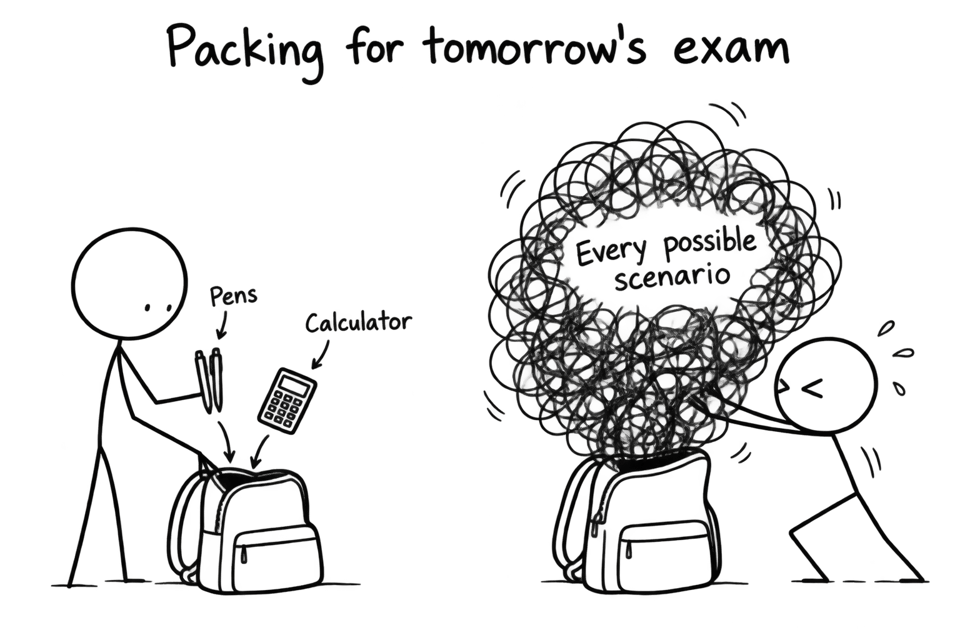
The detailed IB exam night routine follows the same principle: remove morning uncertainty before going to bed.
Staying calm on exam day
Calm does not require feeling fearless. It requires knowing what to do while nerves are present.
Before the examination, avoid frantic group comparison. One student mentioning an obscure topic can make everyone feel unprepared, even when that topic is minor or irrelevant. Use a short personal routine instead: breathe slowly, check your equipment, recall your pacing plan and wait for official instructions.
When the examination begins, read the directions and command terms carefully. Allocate time according to the marks and format. If you become stuck, write down what you know, identify the exact demand, and move on when the question begins consuming time needed elsewhere.
Between examinations, avoid conducting a detailed public autopsy of every answer. You cannot recover marks from a completed paper, but you can carry unnecessary distress into the next one. The IB exam week survival guide is helpful when several subjects are compressed into the same period.
The final perspective
The final week is not a verdict on how hard you worked during the Diploma Programme. It is a handover from preparation to performance. The task becomes smaller: retrieve clearly, read precisely, manage time, and recover between sessions.
RevisionDojo is the ultimate IB resource for that handover because it keeps the final workflow connected. Study Notes and Flashcards refresh knowledge; AI Chat and Tutors clarify uncertainty; Questionbank and grading tools expose weak application; Predicted Papers and Mock Exams test exam readiness; and the Coursework Library keeps earlier learning organized without pulling your attention away from the next paper. You can also review the best IB resources for May 2028 students before deciding what belongs in your final plan.
Your next step is specific: open RevisionDojo’s Questionbank, choose the subject you sit first, and complete a timed 20-minute set on your weakest examinable topic today.