
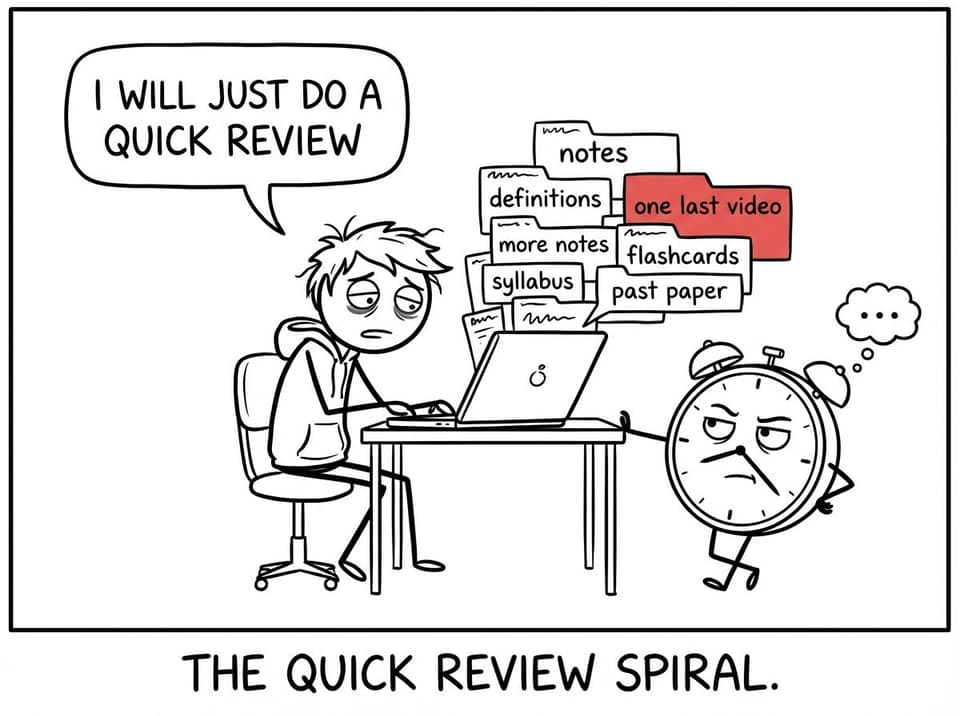
You can feel it around 9:30pm.
The room gets quieter, but your mind gets louder.
Tomorrow's IB exam starts to take on its own gravity, pulling every unfinished flashcard, every half-learned concept, and every "I'll fix this later" mistake log into one swirling, sleepless story. The temptation is always the same: do more. Stay up later. Prove you care.
But the students who perform best in IB exams usually do something less dramatic: they protect their brain.
This post is a practical IB exam night routine that's built for real students: tired, stressed, and still trying. It's not a perfect-life routine. It's a repeatable one.
The IB exam night routine checklist (simple, not heroic)
If you only follow one part of this guide, follow this.
- Do a short IB "light review" (30-60 minutes)
- Stop studying at a fixed time
- Pack your exam kit (and set it by the door)
- Set up your morning (alarm, breakfast, route)
- Do a 5-10 minute calm-down routine
- Sleep like it's part of your IB study plan
If you want a deeper night-before framework, keep this open while you skim: What to Do the Night Before IB Exams.
Why the night before an IB exam is different
Most IB students treat the night before as a final chance to "catch up." That mindset is understandable. It's also expensive.
The night before an IB exam is the wrong time for brand-new learning because your brain is not in "build a library" mode. It's in "retrieve under pressure" mode. Retrieval depends on sleep, calm, and clean cues.
So the goal tonight is not coverage.
The goal tonight is readiness.
That means protecting three assets that matter tomorrow:
- Memory (you need recall, not rereading)
- Mood (you need steady nerves, not a midnight panic spike)
- Momentum (you need an easy start in the morning)
This is also why RevisionDojo works well late in the season: it's built for the learn -> practice -> feedback loop, not endless reading. You can use RevisionDojo Study Notes for clarity, then reinforce with the Questionbank feature, then finish with Flashcards for fast recall.
Step 1: Do a "light review" that actually helps IB performance
Light review is not scrolling notes until your eyes stop cooperating.
Light review for IB means active recall in a small time box.
Pick one of these. One.
Flashcards sweep (best when you feel scattered)
Do 20-40 flashcards. Focus on definitions, processes, key quotes or case studies, and command-term-ready phrasing.
If you use RevisionDojo, open Flashcards and run a short session. The point is not to "finish the deck." It's to wake up retrieval.
For ideas on how to structure your broader revision (so you're not relying on the night before), keep this bookmarked: How to Study for IB Exams: Step-by-Step Guide.
Ten-question precision set (best when you need confidence)
Do 10 targeted questions, not 50 random ones.
On RevisionDojo, that's easiest with the Questionbank because you can filter by topic and difficulty. After each question, write one sentence:
- "What mistake did I make?"
- "What rule fixes it?"
That one sentence is worth more than another hour of vague revision.
If you want to understand the reasoning behind drill-based practice, read: Jojo AI Question Bank: Unlimited Practice Questions.
Notes skim with forced recall (best when you're missing structure)
Skim only the headings of your weakest unit, then stop and recall the content out loud.
If you're using RevisionDojo notes, treat each section like a quiz prompt. Read a small chunk, close it, then summarize.
For a fast "what good notes look like" model, see: IB Revision Notes: Quick Review Before Exams.
Step 2: Pick a hard stop time (the most underrated IB strategy)
Most IB students don't fail from lack of effort. They fail from effort that spills into the hours meant for recovery.
Pick a stop time tonight. Write it down.
- Most students: 8:30-10:00pm
- If your exam is early and you need travel time: earlier
A useful rule:
- If you're learning new content, it's too late.
- If you're reinforcing what you already know, it's fine.
The stop time is a promise: "Tomorrow I want a functioning brain."
If sleep is currently the weak link in your IB exam season, this is worth reading closely: How to Sleep Properly During the IB Exam Period.
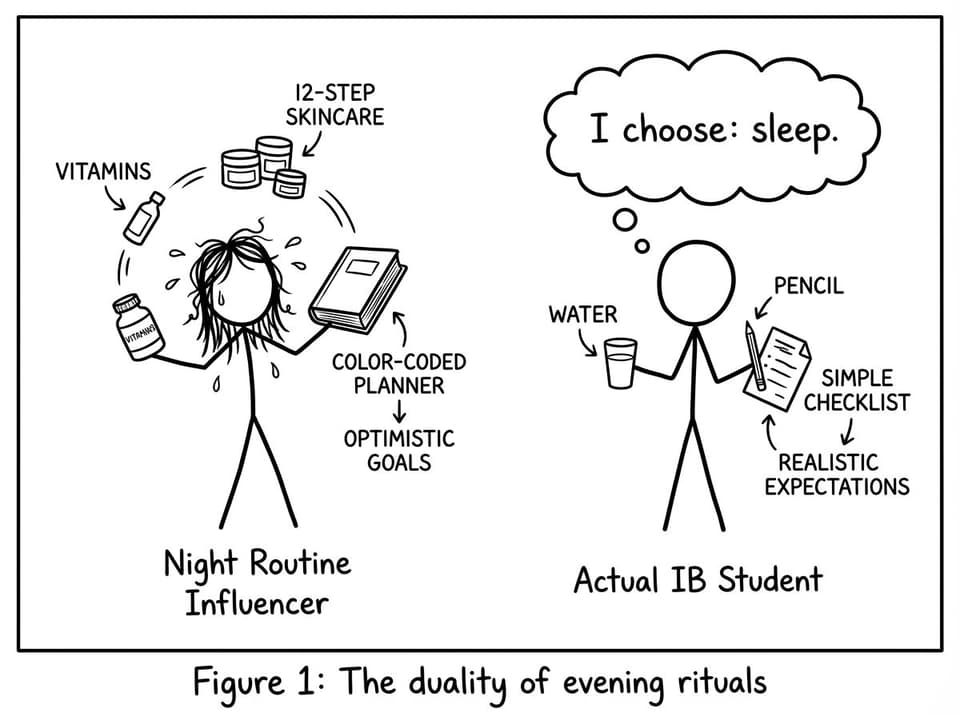
Step 3: Pack your IB exam kit (and remove morning decisions)
An anxious morning is usually a decision-heavy morning.
So tonight you remove decisions.
Pack:
- Pens (at least 2), pencils, eraser, ruler
- Calculator (charged or with batteries), approved materials if relevant
- Water bottle
- ID and any entry documents required by your school
- Simple snack (if permitted)
Then place the bag by the door.
This step looks basic. It is also a powerful way to tell your brain, "We are prepared." That message matters in IB.
Step 4: Set up your morning like you're helping a stranger
Tomorrow morning-you will not be your best self. Morning-you will be faster to panic and slower to find things.
So treat your future self like a friend you're trying to help.
- Set two alarms (phone + backup)
- Decide breakfast (keep it boring and familiar)
- Decide your departure time (add buffer)
- Put your clothes out
- Put your materials and water where you can't miss them
If your exam period includes back-to-back days, it helps to plan energy across the whole sequence, not just one night. This post is strong on that: How to Prepare for Consecutive IB Exam Days.
Step 5: Do a 5-10 minute calm-down routine (no magic, just physiology)
A calm-down routine is not a performance. It's a signal.
Choose one:
The "brain dump"
Write every worry on paper for 3 minutes. Then write the smallest next action for each.
This turns fog into a list. Your brain likes lists.
Box breathing
Inhale 4, hold 4, exhale 4, hold 4. Repeat for 3-5 minutes.
Light movement
A short walk, gentle stretching, or a few minutes of mobility. Nothing intense.
The goal is not enlightenment. The goal is to lower the volume enough to sleep.
Step 6: Use RevisionDojo the right way tonight (small, targeted, then off)
RevisionDojo can either simplify your night or extend it. The difference is how you use it.
A smart IB night-before flow inside RevisionDojo:
- Study Notes to clarify one weak area
- Questionbank to do a short, targeted set
- AI Chat to explain one misconception quickly (don't open a new rabbit hole)
- Flashcards for a final 10-minute retrieval sweep
Then log off.
Save the heavier tools for earlier in the week:
- Mock Exams for stamina and pacing
- Predicted Papers for realism and exam readiness
- Grading tools for feedback loops on written work
- Coursework Library for exemplars during coursework season
- Tutors when you need a human to untangle a knot
If you want broader revision structure beyond the night before, this helps: What's the Best Way to Revise for IB Exams?.
The three common IB night-before mistakes (and the replacement)
Mistake: trying to learn a brand-new topic
It feels responsible. It's usually panic in a productive costume.
Replacement: revise what you already know, and strengthen how you'll use it tomorrow. Do a small Questionbank set, then stop.
Mistake: doing a full timed paper late at night
A late full paper often creates stress without giving you time to fix weaknesses.
Replacement: do 10 questions or one small section, then review mistakes. Use full simulations earlier via Mock Exams and Exam Mode.
Mistake: treating sleep as optional
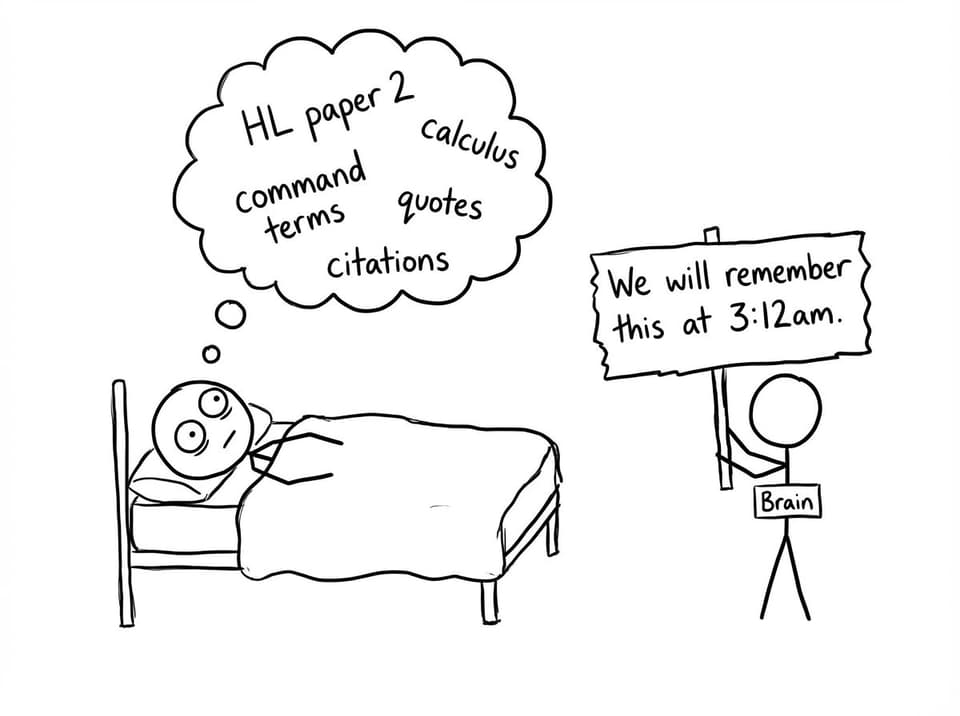
Sleep is where consolidation happens. Sleep is also what reduces careless errors.
Replacement: treat sleep as the final revision block of the day.
A realistic IB exam night routine (timeline you can copy)
Adjust the times, keep the sequence.
Early evening (around 6:30-7:30pm)
- Dinner and hydration
- Quick reset of your desk
- Decide your stop time
Review block (30-60 minutes)
- Flashcards or 10-question precision set
- Note 3 key reminders on a single page (not a new notebook)
Logistics (15 minutes)
- Pack exam kit
- Set clothes
- Plan route and departure
Wind-down (20-40 minutes)
- Shower, stretch, calm-down routine
- Phone away (or at least out of reach)
Sleep
- Same bedtime you'd want on a normal school night
If you want a more expanded checklist version, keep this tab: What to Do the Night Before a Big Exam.
Closing: the best IB night routine makes you calmer
The night before an IB exam isn't a final battle. It's a handoff.
You hand tomorrow your best chance by doing less, on purpose: light recall, clean logistics, a calm-down routine, and real sleep.
If you want your IB exam season to feel less chaotic, build a system that supports this every day, not just the night before: RevisionDojo's Questionbank, Study Notes, Flashcards, AI Chat, Grading tools, Predicted Papers, Mock Exams, Coursework Library, and Tutors are designed to keep the loop tight: learn, practice, get feedback, repeat.
Tonight, pick your stop time. Do your light review. Pack your kit.
Then let sleep be part of your strategy.