



The strategic way to use historical IB exam papers in the final stretch is not to complete as many as possible. Follow a tighter loop: attempt, mark, diagnose, repair, and retest.
That distinction matters during the September-to-November window. Time can feel abundant until schoolwork, revision, and fatigue begin competing for the same evenings. A completed paper may feel productive, but its value comes from what happens after the timer stops.
For November 2026 candidates, the official examination window runs from 23 October to 13 November. Your subjects, exam zone, and school instructions determine your personal schedule, so obtain the final timetable from your coordinator. RevisionDojo's November 2026 exam schedule and study plan can help you plan backwards from each assessment.
The final-stretch checklist
Use this workflow for every important practice session:
- Choose a paper or section with a clear purpose.
- Reproduce the correct time limit and permitted resources.
- Mark the attempt strictly.
- Classify every lost mark by cause.
- Repair one or two high-value weaknesses.
- Retest them with fresh questions.
- Record whether accuracy, speed, or independence improved.
The goal is not a large pile of completed work. It is to make repeated mistakes less likely when the result counts.
Start with diagnosis, not performance
Your first September attempt should reveal where marks disappear. It does not need to prove that you are ready.
Choose a representative section from each subject and complete it under closed-book conditions. If a full paper would consume too much time or reveal mostly predictable gaps, use a substantial section instead. Then classify each lost mark:
| Error type | What it reveals | Best next action |
|---|---|---|
| Knowledge | A concept, fact, formula, or example was missing | Review a narrow section of Study Notes |
| Application | You knew the content but could not use it | Complete targeted Questionbank sets |
| Interpretation | You misunderstood data, wording, or a command term | Compare your response with the marking logic |
| Structure | Your answer lacked required development | Rewrite using the mark allocation |
| Timing | You could answer but worked too slowly | Practise shorter timed sections |
| Carelessness | You knew the method but still lost marks | Create a checking routine and retest |
This turns a score into a plan. A 58% caused by missing knowledge requires a different response from a 58% caused by unfinished questions.
RevisionDojo's IB Questionbank lets you move from broad diagnosis to focused practice by topic and question style. That is more efficient than immediately attempting another complete paper and hoping the weakness disappears.
Match paper practice to the calendar
Some students call this sitting the IB NovExam, while others say the November session. Either way, the calendar matters more than the label. The fall term is short, and each stage needs a different kind of practice.
September: expose and repair weaknesses
Use selected sections to test syllabus coverage. Work without notes, but do not make every session fully timed. Identify the topics, command terms, methods, and formats that repeatedly cost marks.
After each attempt, use RevisionDojo Study Notes and its wider exam-preparation workflow to repair only the concepts your results exposed. Turn essential facts, formulas, examples, and distinctions into Flashcards. If one misconception remains stubborn, ask AI Chat a narrow question instead of requesting another general summary.
Early October: combine skills under time
Move towards timed sections and mixed-topic practice. This is where knowledge must become executable.
A basic time budget is: available minutes multiplied by the question's marks, divided by the paper's total marks. Treat that as a starting point rather than a rigid law. Essays need planning, while short questions may require a checking buffer. The purpose is to stop treating time as something you notice only after it runs out.
Use RevisionDojo's Predicted Papers when you need fresh, syllabus-aligned material. It also helps to understand the difference between predicted and specimen papers. Predicted sets provide realistic rehearsal, not promises about what will appear.
Final weeks: rehearse the real sequence
During the final 2-3 weeks, complete selected full simulations under realistic conditions. Use only permitted materials. Do not pause the clock, check notes, or extend the finish time.
If your timetable contains consecutive demanding days or two papers on one day, rehearse that sequence once. RevisionDojo's guide to the hardest November exam days can reveal pressure blocks, although your coordinator's timetable remains authoritative.
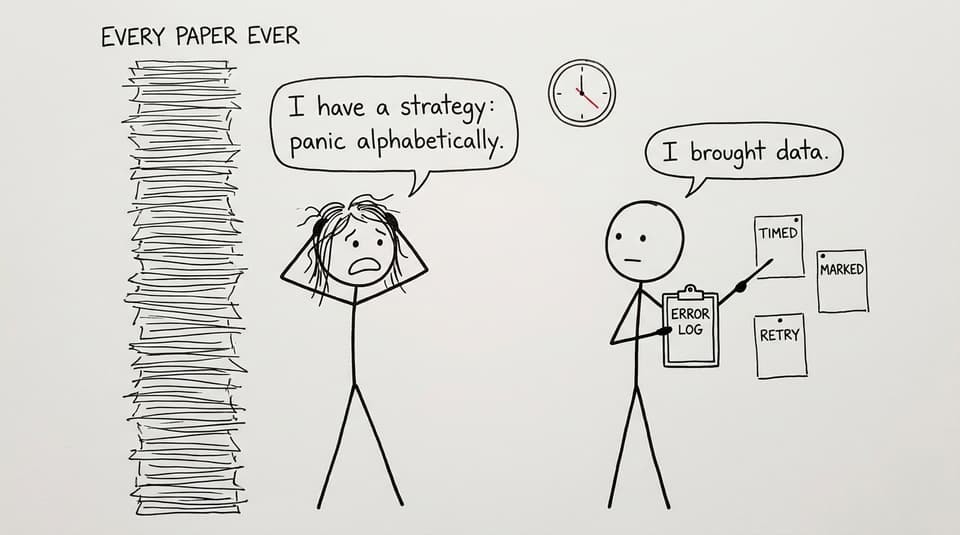
Treat marking as the main study session
An attempt creates evidence. Marking turns that evidence into improvement.
Review the work immediately or later that day. Mark what you wrote, not what you intended. For each incorrect answer, find the first point where your reasoning failed. The final line may be wrong because of an earlier misconception, omitted unit, weak example, or rushed reading.
For extended responses, RevisionDojo's Grading tools can help you inspect structure and alignment with criteria. Compare that feedback with your teacher's guidance. If a weakness persists, a RevisionDojo Tutor can help distinguish a content problem from an exam-technique problem.
Record the subject, topic, question type, marks lost, cause, corrective action, and retest date. That final field is crucial. Without a scheduled retest, an error log becomes a museum of mistakes rather than a training system.
Retest instead of rereading corrections
A model answer can create an illusion of understanding. Once you have seen the route, it feels obvious.
Close the solution, wait 2-3 days, and attempt a fresh question requiring the same skill. If you can solve it independently within a sensible time, the repair is probably holding. If not, return to a smaller unit of practice.
Review one precise concept with Study Notes, explain it from memory, complete 3-5 related Questionbank questions, and use Flashcards for information that must become automatic. Then retest through a mixed or timed set. This follows the learn, apply, receive feedback, and revisit cycle in RevisionDojo's month-by-month IB revision plan.
Not every paper deserves a full simulation. Use targeted questions for isolated weaknesses, timed sections for speed, and Mock Exams for stamina and decision-making. Build these sessions around your real school week using the balanced IB study schedule guide.
Taper before each examination
During the final 48-72 hours, favour short, confidence-building work. Review error rules and formula triggers, complete a small familiar set, rehearse one essay plan or calculation sequence, and confirm equipment, transport, start time, and permitted materials. Protect sleep and stop at a planned hour.
A final full simulation may expose problems without leaving enough time to repair them. Close to the examination, stability becomes more valuable than volume. RevisionDojo's guide to planning final revision from the official timetable can help you decide when to practise hard and when to taper.
The final stretch is not won by proving how much work you can endure. It is won by noticing what your work reveals. RevisionDojo brings the complete cycle together: Study Notes restore clarity, Flashcards preserve recall, the Questionbank repairs weaknesses, AI Chat explains stubborn concepts, Grading tools sharpen responses, and Mock Exams test whether improvement survives pressure. That is how paper practice becomes a strategy rather than a ritual.