

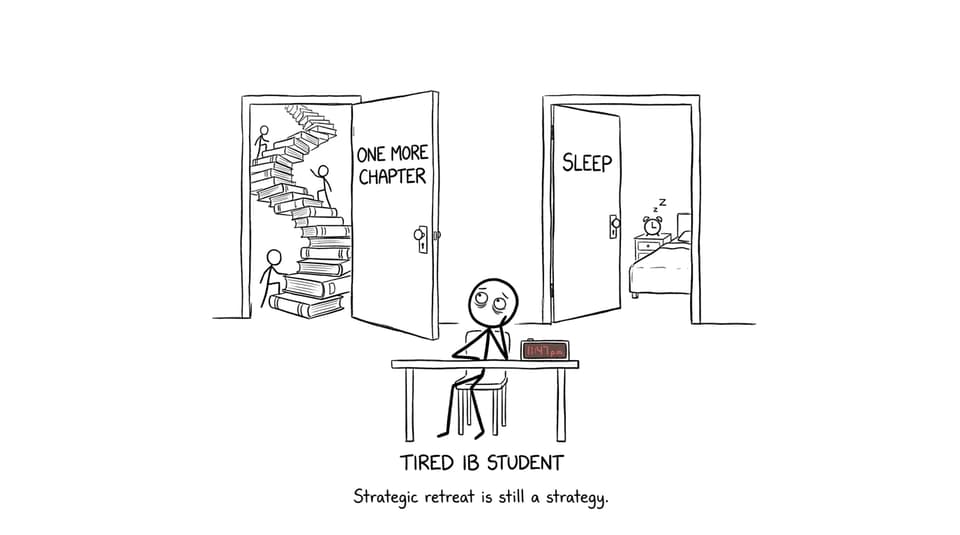
The night before an IB exam creates a strange illusion: every additional hour at your desk feels valuable simply because time is running out. Yet the practical answer is usually clear. You should not keep studying deep into the night before an exam. Complete a short, targeted review, resolve one or two genuine uncertainties, and then stop early enough to protect your sleep.
If your anxious search was something like “keep studying night exam,” you probably want a decision rather than another lecture about preparation. Use this rule: study only while the next block is likely to improve tomorrow’s performance more than the lost sleep will reduce it. For most students, that means 30-60 minutes of active recall, not several hours of new learning.
This matters particularly during the IB November exam session. The 2026 timetable runs from late October into November, so consecutive papers can turn one late night into several tired days. Check the IB November 2026 exam schedule and study plan, confirm your local start time with your coordinator, and plan for the entire sequence rather than treating each evening as an isolated emergency.
The short night-before checklist
- Identify the subject and paper you are sitting next.
- Review one weak but recoverable area.
- Use active recall instead of passive rereading.
- Stop heavy work 60-90 minutes before bed.
- Pack approved equipment and required identification.
- Write down your wake, breakfast, departure, and arrival times.
- Aim for a normal sleep window, not a heroic final session.
For a more detailed setup, save RevisionDojo’s IB exam-night checklist.
Should you keep studying the night before an exam?
A little studying can help. Open-ended studying usually does not.
The useful version has a defined purpose: retrieve essential formulas, outline likely essay structures, revisit recurring errors, or confirm a concept that keeps getting confused. The unhelpful version begins without a stopping point and gradually becomes an attempt to rebuild the entire course before midnight.
Ask three questions before opening your notes:
- What specific gap am I trying to close?
- Can I test that gap in less than 30 minutes?
- Will finishing this task make it easier to sleep?
If you cannot answer those questions, your next best action is probably preparation for bed.
Sleep is not empty time taken away from revision. Research on learning consistently connects sleep with memory consolidation, while insufficient sleep can undermine attention and alertness. Health guidance recommends that teenagers aged 13-18 regularly receive 8-10 hours of sleep per 24 hours. One imperfect night does not determine your result, but deliberately trading several hours of sleep for unfocused rereading is rarely a sensible bargain.
What to study during your final review
Choose material that is already partly familiar. The night before an exam is suitable for strengthening retrieval, not constructing a new foundation.
| Useful final review | Better scheduled earlier |
|---|---|
| Definitions and formulas | Entire unfamiliar chapters |
| Essay plans and evidence lists | Full timed papers |
| Frequent errors from your mistake log | Large mixed-topic problem sets |
| Command terms and answer structure | Detailed rewriting of all notes |
| A few representative questions | New revision systems or resources |
RevisionDojo makes this final review easier to contain. Open concise IB subject notes, retrieve the ideas with Flashcards, and use the IB Questionbank effectively for a tiny targeted set. If one misconception remains, ask AI Chat a precise question and close the session after resolving it.
Do not let one uncertain answer become permission to complete another 40 questions. Confidence on exam night comes from evidence that you can retrieve the method, not from exhausting every resource available.
A practical 45-minute shutdown plan
When anxiety is high, a preset routine prevents negotiation. Try this:
Minutes 0-20: retrieve
Use Flashcards or a blank page to recall formulas, quotations, definitions, diagrams, or essay themes. Do not copy from notes. Retrieval reveals what you can actually produce.
Minutes 20-30: verify
Check only the items you missed. If necessary, complete two or three targeted Questionbank problems. Stop once you can explain the corrected method without assistance.
Minutes 30-35: write your final sheet
Create one page containing the essentials you may review briefly in the morning. Keep it small enough to prevent frantic scrolling through multiple documents.
Minutes 35-45: prepare tomorrow
Pack your equipment, check calculator requirements with your school, set two alarms, choose clothes, and confirm transport. Then begin your wind-down routine. RevisionDojo’s guide to calming exam-night anxiety offers a fuller routine when your mind will not switch off.
What changes during the IB NovExam fall term
For November-session students, September should be the month for identifying gaps. October should increasingly emphasize timed execution, error review, and paper-specific technique. The night before each examination should be for stability.
That division of labour matters. Predicted Papers and Mock Exams can develop pacing and stamina, but they belong earlier in the week. Use custom IB mock exams to diagnose weaknesses while there is still time to repair them. Use IB Predicted Papers responsibly as realistic rehearsals, not as promises about what will appear.
RevisionDojo’s Grading tools can then show where written responses are losing marks. The Coursework Library and Tutors are most valuable earlier in the fall term, when substantial feedback can still change your approach. Exam night should narrow to Study Notes, Flashcards, perhaps one Questionbank set, and one focused AI Chat clarification.
The closer the exam becomes, the less broad your work should become.
When additional study may still make sense
There are exceptions. Another short session may be worthwhile if you have confused two formulas, forgotten the structure of a required response, or discovered that you misunderstood a high-priority concept. Set a timer for 15-25 minutes and define the finish line before beginning.
Continuing is less sensible when you are rereading without retaining, making unusually simple mistakes, switching repeatedly between topics, or studying mainly to quiet guilt. Those signals suggest fatigue rather than productive difficulty.
If you are genuinely underprepared, an all-night session still cannot compress months of learning into one evening. Choose the most examinable core knowledge, practise basic answer structures, and preserve enough sleep to use what you do know. Triage is uncomfortable, but it is more rational than panic.
Protect the whole November examination sequence
The first exam can tempt students to spend everything at once: all their energy, all their sleep, all their emotional attention. But an IB examination session is a sequence. Tomorrow’s paper matters, and so does the one two days later.
After each exam, avoid conducting a long post-mortem with friends. Eat, hydrate, take a short break, and turn calmly toward the next scheduled paper. The sleep routine for IB students can help you keep wake times and shutdown cues consistent across the session.
The night before an exam is not the moment to prove how hard you can work. It is the moment to protect the work already completed. RevisionDojo gives you the complete IB system for building that preparation beforehand: Questionbank practice, Study Notes, Flashcards, AI Chat, Grading tools, Predicted Papers, Mock Exams, the Coursework Library, and Tutors. Use the full system during September and October. On exam night, use only the smallest part that helps you arrive clear, rested, and ready to think.