

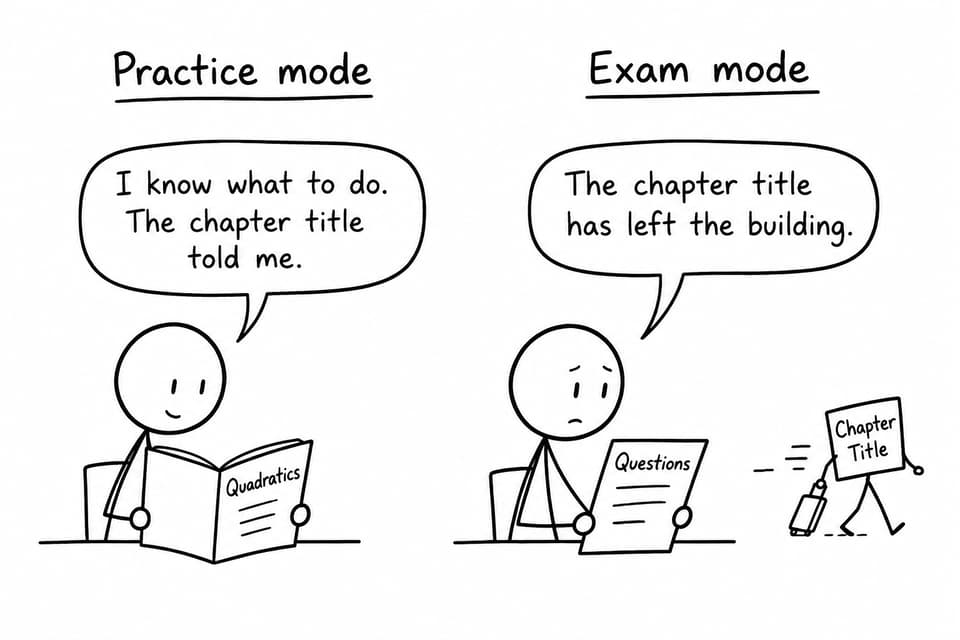
Starting IB DP1 can make revision feel deceptively simple. Your class finishes quadratics, so you practise quadratics. The next week brings trigonometry, so you practise trigonometry. Every question appears beneath a heading that quietly tells you which method to use.
The exam will not be so helpful.
Interleaving study means mixing related topics or question types within one practice session. Instead of completing 15 identical problems, you might alternate among quadratics, functions, and trigonometry. In Chemistry, you could mix stoichiometry with bonding and energetics. This forces you to identify the problem before solving it, one of the central demands of IB Maths and Sciences.
Learn a topic clearly before interleaving it. Mixing methods too early produces confusion. Mixing them after initial understanding develops flexible knowledge.
Interleaving study at a glance
Use this checklist when planning a session:
- Choose two or three related topics you have already learned.
- Mix short questions rather than completing one full topic at a time.
- Hide labels that reveal the required method.
- Explain why you selected each formula, model, or procedure.
- Mark your work and classify the mistake.
- Revisit difficult questions after a delay.
- Keep some blocked practice for genuinely new or weak material.
Interleaving is not random chaos. It is controlled variety, with enough similarity to make comparison useful and enough difference to make you choose.
Why blocked practice can create false confidence
Imagine answering ten differentiation questions in succession. By question three, you are no longer deciding whether differentiation is appropriate. The chapter heading, previous question, and repeated format have already made that decision for you.
Speed feels like learning, but some improvement comes from keeping the same procedure active in working memory.
Mixed practice removes that prompt. When a rate-of-change question appears beside problems about functions and sequences, you must diagnose its structure. Is the question asking for a derivative, equation, pattern, or numerical model? That decision is part of the mathematical work.
A 2019 cluster-randomized classroom study published in the Journal of Educational Psychology compared interleaved and blocked mathematics assignments across 54 seventh-grade classes. One month later, the interleaved group performed better on an unannounced assessment. The learners were younger than IB students, so the result should not be transferred uncritically. Still, it supports the principle that distinguishing among strategies can improve later performance.
Research reviews also suggest interleaving is not universally superior for every material or learner. Its value depends on what is mixed and how well the content is understood. That is why effective IB study techniques combine interleaving with explanation, retrieval, feedback, and spacing.
Why mixing topics works in IB Maths
IB Maths questions rarely reward formula recognition alone. They test whether you can interpret information, select an approach, execute it accurately, and judge whether the result makes sense.
Interleaving strengthens the selection step. Consider this mixed set:
- Find the vertex of a quadratic model.
- Determine whether a sequence is arithmetic or geometric.
- Use trigonometry to calculate an unknown length.
- Interpret the gradient of a function in context.
- Solve an exponential equation.
The productive difficulty comes from switching. You must notice cues such as constant differences, ratios, right-angled geometry, rates of change, or exponential structure.
This also reveals confusion between similar methods. A student may know the sine rule and cosine rule when each appears in its own worksheet, yet hesitate when no heading identifies which one applies. That hesitation is useful evidence that knowledge has not yet become flexible.
A good DP1 progression is:
| Stage | Best practice format |
|---|---|
| First encounter | Worked examples and a small blocked set |
| Basic understanding | Questions with gradually reduced support |
| Growing confidence | Two related topics mixed together |
| Secure understanding | Three or four topics in varied order |
| Review | Timed mixed questions with error analysis |
RevisionDojo’s guide to combining Maths practice with active recall adds another layer. Before calculating, retrieve the relevant conditions, definitions, and formulas from memory. The IB Math AA HL study plan can help place that practice within a sustainable week.
How interleaving applies to IB Sciences
Science interleaving should mix decisions, not merely vocabulary. The aim is to compare explanations, calculations, graphs, experimental designs, and data-based reasoning.
Biology
Within a connected area, mix questions requiring different kinds of thinking. A session on cells might involve identifying a structure, explaining membrane transport, interpreting an unfamiliar graph, and evaluating an investigation.
This prevents revision from becoming pure fact recognition. A broader IB Biology study strategy should therefore include data interpretation and extended responses alongside recall.
Chemistry
Chemistry offers natural opportunities because calculations depend on conceptual understanding. Try mixing:
- amount-of-substance calculations
- equations and mole ratios
- bonding explanations
- energetics calculations
- periodic trends
One question may require , while the next asks you to explain a difference in boiling point. The switch prevents the previous formula from automatically controlling your next answer.
Physics
Physics students can mix kinematics, forces, energy, and momentum after learning each foundation. Before using a calculator, write a method label such as “conservation of energy” or “constant acceleration,” then justify it from the information given.
That pause separates model selection from calculation. It exposes a common problem: remembering equations without recognizing their conditions.
What DP1 students should and should not mix
Interleaving works best when topics are related enough to be compared or confused. Mixing differentiation with integration can be useful. Mixing new calculus with an unrelated topic you barely understand may create unnecessary overload.
Mix familiar foundations. If you cannot complete a basic question with notes, return to explanation and blocked practice. RevisionDojo Study Notes and AI Chat can clarify the concept before you mix it with others.
Keep the set small. Two topics are enough at first. A session involving eight chapters, three subjects, and constant task-switching is fragmentation, not sophisticated interleaving.
Mix within a subject before mixing subjects. Alternating Maths with Chemistry is usually less useful than mixing several mathematical methods. The productive comparison happens between competing approaches.
Preserve feedback. Marking only after a large set allows misconceptions to repeat. Use the Questionbank and Grading tools to check short batches, then ask AI Chat to explain why a method failed.
Space the next encounter. Interleaving changes the order within practice. Spacing means returning after time has passed. They work well together, but they are not identical. The IB memory techniques guide explains how retrieval and spacing complete the process.
A 30-minute interleaving routine to start today
You do not need to rebuild your timetable. Start with one short session.
Minutes 0-3: Choose the mix. Select two secure topics and one slightly weaker topic, such as quadratics, sequences, and functions.
Minutes 3-8: Retrieve. Without notes, write key formulas, definitions, diagrams, or decision rules. Check them against your Study Notes and turn gaps into Flashcards.
Minutes 8-23: Solve six mixed questions. Choose two from each topic and shuffle their order. Before each solution, write the expected method and one reason for choosing it.
Minutes 23-28: Mark and diagnose. Classify each lost mark as a knowledge gap, method-selection error, algebraic or numerical slip, misread instruction, or incomplete explanation.
Minutes 28-30: Schedule the return. Add the hardest two questions to a mixed session later in the week. A delay makes retrieval meaningful.
If scheduling is the obstacle, place this routine inside an IB time-management system. Consistency matters more than creating a perfect revision calendar.
Turn mistakes into the next mixed set
The most useful question after practice is not “What score did I get?” It is “What decision failed?”
Suppose you calculate a gradient correctly but fail to interpret its units. The next set should move between calculation and contextual interpretation. If you choose the wrong mechanics model, mix similar-looking problems requiring energy, momentum, or force reasoning.
This is deliberate interleaving. Your errors determine the next session.
RevisionDojo makes that loop easier. Use the Questionbank for controlled mixtures, Study Notes when foundations need repair, Flashcards for definitions and conditions, AI Chat for explanations, and Grading tools for specific feedback. Later, Predicted Papers and Mock Exams can test broader selection under time pressure, while the Coursework Library and Tutors support work requiring different guidance.
For further examples of combining tools rather than relying on one technique, read how top IB students structure revision.
Build flexibility before the workload grows
DP1 is an ideal time to begin interleaving study because the goal is not frantic coverage. It is to build habits that make knowledge usable.
Learn new content in a clear block. Practise until the basic method is stable. Then mix it with related ideas, retrieve what you need, explain your choice, and study your errors. That sequence is harder than repeating a comfortable worksheet, but it resembles the decisions an exam requires.
To begin, save a relevant Flashcard deck to your free RevisionDojo account. Use it for five minutes of retrieval, then open a small mixed Questionbank set. The deck is not the whole session. It is the useful first step that gets the session moving.