

Introduction: The quiet moment TOK is really testing
The most dangerous sentence in IB season is the one you whisper to yourself at 1:17 a.m.: “It’s fine. Everyone does it.” It might be about borrowing a classmate’s phrasing, lifting a clever example from an online post, or letting an AI tool “tighten” a paragraph until it no longer sounds like you.
TOK is where that sentence gets challenged.
Because TOK is not only a course about knowledge. It’s a course about you as a knower: your habits, your honesty, and your willingness to tell the truth about how you reached a conclusion. In your essay and exhibition, your marks don’t come from sounding sophisticated. They come from thinking in a way an examiner can trust.
Integrity in TOK is what turns a set of ideas into a credible voice.
If you want a big-picture map of the course as you revise, keep the IB Theory of Knowledge (TOK) hub open while you work.
TOK integrity checklist (save this before you draft)
Use this quick scan before any TOK essay paragraph, exhibition commentary, or final export:
-
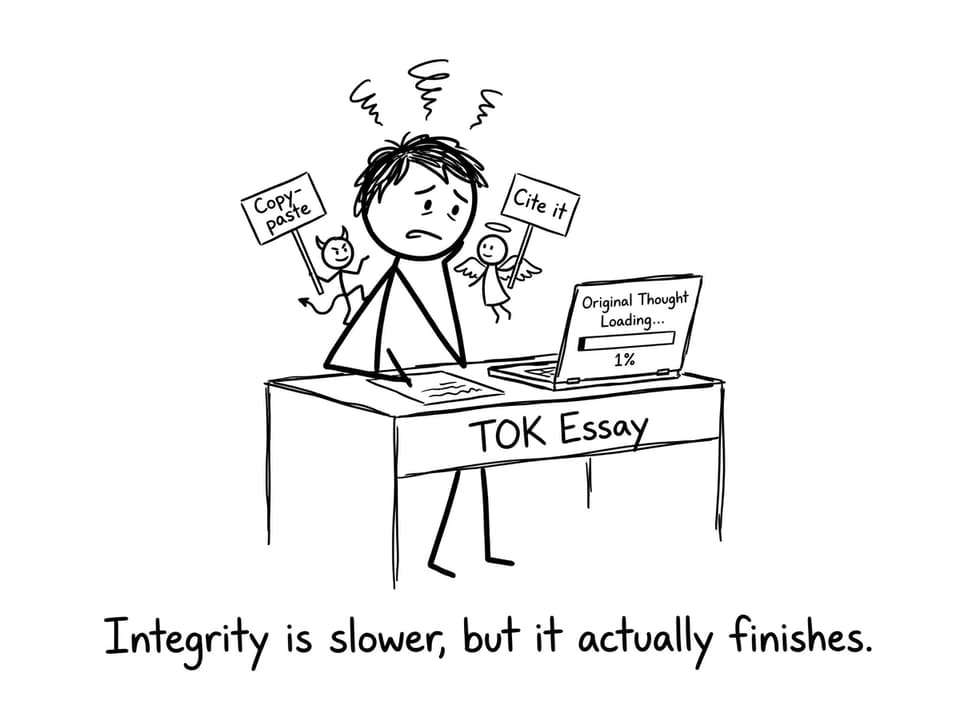
Can I explain how I got every claim? If you can’t defend the path, you can’t defend the conclusion.
-
Have I credited every external idea? If it isn’t yours, label it.
-
Are my examples verifiable and specific? “A study said…” is a red flag in TOK.
-
Do I have genuine evaluation? Not just claim/counterclaim, but why the tension matters.
-
Is AI support clearly limited? Use tools for feedback and clarity, not authorship.
-
Does my voice sound like me? Examiners read thousands of TOK scripts. Authentic writing has a pulse.
For exam-focused writing habits that translate directly into marks, see TOK Thinking and Skills: How to Succeed in IB TOK.
What integrity means in TOK (beyond “don’t plagiarise”)
Most students hear “integrity” and think only of plagiarism. In TOK, integrity is wider and more interesting. It includes:
Intellectual honesty
In strong TOK, you admit uncertainty without collapsing into vagueness. You acknowledge what your example can and cannot show. You don’t pretend your argument is airtight if it isn’t.
Respect for other knowers
Your essay and exhibition are conversations with other minds: historians, scientists, artists, communities, and sometimes your own classmates. Integrity means you treat those minds fairly and you don’t misquote, cherry-pick, or use a source as decoration.
Authorship
The IB doesn’t need you to be a philosopher. It needs you to be the author of your reasoning. In TOK, your credibility comes from being able to say: “This is my line of thought, and here’s what shaped it.”
If you want a broader integrity framework across the IB (useful when exam pressure rises), read How RevisionDojo Helps You Maintain Academic Integrity While Studying.
The temptation trap: recycled examples and “template thinking”
There’s a specific kind of panic that happens when you search for TOK examples online. You find an example that looks perfect: famous, dramatic, and already analysed. The danger is not that you use it. The danger is that you use it the way everyone else uses it.
Integrity in TOK doesn’t mean you must invent brand-new real-world situations. It means your TOK writing must show ownership:
-
You can summarise the example accurately.
-
You can explain why it matters for your knowledge question.
-
You can evaluate it from more than one perspective.
-
You can connect it to an Area of Knowledge without forcing it.
A practical rule: if your example could be swapped into any essay title, it’s probably too generic.
When you need structured planning for the current prompts, use the RevisionDojo Ultimate TOK May 2026 Essay Guide.
Writing original knowledge questions in TOK (without being “unique” for the sake of it)
Originality in TOK is often misunderstood. It’s not about producing the strangest question in your class. It’s about producing a question that genuinely creates room for evaluation.
A reliable method:
Start from a real tension
Look for a moment where two reasonable people could disagree: a controversial historical interpretation, a disputed scientific model, a moral dilemma in technology, or even a personal experience where memory felt unreliable.
Make the question neutral
If the wording already implies the answer, your TOK argument will become a speech, not an inquiry.
Make it answerable in 1,600 words
A good TOK knowledge question is focused enough to explore, but open enough to evaluate.
If you’re also preparing the exhibition, you can build better questions by aligning the tasks. Try Linking the May 2026 TOK Essay to the Exhibition so your examples don’t feel split across two different worlds.
Ethical referencing in TOK: simple, visible, examiner-friendly
You don’t need to drown TOK in citations. But you do need transparency. The examiner should never wonder where an idea came from.
Use these habits:
-
Signal phrases: “As Kuhn argues…”, “A BBC report on…”, “A museum label describing…”
-
Image credits: every image used in your exhibition documentation needs a source.
-
A short reference list: keep it clean and real. Only include what you actually used.
-
No fake authority: a made-up reference is worse than no reference.
Integrity also means accuracy. If your real-world example includes data, dates, or quotes, verify them. In TOK, a shaky fact doesn’t just weaken evidence; it weakens trust.
To strengthen your general IB integrity habits (especially under pressure), keep Building a Culture of Academic Honesty in IB Classrooms bookmarked.
TOK exhibition authenticity: three objects, one honest voice
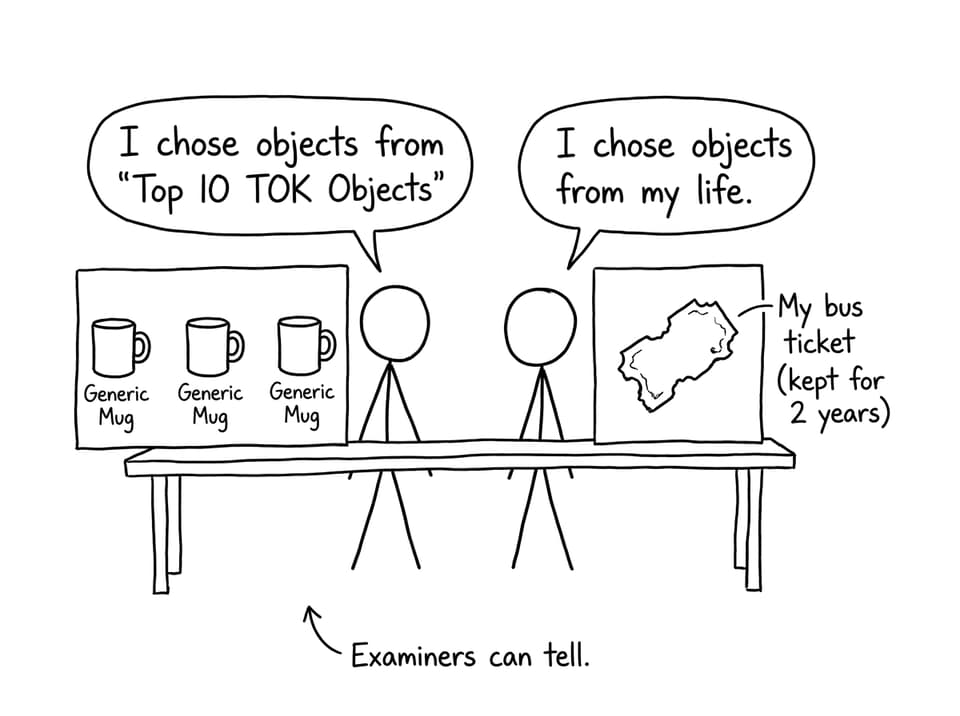
The TOK exhibition is a strange assessment because it looks simple: choose a prompt, choose three objects, write a commentary. But the scoring difference is usually not “better objects.” It’s better justification.
Integrity shows up in the exhibition when:
-
Your objects have specific context (where from, why you have them, why they matter).
-
Your links to the prompt are explicit, not symbolic.
-
You admit limitations: “This object suggests X, but it may not capture Y because…”
If you’re still selecting objects, use Selecting TOK Exhibition Objects That Score and What are the TOK Exhibition Prompts? to interpret prompts as lenses rather than topics.
For examples you can learn from without copying, explore the TOK Exhibition exemplars library. Use it like a mirror for quality, not a script for content.
Responsible AI use in TOK: support your thinking, don’t replace it
Let’s be honest: AI is everywhere in exam season. So integrity in TOK needs a practical approach, not moral panic.
A strong boundary is this:
-
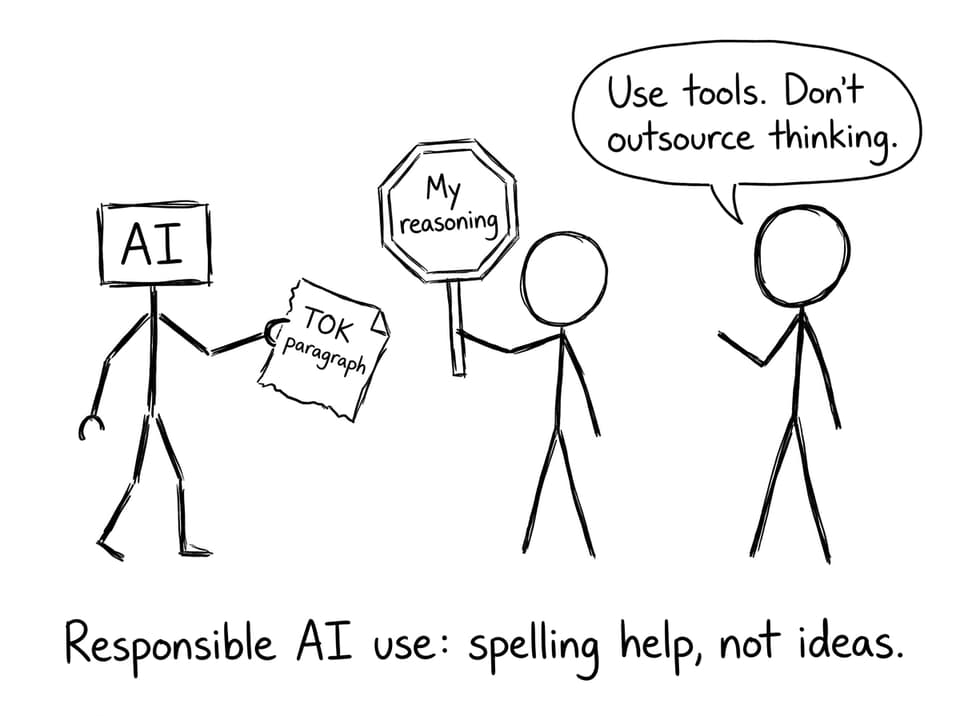
AI can help you plan, check clarity, and spot weak reasoning.
-
AI should not write your analysis, invent your examples, or produce your final phrasing.
Why? Because TOK is assessing the shape of your reasoning. If a tool supplies the reasoning, the work stops being evidence of your thinking.
RevisionDojo makes this boundary easier to follow. You can draft in your own voice, then use the IB Coursework Grader for rubric-aligned feedback on structure, clarity, and criterion focus. Pair that with RevisionDojo’s AI Chat to ask questions like “Which assumption am I making here?” or “Where is my counterclaim too weak?” That keeps authorship with you.
How RevisionDojo helps you practise TOK with integrity
Integrity becomes easier when your workflow rewards learning, not shortcuts. RevisionDojo is built for that.
-
Study Notes clarify core TOK concepts so you’re not tempted to borrow someone else’s explanation.
-
Flashcards help you retain key language (AOKs, methods, common knowledge issues) so you can write confidently in your own words.
-
Questionbank builds exam-style thinking habits: interpret a prompt, make a claim, test it, refine it.
-
AI Chat supports your process like a tutor: questioning assumptions, strengthening evaluation.
-
Grading tools give criterion-aligned feedback without turning your work into a generic template.
-
Mock Exams and Predicted Papers simulate pressure so you can stay honest when it counts.
-
The Coursework Library provides exemplars to calibrate standards responsibly.
-
Tutors help you talk through your thinking without taking over your writing.
To see how exam practice tools fit into a calm revision loop, read RevisionDojo App: The Smarter Way to Prep for IB Exams and explore the Questionbank feature.
FAQ
What does academic honesty mean in TOK specifically?
Academic honesty in TOK means your essay and exhibition demonstrate authentic inquiry. That includes writing in your own voice, using examples you can genuinely explain, and making your reasoning visible. It also means being transparent about what influenced your thinking, whether that’s a book, a documentary, a lecture, or a conversation. In practice, you should be able to point to any sentence and explain where it came from: personal reasoning, a source, or a clarified definition. Honesty also shows up in how you handle uncertainty, because TOK rewards careful evaluation more than confident exaggeration. Finally, academic honesty is not just avoiding misconduct; it’s building trust between you and the reader.
Can I use online TOK examples if I reference them?
You can use online examples in TOK, but you must use them responsibly. First, verify the facts using a credible source, because online summaries often contain errors or missing context. Second, your marks will come from your analysis, not the example itself, so you need to explain why the example creates a knowledge problem. Third, referencing is necessary but not sufficient: even with a citation, copying someone else’s interpretation is still weak TOK thinking. A good test is whether your paragraph would still make sense if the examiner asked you follow-up questions out loud. If you can defend it clearly, the example is serving you, not replacing you.
How should I reference sources in the TOK essay and exhibition?
In TOK, referencing should be light but unmistakable. Use signal phrases in the sentence where the idea appears, so the reader can immediately see what is yours and what comes from elsewhere. Keep a short reference list at the end with working links or full publication details, and make sure it matches what you actually used. For the exhibition, treat object images carefully: if you didn’t take the photo yourself, credit it. Also be consistent with one citation style so the presentation looks calm and credible. Most importantly, avoid “citation dumping” at the end; integrity works best when attribution is built naturally into your writing.
Is it ever okay to use AI in TOK work?
It can be okay to use AI in TOK if it supports learning without replacing authorship. For example, you can ask for clarification of a concept, get help spotting a missing counterclaim, or check whether your phrasing is clear. But you should not submit AI-generated analysis or paragraphs as your own, because then the work no longer demonstrates your reasoning. If you use AI in a meaningful way, follow your school’s guidance on disclosure, and keep drafts so you can show your process if asked. A practical habit is to write first, then use tools to edit for clarity, not content. TOK is ultimately evaluating you as a thinker, so keep the thinking human.
Conclusion: TOK integrity is a study strategy, not a slogan
The calm secret of TOK is that integrity is not something you add at the end. It’s something you build into your process: how you choose examples, how you phrase claims, how you admit limitations, how you credit other minds.
When you practise TOK with integrity, your work becomes simpler to write and easier to defend. You stop performing certainty and start demonstrating judgment.
If you want a system that makes ethical thinking easier under exam pressure, use RevisionDojo as your home base: revise with Study Notes, retain with Flashcards, practise with the Questionbank, stress-test with Mock Exams and Predicted Papers, and refine with AI Chat and Grading tools. That’s how TOK turns into marks, and into a habit of thinking you’ll keep long after the diploma.