
When you're deep in IB season, urgency multiplies.
A teacher mentions "this will be on the exam." Your group chat announces a surprise quiz. Your coursework starts blinking like a low-battery warning. And suddenly your brain does the one thing it thinks will keep you safe: it treats everything as an emergency.
The problem is that an IB student who studies like everything is urgent usually studies like nothing is clear. You bounce between subjects, half-starting tasks, collecting open tabs like trophies. You feel busy. But you don't feel calmer, and your marks don't rise in proportion to the effort.
This post is a reset button. Not motivational hype. A real system for what to do when everything feels urgent, so you can get back to steady, exam-focused IB preparation.
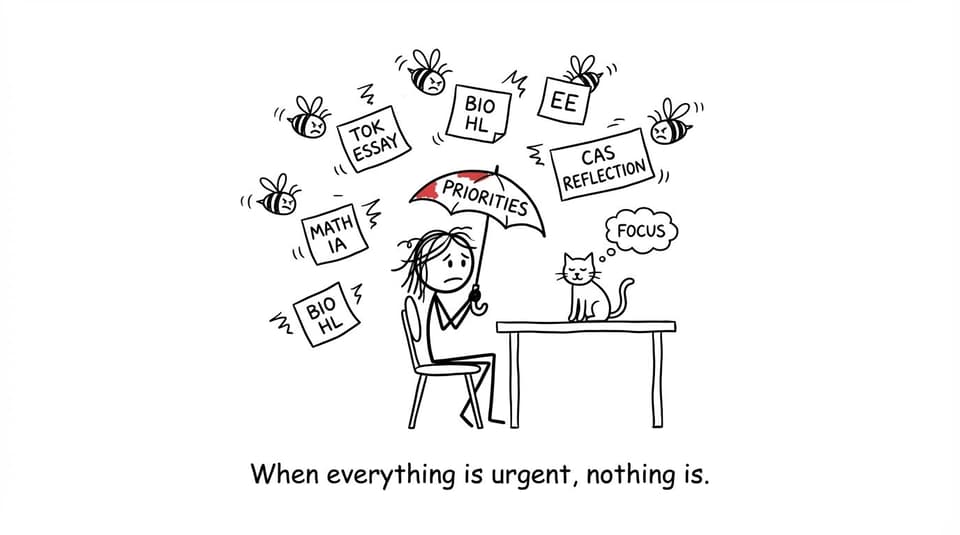
The IB "urgent feeling" (and why it lies)
In the IB, urgency often shows up when you're actually facing uncertainty.
Not "I have too much work," but:
- "I don't know what will be assessed."
- "I don't know what to revise first."
- "I don't know if I'm improving."
Your brain hates uncertainty, so it replaces it with motion. The motion looks like productivity: rewriting notes, reorganizing folders, watching yet another explainer video. But motion isn't always progress.
Progress, in the IB, is measurable: can you answer questions under pressure, with the right command terms, in the right time?
That's why your first goal isn't to "do more." It's to reduce uncertainty.
A good place to ground yourself is the overview of what the diploma is really asking you to do: International Baccalaureate (IB).
A quick checklist: what to do when everything feels urgent
Keep this list somewhere you can see it. When urgency spikes, you don't need a new personality. You need a script.
- Write down every urgent task in one place (one list only).
- Triage by grade impact and time sensitivity.
- Choose one high-impact task for the next 45 minutes.
- Use active recall: questions + flashcards, not rewriting.
- End the session by logging mistakes and scheduling the next block.
If you need a full exam-prep structure to plug this into, read: How to Study for IB Exams: Step-by-Step Guide.
IB triage: separate "urgent" from "important"
Here's the mental shift that changes everything:
Urgent means "it's loud."
Important means "it moves your grade."
The IB rewards important work: practice that looks like the exam, feedback that matches mark schemes, and repetition that targets weaknesses.
So triage like an emergency room:
The 4-box filter (fast and honest)
Take your urgent list and label each item:
- Red (Do today): high grade impact + deadline within 48 hours.
- Orange (Schedule): high grade impact + deadline later.
- Yellow (Limit): low grade impact + deadline soon.
- Grey (Ignore for now): low grade impact + deadline later.
Example:
- Red: tomorrow's timed Paper section, a major coursework submission due in two days.
- Orange: a weak topic that repeatedly appears in your mistakes.
- Yellow: polishing formatting, "perfect" diagrams, extra decoration.
- Grey: reorganizing notes folders, rewriting "clean" notes.
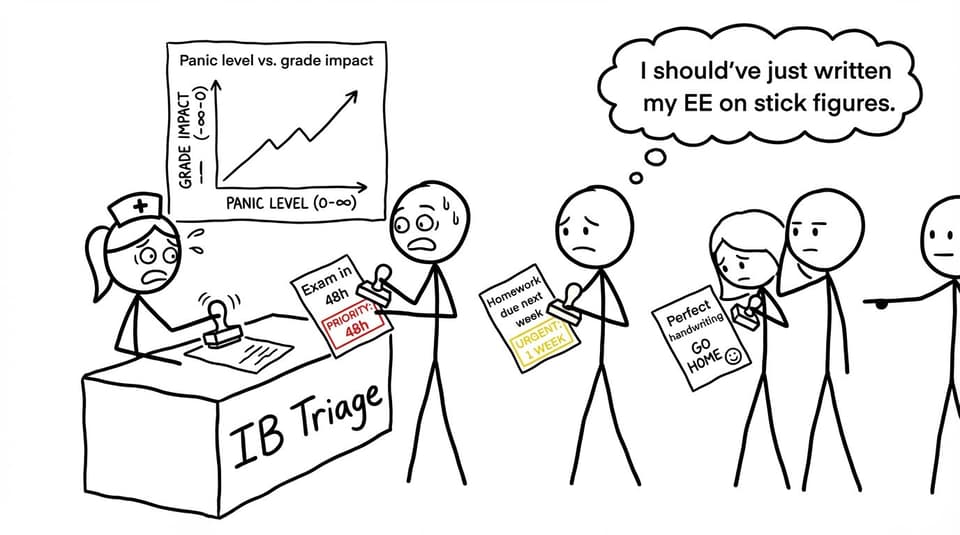
This is where RevisionDojo helps an IB student immediately: instead of guessing what's important, you can use exam-style practice and feedback loops to see what actually moves the mark.
Try the feature that turns uncertainty into a plan: Questionbank.
The "Two-List System" that stops panic spirals
When everything feels urgent, your brain keeps reopening the same loop: What should I do next? That question burns energy.
So you stop asking it.
List A: "Today"
Only 3 items max. Each must be:
- specific,
- finishable,
- and tied to IB outcomes.
Examples:
- "Do 20 Questionbank questions on Functions (HL) and review all mistakes."
- "Write one timed essay plan, then check against the mark scheme expectations."
- "Review 30 flashcards for definitions I keep missing."
List B: "Not Today"
Everything else goes here. This list is not failure. It's containment.
The IB is heavy partly because it's mentally loud. The Two-List System turns loud into quiet.
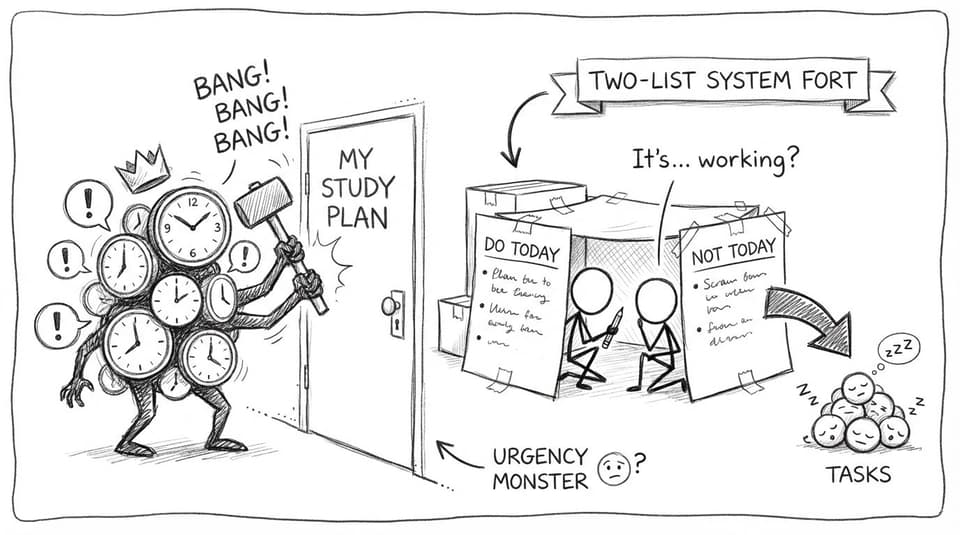
The IB 45-minute reset session (when you're overwhelmed)
When panic is high, do not design a six-hour plan. Do one high-quality block.
Here is the 45-minute reset that works across IB subjects:
Choose one topic (2 minutes)
Pick the topic that either:
- shows up often, or
- you keep getting wrong.
If you don't know what that is, that's your cue to start with exam-style questions so your mistakes tell you.
A strong guide to why this works: Comprehensive IB Question Bank: Thousands of Practice Questions.
Do focused practice (25 minutes)
Attempt questions under light timing. Not perfect timing, just real pressure.
Get feedback immediately (10 minutes)
In RevisionDojo, Jojo AI feedback and marking logic reduce the delay between mistake and correction. That delay is where confusion grows.
If you want a broader picture of how the platform fits together for IB exam prep, see: RevisionDojo App: The Smarter Way to Prep for IB Exams.
Convert mistakes into memory (8 minutes)
Turn errors into a tiny flashcard set:
- the definition you forgot,
- the step you skipped,
- the command term you misread.
This is where IB revision starts to compound.
If you want to make flashcards actually work (instead of becoming another pile), read: IB Flashcard System: Active Recall for Better Memory.
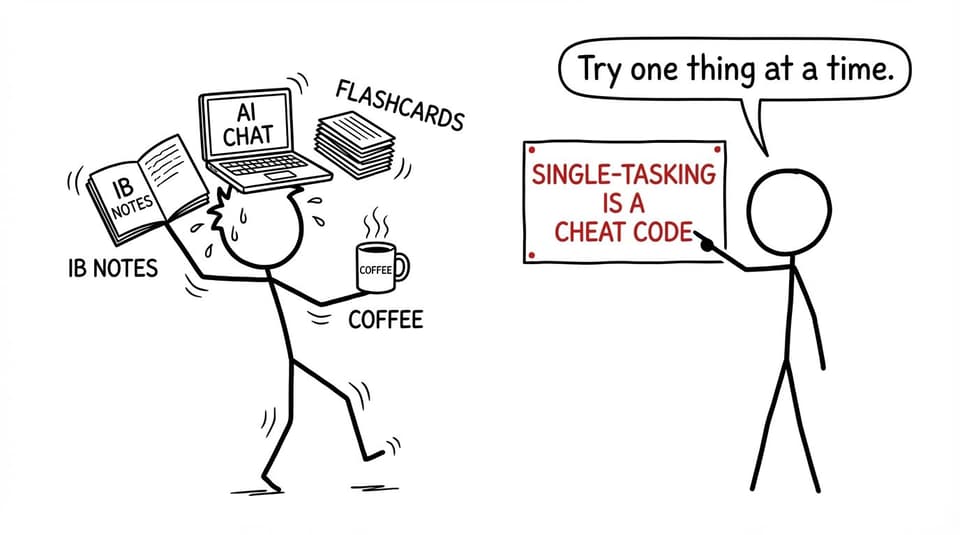
Stop multitasking: urgency thrives on context switching
Urgency makes you believe you should do many things at once.
But every time you switch between Chemistry and English and Math, your brain pays a tax. You lose focus, then try to buy it back with stress.
One of the cleanest IB rules is this:
Single-tasking is a grade strategy.
- One subject.
- One topic.
- One question set.
- One review.
That's also why RevisionDojo's workflow is built like a loop: Study Notes (clarity) to Questionbank (application) to Flashcards (retention) to AI Chat (unstuck) to repeat.
If you need a reminder that you can prepare for IB exams without sacrificing every evening, this piece helps: IB Exams Without Pausing Your Life.
When urgent is real: how to handle the last 7 days before an IB exam
Sometimes urgency isn't an illusion. Sometimes the exam is close.
In the final week, the winning IB strategy is not "learn more." It's:
- improve recall speed,
- sharpen technique,
- reduce careless errors,
- practice timing.
That's why "quick review" resources matter late in the game, especially when they reduce decision fatigue.
Use: IB Revision Notes: Quick Review Before Exams to keep your review tight and exam-aligned.
And then simulate pressure.
RevisionDojo supports this with Mock Exams and Predicted Papers that help the real exam feel familiar (not mythical). For timing workflows, see: How to Run Timed IB Mock Exams in RevisionDojo.
A calm study stack for IB students (and why it lowers stress)
A lot of IB stress comes from carrying too many tools: random PDFs, scattered decks, a dozen tabs, unclear mark schemes.
When your system is fragmented, your mind stays fragmented.
A calmer stack is integrated:
- Study Notes for fast understanding (and less rewriting).
- Flashcards for daily recall and spaced repetition.
- Questionbank for exam-style practice and targeted drills.
- AI Chat for quick clarification when you're stuck.
- Grading tools for coursework feedback that matches rubrics.
- Predicted Papers and Mock Exams for realism and stamina.
- Coursework Library to see what strong work looks like.
- Tutors when you need a human to untangle a knot quickly.
If you want a quick hub of what's available for IB students in one place: All your IB revision needs, in one place.
Closing: make urgent smaller, then make it measurable
The IB has a way of making decent students feel like they're behind, even when they're working hard. That's not a personal flaw. It's what happens when too many tasks compete for attention and none of them come with immediate proof of progress.
When everything feels urgent, do triage. Choose one block. Create feedback. Repeat.
If you want the most reliable way to turn urgency into calm, build your loop inside RevisionDojo: learn quickly with Study Notes, retain with Flashcards, prove it with the Questionbank, get unstuck with AI Chat, and rehearse the real thing with Mock Exams and Predicted Papers. Your future self doesn't need more panic. Your future self needs a system that makes IB progress visible.