

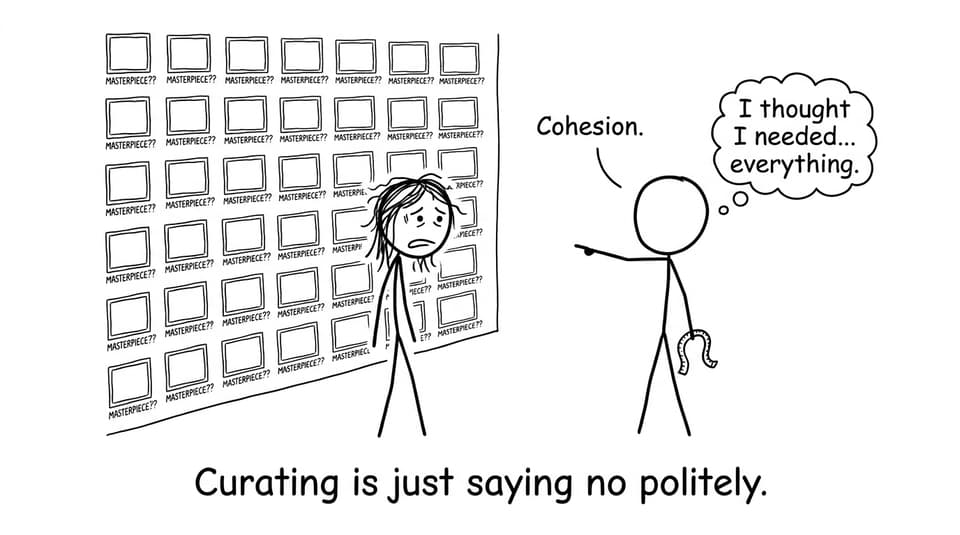
In the final weeks before an exhibition, most IB Visual Arts students don’t panic because they have nothing to show.
They panic because they have too much.
A drawer of experiments that taught you something. A painting you love but can’t explain. A risky piece that still feels unfinished (but honest). And then the quiet fear underneath it all: What if I choose the wrong works and the examiner never meets the real me?
Choosing artworks for your IB Visual Arts exhibition is less like picking your “best” pieces and more like editing a story. You’re deciding what the viewer needs to see to understand your intention, your growth, and your control of materials. And because the exhibition is assessed, your choices need to make sense both emotionally and strategically.
Quick curation checklist (save this)
Use this checklist to shortlist works before you worry about layout or labels:
-
Does each artwork clearly connect to my central idea or inquiry?
-
Do I show enough technical range without looking scattered?
-
Can I point to visible development across the selected works?
-
Is my personal voice obvious (not just my “skill”)?
-
Can I write a specific, evidence-based curatorial rationale for every piece?
If you want a bigger course overview first, keep this nearby: How to "Study" IB Visual Arts Effectively.
What the IB Visual Arts exhibition is really marking
The exhibition is often described as a showcase, but in IB Visual Arts it’s closer to a proof.
You’re proving that you can:
-
Build coherence across multiple artworks
-
Demonstrate variety and purposeful exploration
-
Show technical competence in your chosen media
-
Communicate conceptual depth (meaning, context, intention)
-
Justify choices through a clear curatorial rationale
If you haven’t read the criteria in plain language yet, use: How Examiners Grade the IB Visual Arts Exhibition.
Choose artworks like you’re building a single argument
A strong IB Visual Arts exhibition feels like one conversation with multiple voices. Even when the media changes, the thinking stays connected.
Start with one sentence you can defend
Before you select anything, write one sentence:
“This exhibition explores… (theme) through… (methods/visual language) to communicate… (why it matters).”
Now test each candidate work:
-
Does it support that sentence?
-
Does it deepen the inquiry, or repeat what you already said?
This doesn’t mean every piece must look similar. It means every piece must belong.
For theme and scoring signals, it helps to scan what tends to score well: Best Marked Art Styles in IB Visual Arts.
Pick a “spine” of 4-6 anchor works
Anchor works are the pieces that carry your main idea. They usually have:
-
the clearest intention
-
the strongest resolution
-
the most obvious connection to your research and development
Once your anchors are chosen, supporting works become easier to judge. A supporting work should either:
-
show a meaningful shift (risk, change of approach), or
-
reveal process and evolution that the final pieces don’t show alone
Show variety without losing coherence
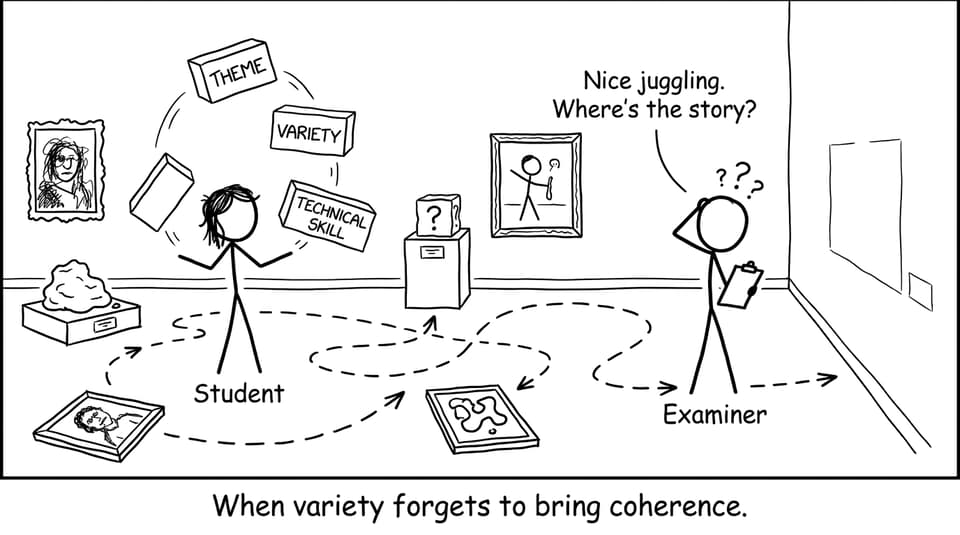
In IB Visual Arts, variety is rewarded when it looks intentional. Variety is punished when it looks like you changed your mind every week.
Use “controlled variety”
Try varying one major thing at a time:
-
same theme, new medium
-
same medium, new scale
-
same subject, new cultural/contextual lens
That way, the examiner can still follow your thinking.
Balance risk with resolution
A risky piece can be exhibition-worthy even if it isn’t the prettiest thing you made. But it must show:
-
decision-making (not randomness)
-
evidence of refinement
-
a reason it belongs in the story
If you’re unsure what “risk” looks like academically, read: Integrity and Originality in IB Visual Arts: Creating Authentic Work.
Choose pieces that make your growth visible
Examiners can’t grade your private thoughts. They grade what they can see.
So your selection should make development obvious:
-
early experiments that lead to a breakthrough
-
a mid-course shift in materials or symbolism
-
a final outcome that resolves a problem you struggled with
A simple trick: line your candidate pieces up chronologically (photos are fine). If the sequence doesn’t show progression, swap in works that do.
For a fuller “portfolio to exhibition” view, this helps: IB Visual Arts Portfolio: Build One Examiners Remember.
Curate for space, flow, and viewing experience
Your exhibition is judged as a viewing experience, not a folder of images. In IB Visual Arts, display choices quietly signal professionalism.
Think in sightlines, not just walls
Ask:
-
What does the viewer see first?
-
Where do they pause?
-
What’s the final work they leave with?
A layout that guides attention can make the same artworks feel clearer and more intentional.
For practical setup planning, use: IB Visual Arts Exhibition Setup Tips for High Marks and Mistakes to Avoid in IB Visual Arts Exhibition Layout.
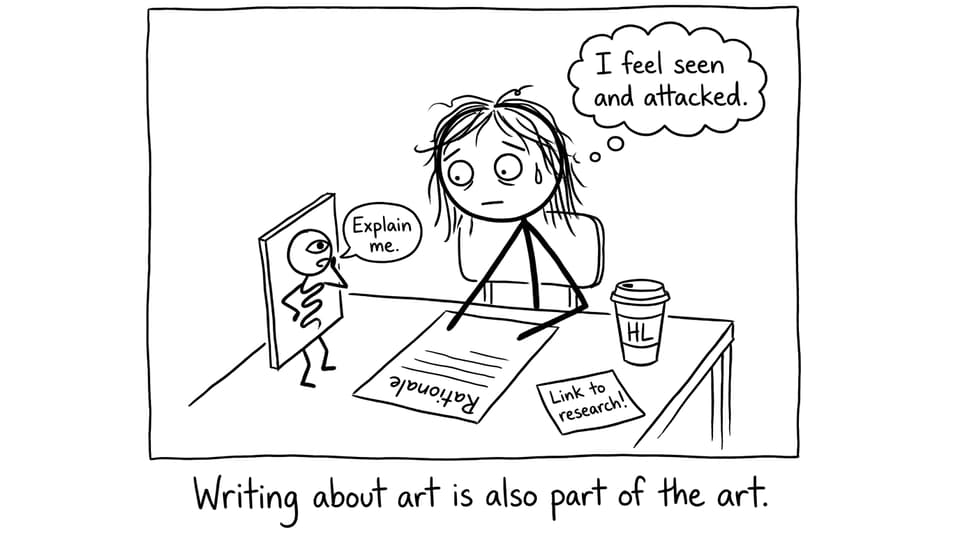
Your curatorial rationale is part of the selection
Here’s the uncomfortable truth: in IB Visual Arts, an artwork you can’t explain is often an artwork you shouldn’t include.
Not because it’s “bad,” but because you’re assessed on intention and justification.
When you shortlist pieces, draft 2-3 bullet points for each:
-
intention (what you wanted to communicate)
-
key decisions (materials, composition, process choices)
-
context (artist influence, cultural reference, research link)
If a piece produces vague bullets like “I liked the colors,” it may be a studio success but an exhibition liability.
A practical selection method (that keeps you sane)
Use this three-round method to choose works for your IB Visual Arts exhibition:
Round 1: The emotional cut
Pick the works you’d fight for if someone tried to remove them. Don’t overthink.
Round 2: The rubric cut
Now remove anything that doesn’t clearly support coherence, variety, technical competence, and conceptual depth.
Round 3: The viewer cut
Lay the remaining works in an order. If two pieces compete for the same role, keep the one that:
-
is more resolved, or
-
shows more growth, or
-
is easier to justify in your rationale
How RevisionDojo helps you curate with confidence
Exhibition stress often comes from guessing what matters. RevisionDojo reduces the guesswork.
-
Use the Coursework Library and IB Visual Arts Examples to see what coherent, well-justified selections look like.
-
Build your art vocabulary and criteria awareness with IB Flashcards with Spaced Repetition (SRS).
-
Practice exam-style thinking across the Diploma using the free Questionbank, then use AI Chat and grading tools inside RevisionDojo to tighten explanations and markband language.
-
When deadlines compress, Predicted Papers and Mock Exams help you train the skill that matters most: performing under time and pressure.
Final thought: curate like you respect your own time
Your exhibition is not a greatest-hits album. It’s a carefully edited narrative of what you learned, what you chose, and what you can now control.
If you treat selection as storytelling, IB Visual Arts becomes less mysterious. You stop asking, “Which work is my best?” and start asking, “Which works make my intention undeniable?”
When you’re ready to tighten your choices, draft your rationale, and check your rubric alignment, use RevisionDojo’s Visual Arts guides and tools to move from uncertainty to clarity, and to walk into the exhibition knowing you’ve curated with purpose.