

Introduction
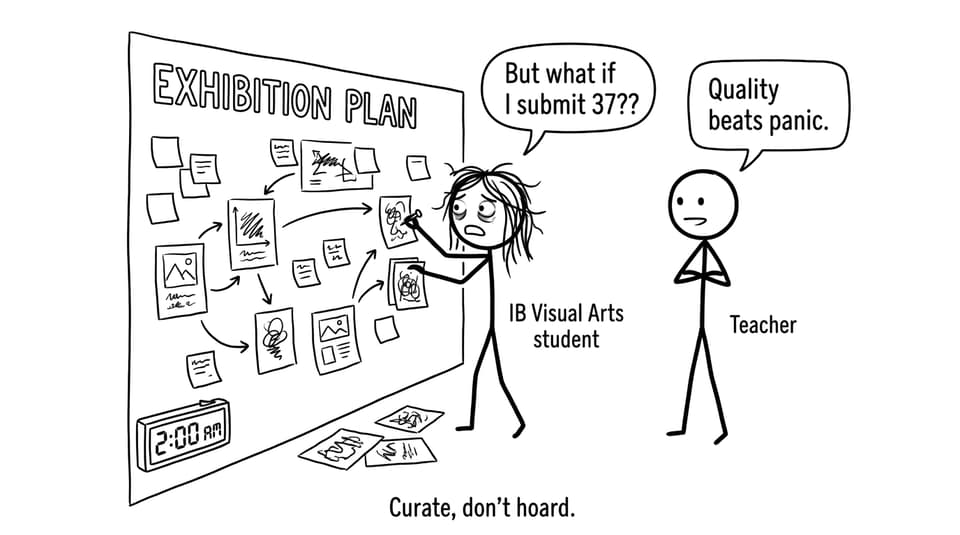
The night before a deadline, every piece you’ve ever made suddenly looks “exhibition-worthy.” That half-finished experiment? A bold concept. That tiny sketch? A “study in restraint.”
But IB Visual Arts doesn’t reward panic-piling. It rewards curation: selecting a clear, coherent set of resolved works that shows growth, intention, and control.
If you’re asking “How many artworks do I need for the exhibition?” you’re really asking something deeper: How do I hit the requirements without diluting my strongest work? Let’s make it simple.
The official IB Visual Arts exhibition requirements
For the IB Visual Arts Exhibition, the numbers are fixed:
-
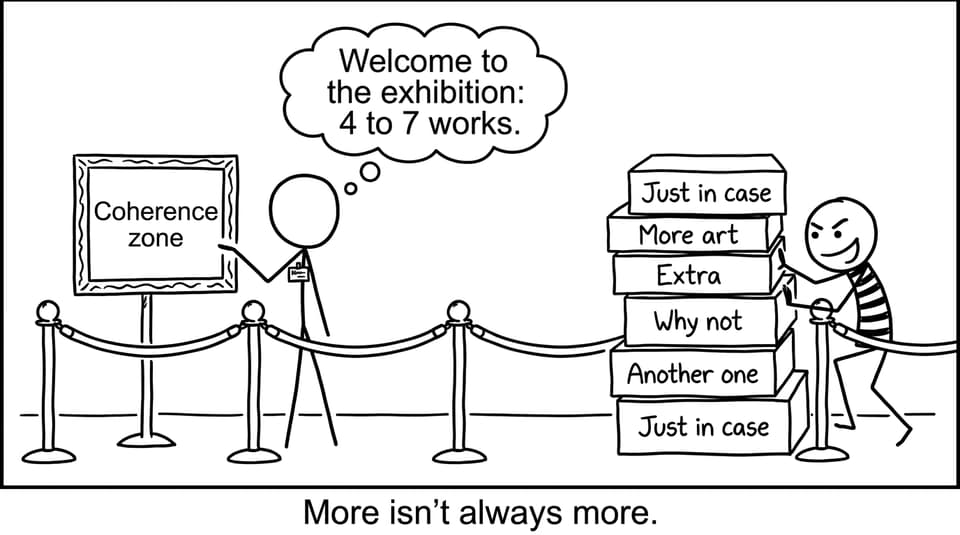
SL: 4-7 artworks
-
HL: 8-11 artworks
Submitting fewer than the minimum risks losing marks because you’re not meeting the component requirements. Submitting at the top end is allowed, but only helps if every piece earns its space.
For a broader course view (Comparative Study, Process Portfolio, Exhibition), see Requirements for IB Visual Arts.
Quick checklist: choosing your final number
Before you lock in your count, use this fast filter (it works for IB Visual Arts SL and HL):
-
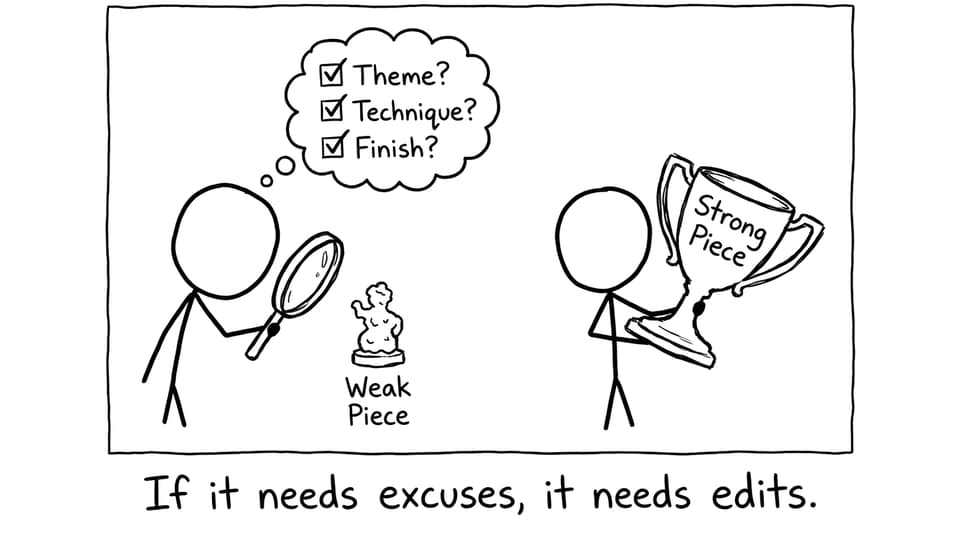
Does every artwork feel resolved (not “almost”)?
-
Can you explain how each piece supports your theme in one sentence?
-
Do you show variety (media, scale, approach) without chaos?
-
Would removing your weakest work make the set stronger?
If you want deeper context on what the Exhibition is testing, read The Exhibition in IB Visual Arts: What You Need to Know.
Why the number of artworks matters in IB Visual Arts
In IB Visual Arts, quantity is never the point. The number matters because it changes what the examiner can see:
Coherence gets harder as you add work
With 4 strong pieces, unity is easier. With 11, one off-theme artwork can make the whole exhibition feel unfocused. If you’re unsure what “coherent” looks like to examiners, use How Examiners Grade the IB Visual Arts Exhibition.
Variety should look intentional, not random
A painting + photo + sculpture can be powerful if they’re speaking the same conceptual language. Variety that feels like “I tried everything” can read as uncertainty.
Your curatorial rationale has to carry the set
More artworks means more curatorial decisions to justify. HL students especially need their selection to feel deliberate. For level comparison, see SL vs HL in IB Visual Arts: What's the Difference?.
How to decide your final exhibition count (SL and HL)
A practical approach many IB Visual Arts students use:
Start at the minimum, then add only “earned” pieces
-
If you’re SL, build a strong 4 first.
-
If you’re HL, build a strong 8 first.
Then only add a piece if it clearly improves the exhibition: stronger technique, deeper concept, better variety, or clearer narrative.
Aim for the top end only if you have consistency
7 (SL) or 11 (HL) can work beautifully, but only when the weakest piece is still genuinely strong.
Use external feedback early
If you’re stuck, it’s usually a selection problem, not a making problem. RevisionDojo helps you pressure-test choices with tools like AI Chat, and if you need human eyes, Tutors can help you spot what feels inconsistent.
You can also browse high-quality models in the IB Visual Arts Examples Coursework Library.
Common mistakes that lower exhibition marks
These show up a lot in IB Visual Arts:
-
Stuffing the show: adding filler work “just to reach the maximum.”
-
Keeping unfinished pieces: an interesting idea still needs resolved execution.
-
Breaking your theme: one unrelated artwork can confuse the whole reading.
-
Forgetting the written logic: the curatorial rationale must explain why each work belongs.
If your portfolio evidence feels messy, it may help to revisit how experimentation should be documented in What Examiners Look for in the IB Visual Arts Process Portfolio.
Conclusion: hit the range, then curate like it matters
For the IB Visual Arts Exhibition, the requirement is simple: SL needs 4-7 artworks, HL needs 8-11 artworks. The harder (and more important) part is choosing a set that feels coherent, resolved, and intentionally varied.
If you want a calmer workflow, RevisionDojo supports the full cycle: build understanding with Study Notes, refine decisions with AI Chat, strengthen recall with Flashcards, and get structured support through the Coursework Library, Grading tools, and Tutors. Your exhibition isn’t a storage shelf for everything you made. It’s your story, edited on purpose.
Explore more IB Visual Arts guidance here: All IB Visual Arts Posts.