
Results day compresses two years of work into a few numbers on a screen. For a parent, the instinct is often to decode those numbers immediately, predict every consequence, and start solving. Your child may need something different.
Here is the short answer: students access their IB exam results online, review their subject grades, total points, core outcome, and diploma status, then compare those results with any university conditions. Parents are most helpful when they prepare the practical details beforehand, let the student control how the results are opened, and postpone major decisions until the initial emotion has settled.
This IB results day guide for parents explains the experience itself: what appears, what to say, what not to say, and what happens when the outcome is better or worse than expected.
The parent checklist for IB results day
Before the day arrives, help your child confirm the following:
- They have their personal code and individual PIN from the IB coordinator.
- They know their individual release time and can access the candidate website.
- They have written down any university conditions, including total points and subject-specific requirements.
- They have decided whether they want to open the results alone, with you, or with someone else nearby.
- They know how to contact their IB coordinator and university admissions team.
- They have a quiet place, a charged device, and reliable internet access.
- Family members understand that the student decides when wider news is shared.
The practical preparation is deliberately ordinary. That is its value. A forgotten PIN can feel catastrophic when everyone is already tense, even though it says nothing about the result. RevisionDojo's IB results day countdown checklist can help students organize these details before emotion enters the room.

What happens when IB results are released?
For the May examination session, the IB currently makes Diploma Programme and Career-related Programme results available to candidates from 12:00 GMT on 6 July. Access is staggered, so each student should use the time shown on their individual PIN report or candidate account rather than assuming a friend's time applies to them. Schools receive May-session results on 5 July.
November-session arrangements follow a different schedule, with candidate access staggered by the school's local time zone. Because procedures and access times can be updated, the student's coordinator remains the best source for the exact release time.
Students sign in to the IB candidate website with the credentials supplied by their coordinator. The IB cannot provide those credentials directly to a parent or student for data-protection reasons, so missing details should be raised with the school.
Once inside, a Diploma Programme student will usually focus on five things:
- A grade from 1 to 7 for each subject
- The total Diploma Programme score out of 45
- Theory of Knowledge and Extended Essay grades
- Up to three core points from TOK and the Extended Essay
- Whether the IB Diploma has been awarded
Six subjects can contribute 42 points, while TOK and the Extended Essay can add up to three. A minimum total of 24 is required for the diploma, but reaching 24 is not sufficient by itself. Students must also satisfy the IB's other conditions, including requirements involving Higher Level and Standard Level totals, subject grades, the core, and CAS.
For a fuller interpretation, use RevisionDojo's guide to the IB grading system. The first task on results day, however, is simpler: record what the screen actually says before trying to explain why.
Let the student choose how the moment happens
Parents often imagine results day as a shared family event. Students may experience it as something more private. Ask beforehand: “Would you like me beside you, nearby, or available afterward?”
That small question gives control back to the person whose work is being measured. Avoid inviting relatives onto a video call, positioning a camera nearby, or asking siblings to wait for an announcement. Even positive attention can turn the moment into a performance.
Once the results appear, allow silence. A student may need time to understand whether an overall score also meets specific Higher Level or subject conditions. A delighted reaction may arrive slowly. So may disappointment.
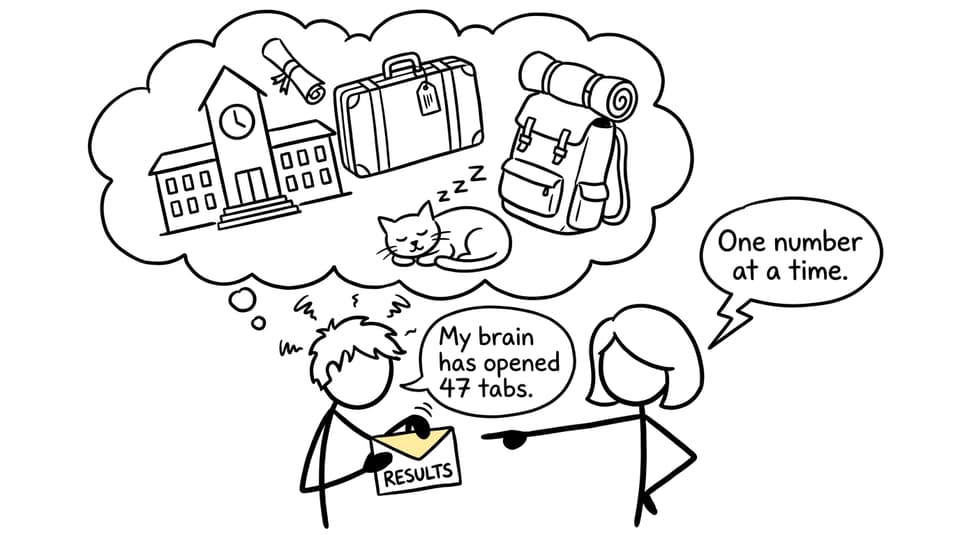
A useful first question is: “Do you want comfort, space, or help making a plan?” It is more effective than “What happened?” because it does not assume that something went wrong. RevisionDojo's advice on supporting students on IB results day offers additional scripts for keeping the first conversation calm.
What parents should say after the result
The result may influence a university offer, but it does not measure the whole two-year experience. Your first words should recognize the student before analyzing the score.
If the result is positive, try:
- “You worked hard for this. Take a moment to enjoy it.”
- “Would you like to celebrate privately first or tell people?”
- “What feels most important to you about this result?”
If the result disappoints them, try:
- “I know this hurts. We do not have to solve everything this minute.”
- “This result changes the plan, not your value.”
- “When you are ready, we can get the facts and look at the options.”
Avoid instant comparisons with predicted grades, classmates, siblings, or school averages. Also avoid saying that the result “doesn't matter.” It may matter deeply to the student, particularly when an offer depends on it. Reassurance works best when it acknowledges the consequence without treating that consequence as permanent.
What happens to university offers?
Where students authorized the IB to send an official transcript, participating universities can receive results electronically. UK applicants should confirm that UCAS was included correctly in the IB transcript arrangements; UCAS matches received IB results to applications and passes them to the universities holding offers.
An offer may depend on more than the total. It might require particular grades at Higher Level or in a named subject. Compare the exact offer with the exact result rather than focusing only on the score out of 45.
If every condition has been met, the next step is usually to wait for the institution's formal confirmation and follow its enrollment instructions. Admissions systems do not always update at the same moment as the IB portal, so a short delay is not evidence of a problem.
If a condition has been missed, the university may still be considering the application. The student should contact admissions promptly and politely, provide their applicant information and achieved result, and ask what options remain. RevisionDojo's guide to conditional IB university offers provides a clear framework for that conversation.
When the result is lower than expected
Disappointment creates urgency, but not every decision is equally urgent. Begin by writing down the total, subject grades, core result, diploma status, and relevant university conditions. Then contact the IB coordinator.
Ask the coordinator:
- How close was the subject result to the next grade boundary?
- Which assessment components contributed to the outcome?
- Would an Enquiry Upon Results be appropriate?
- What are the school's fees and internal deadlines?
- Would one changed grade materially affect a diploma or university decision?
An Enquiry Upon Results is the IB's formal review route. It must be submitted through the school, not directly by a parent or student. A re-mark can leave a grade unchanged, raise it, or lower it, so the school must obtain written consent where a result could change. The RevisionDojo guide to IB regrades and appeals explains the distinction between a re-mark and a later procedural appeal.
Closeness to a boundary is useful information, but it is not a promise of another point. The practical question is whether a review has a reasonable basis and whether a changed grade would alter the student's next step.
When the diploma is not awarded
A student who does not satisfy every Diploma Programme requirement still receives DP course results showing the grades earned in individual subjects and relevant core outcomes. The day may feel final, but several routes can remain: a university may consider the available results, another program may be suitable, or the student may explore a future examination session.
This is where parents can protect the student's decision-making. Do not announce a retake before the coordinator has explained the result. Do not assume that every subject must be attempted again. First establish the smallest change that would create the desired outcome.
The IB permits candidates to retake a subject in a future session, subject to its rules and registration through an IB World School willing to accept the candidate. Curriculum changes can affect what must be studied, and schools set their own fees. RevisionDojo's IB exam retake guide helps families compare that route with accepting the current result or changing plans.
The calmest sequence for the first 24 hours
Results day becomes more manageable when actions happen in order:
Record
Save the subject grades, total, core outcome, and diploma status. Check them against the exact university conditions.
Pause
Step away from the screen. Eat, walk, or sit quietly. Avoid group-chat comparisons while the result is still raw.
Confirm
Check whether the relevant university received the transcript and whether its admissions portal has updated. Contact the coordinator if information appears missing.
Investigate
If a grade matters, request boundary and component information. Learn the consequences and deadline before consenting to a review.
Decide
Choose among accepting the outcome, contacting a university, requesting an Enquiry Upon Results, considering a retake, or exploring another route. Not every choice must be completed on the same afternoon.
From results day to the next useful step
The most valuable thing a parent can bring to IB results day is not an answer. It is steadiness. Prepare the login details, understand what the screen contains, let your child control the moment, and move from emotion to evidence without pretending the emotion is unimportant.
If a retake or gap year becomes the right choice, preparation should begin with diagnosis rather than punishment. RevisionDojo brings the IB process into one place through its Questionbank, Study Notes, Flashcards, AI Chat, Grading tools, Predicted Papers, Mock Exams, Coursework Library, and Tutors. Students can revisit weak topics, receive focused feedback, and build a measured plan using the RevisionDojo IB resource hub.
A result can close one route. It can also reveal the next one. The parent's role is to help the student see that difference clearly.