
An IB remark is formally called an Enquiry Upon Results, or EUR. It is a request submitted after official results are released, usually asking the International Baccalaureate to re-mark a candidate's externally assessed work in one subject.
The most important detail: a re-mark can make a result rise, remain unchanged, or fall. It is not an automatic second chance or available for an ordinary DP1 school test. Your programme coordinator must submit the request, and written consent is required because the result may decrease.
Understanding this process during DP1 teaches a useful lesson: marks, scaled totals, and subject grades are related, but they are not interchangeable.
The short answer for DP1 students
Keep this checklist in mind:
- An Enquiry Upon Results applies to official IB examination-session results, not routine DP1 reports.
- A Category 1 EUR is the service commonly meant by an IB remark.
- The school coordinator submits it, not the candidate.
- The IB re-marks externally assessed components in the selected subject.
- The mark and subject grade can increase, stay unchanged, or decrease.
- Written consent is required before submission.
- Confirm fees and deadlines with your coordinator.
- Proximity to a higher grade boundary does not guarantee a change.
For context on subjects, points, and core requirements, see RevisionDojo's complete guide to the IB Diploma Programme.
What an IB remark actually reviews
A Category 1 Enquiry Upon Results is a re-mark of one candidate's externally assessed material for one subject. The IB explains in its assessment questions and answers that a candidate or legal guardian must provide written consent because a grade can be lowered.
The request concerns the subject, rather than one hand-picked response. Eligible externally assessed components are reviewed, but components that cannot be re-marked are not converted into examiner-judged work. Multiple-choice responses, for example, are objectively marked and are not re-marked in the same way as essays or extended responses.
Internally assessed work follows a different system. Teachers initially mark internal assessments, after which the IB moderates a sample to check the school's marking standard. An individual Category 1 request is therefore not a fresh marking of one student's internal assessment.
Students sometimes say, “My IA deserved two more marks, so I will remark it.” That is not how Category 1 works. Ask your coordinator which components contributed to the result and which EUR service addresses your concern.
How an Enquiry Upon Results works
Requests move through schools because results are official records.
| Step | What happens |
|---|---|
| Review the result | The student and coordinator inspect the scaled mark, grade, and distance from the next boundary where available. |
| Discuss the evidence | They consider component types, teacher expectations, university conditions, and downside risk. |
| Give consent | The candidate, or a legal guardian where required, accepts that the mark and grade may fall. |
| Submit through school | The coordinator requests the appropriate EUR category from the IB. |
| Await the outcome | The IB completes the service and communicates the result through the school. |
| Update records | A changed official result replaces the previous one. |
Do not wait until the published IB deadline. A school may set an earlier cut-off to collect consent, payment, and instructions. Fees may also be passed on differently by different schools. Your coordinator can confirm the amount and deadline applying to your case.
Worked example: marks and grade boundaries
Imagine a student receives a scaled subject mark of 68. The boundary for the next subject grade is 70, so the student is two marks below it.
Suppose the re-mark raises the externally assessed total enough to move the final scaled mark from 68 to 70. The student reaches the higher boundary, so the subject grade rises.
Now suppose the re-mark adds only one scaled mark, taking the result to 69. The mark improves, but the subject grade remains the same because 69 is still below 70. “My examiner gave me another mark” and “my IB grade increased” are not equivalent statements.
If fresh marking lowers the scaled mark, the result may remain in the same grade band or cross the lower boundary. The effect depends on the confirmed boundaries and overall recalculation, not simply on whether one response receives a different raw mark.
These figures are illustrative, not actual boundaries. Grade boundaries can differ by subject, level, component, and examination session. Use the official information accompanying your result rather than an old discussion thread.
When requesting a re-mark may be reasonable
A request deserves consideration when several facts point in the same direction.
The result is close to the next boundary
A small gap means a modest mark change could affect the subject grade. It does not mean the mark is probably wrong. Component weightings and the nature of the answers still matter.
RevisionDojo's guide to whether one extra IB point on a remark is rare explores why proximity improves the arithmetic without creating certainty.
The subject involves examiner judgement
Essay-based and extended-response work contains more professional judgement than objectively marked questions. That does not make the original result unreliable. It means there may be more room for legitimate re-evaluation than in components based on fixed answers.
A changed grade would have a practical consequence
One subject grade may affect a university condition, diploma outcome, scholarship requirement, or another threshold. Ask the institution what it needs and by when. Do not assume it will hold a place while an enquiry is processed.
The result conflicts with specific evidence
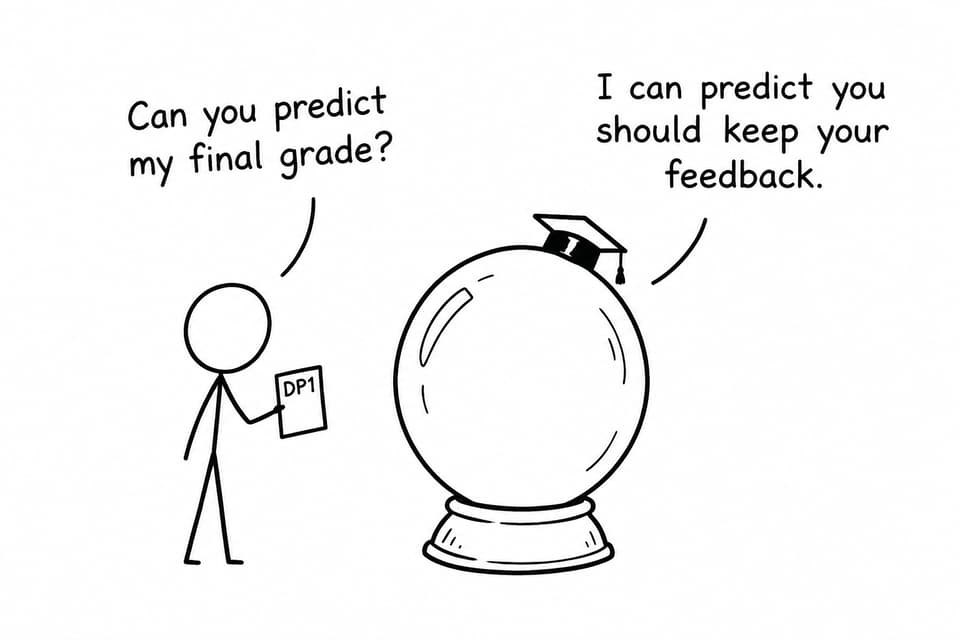
A teacher's surprise can be informative when based on sustained performance, comparable externally assessed tasks, and knowledge of the criteria. “I usually get good grades” is weaker evidence. A forecast is not proof of examiner error.
When caution is the better decision
A re-mark is less compelling when the result sits well inside its grade band. Several marks would need to move before the subject grade changes, while the existing mark remains exposed to downward revision.
Caution is also sensible when the disappointment concerns an internally assessed component that Category 1 will not re-mark, or when a student assumes a higher raw mark must produce a higher subject grade.
Weigh the value of a possible change against the cost, uncertainty, and downside. This does not produce a perfect answer. It distinguishes emotional urgency from evidence. A result can feel unfair yet be a poor candidate for review. Conversely, a calm student may have a strong practical reason to request one.
Other Enquiry Upon Results services
“EUR” is broader than “remark.” Alongside the individual Category 1 re-mark, schools may be able to request a report about the re-mark, return of externally assessed material, or moderation-related review services under that session's regulations.
These are not interchangeable. Returned material may help explain performance, but receiving a script is not itself a re-mark. A report is not an additional attempt to keep changing the grade until the student prefers the outcome.
Because categories, availability, charges, and deadlines are operational rules, ask your coordinator to check the current IB system. For most students using the phrase IB remark, Category 1 is the starting point.
What this means during IB DP1
Final examinations attract attention, but DP1 is where the habits behind those results are built.
Treat each marked task as information. Record the topic, mark, criterion feedback, repeated errors, and your next action. RevisionDojo's IB Questionbank can help you practise weak question types, while IB Study Notes and Flashcards support retrieval and review. AI Chat can clarify an explanation, and grading tools can provide feedback on an attempted answer.
The goal is not to predict a future EUR. It is to document what improves your work. Later, Predicted Papers and Mock Exams can help you rehearse whole-paper decisions under time pressure. The Coursework Library and Tutors offer support when the difficulty involves interpreting criteria or planning an assignment.
A grade is the end of a chain: preparation, performance, marking, scaling, boundaries, and reporting. You control the early links far more than the last one.
Your actionable takeaway
If you receive an unexpected official result, contact your coordinator promptly, confirm the boundary gap, identify which components can be reviewed, and weigh the benefit against no change or a lower outcome. Never assume a re-mark can only help.
For now, use DP1 to preserve evidence. Keep a record of practice scores and feedback alongside your work in RevisionDojo rather than relying on memory. That record helps you choose what to revise, discuss predicted grades, and interpret an unexpected result.