



A child can say, “I’m doing the IB,” and leave a parent with more questions than answers. Is it a curriculum, a qualification, or simply a more demanding form of high school? And why do conversations suddenly fill with acronyms such as HL, TOK, EE, CAS, and IA?
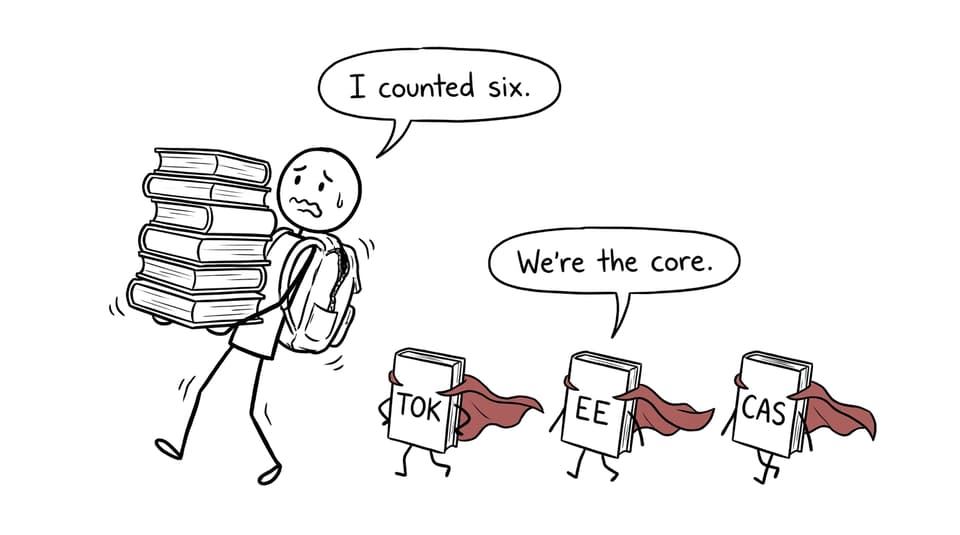
The simple answer is this: the International Baccalaureate Diploma Programme is a two-year, internationally recognized educational programme for students aged 16 to 19. Students study six subjects while completing a three-part core, with achievement measured through examinations, coursework, and other assessed tasks.
It is broad by design. A student might study literature, a second language, economics, chemistry, mathematics, and visual arts at the same time. The challenge is not merely learning more. It is learning how to manage several different kinds of thinking and assessment without losing sight of deadlines.
This IB diploma guide for parents explains what the programme contains, how scoring works, why the workload can feel intense, and how to support a student without taking control of the process.
How RevisionDojo helps with this: Parents and students can begin with the RevisionDojo IB resource hub, where subjects and core resources are organized in one place rather than scattered across multiple systems.
The IB Diploma at a glance
Before going deeper, here is the programme in one checklist:
- It normally runs across the final two years of secondary education.
- Students take six subjects, usually three at Higher Level and three at Standard Level.
- The six subject groups provide academic breadth.
- The core consists of Theory of Knowledge, the Extended Essay, and Creativity, Activity, Service.
- Most subjects combine externally assessed examinations with internally completed work.
- Each subject receives a grade from 1 to 7.
- Theory of Knowledge and the Extended Essay can contribute up to three additional points.
- The maximum Diploma score is 45.
- Students need at least 24 points and must meet all additional passing conditions.
This last point matters. Reaching 24 does not automatically guarantee the Diploma. Students must also complete CAS and satisfy rules involving subject grades, Higher Level points, Standard Level points, and the core.
How RevisionDojo helps with this: The guide to how many subjects students take in the IB offers a useful next step when subject requirements still feel unfamiliar.
How the six IB subject groups work
Students normally choose one course from each of the six groups. The groups are:
| Subject group | What it broadly covers |
|---|---|
| Studies in language and literature | Literature, language, media, and textual analysis |
| Language acquisition | Learning an additional language |
| Individuals and societies | Subjects such as history, economics, geography, and psychology |
| Sciences | Subjects such as biology, chemistry, physics, and computer science |
| Mathematics | Mathematics: Analysis and Approaches or Applications and Interpretation |
| The arts | Subjects such as visual arts, music, theatre, and film |
There is some flexibility. For example, a student may usually replace an arts course with another approved course from languages, individuals and societies, or sciences. Interdisciplinary subjects can also affect how group requirements are met. The school’s actual timetable and course offering ultimately determine which combinations are possible.
Higher Level and Standard Level
Students take at least three and no more than four subjects at Higher Level. The remaining subjects are taken at Standard Level. The IB recommends 240 teaching hours for an HL course and 150 for an SL course, reflecting the greater scope and depth expected at HL.
Subject selection deserves careful thought because university requirements vary by country, institution, and degree. A prospective engineering student may need particular mathematics and science choices, while another student may benefit from a different balance. Families should verify requirements directly with likely universities before choices become difficult to change.
How RevisionDojo helps with this: Students can explore IB lessons organized by subject and use the IB subject note collections to see how content and revision differ across the six groups.
What the IB core actually involves
The core is not a seventh subject. It is three connected requirements intended to develop reflection, independent research, and engagement beyond ordinary lessons.
Theory of Knowledge
Theory of Knowledge, usually called TOK, asks students to examine how knowledge is produced, justified, and challenged. Instead of simply asking whether a claim is correct, students consider evidence, interpretation, perspective, and the limits of certainty.
TOK is currently assessed through an exhibition and a 1,600-word essay. It can initially feel abstract, especially to students accustomed to questions with one expected answer. Its purpose becomes clearer when students learn to construct arguments, evaluate examples, and recognize assumptions.
The Extended Essay
The Extended Essay is an independent research project culminating in a paper of up to 4,000 words. A student develops a focused research question, works with a supervisor, investigates evidence, and produces a structured academic argument.
The difficulty is rarely just the word count. The project stretches across many months, so selecting a manageable question and meeting interim deadlines are often more important than bursts of last-minute writing.
Creativity, Activity, Service
CAS involves experiences across creativity, physical activity, and service. It is not awarded a numerical grade, but successful completion is required for the Diploma. Schools guide and monitor CAS, so local expectations and documentation processes should always be checked with the coordinator.
How RevisionDojo helps with this: Students can use the Extended Essay guides, review TOK learning resources, and examine appropriately selected models in the Coursework Library. These resources should guide understanding, never replace a student’s original work.
How assessment and IB scoring work
Most Diploma subjects use a combination of external and internal assessment. Written examinations form the main external component in many courses. Other externally assessed work can include essays or submitted tasks, depending on the subject.
Internal assessments, commonly called IAs, are completed through the school and usually marked by the teacher before moderation by the IB. Their form depends on the discipline: a scientific investigation, mathematics exploration, language oral, fieldwork report, or artistic performance may all serve different assessment purposes.
Each of the six subjects receives a grade from 1 to 7. Those grades can contribute up to 42 points. TOK and the Extended Essay are graded from A to E and together can add up to three core points, producing the maximum total of 45. CAS contributes no points but must be completed.
A student needs at least 24 total points plus the other Diploma conditions. These include earning sufficient points across HL and SL subjects, avoiding certain combinations of low grades, receiving grades for all required components, completing CAS, and avoiding a failing condition in TOK or the Extended Essay.
Predicted grades are separate from final results. Schools estimate them using available evidence, and universities may use them during admissions, but final Diploma grades come from the completed assessment process.
How RevisionDojo helps with this: The RevisionDojo Coursework Grader provides rubric-aligned feedback for supported IAs, Extended Essays, and TOK work. Students should combine this with teacher guidance and their school’s academic integrity rules.
Why the workload can feel unusually demanding
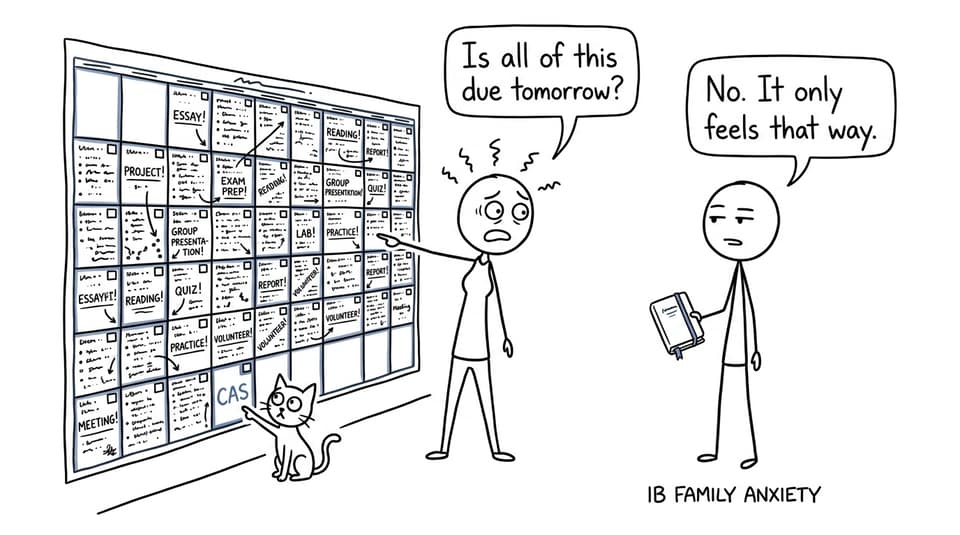
The IB is difficult because several timelines overlap. A student can be preparing for a mathematics test while gathering data for an IA, refining an Extended Essay question, recording CAS reflections, and keeping up with five other subjects.
That does not mean every evening should become a crisis. It means the programme rewards steady systems. A weekly plan is more useful than repeatedly asking whether a student has “finished the IB,” because there is nearly always another task available.
Parents can look for three kinds of pressure:
- Volume pressure: too many tasks competing for the same week.
- Uncertainty pressure: not understanding a rubric or how to begin.
- Performance pressure: believing every assignment must be perfect immediately.
Each requires a different response. Volume needs prioritization. Uncertainty needs clarification from a teacher, AI Chat, or Tutor. Performance pressure often needs permission to produce an imperfect first attempt and improve it through feedback.
How RevisionDojo helps with this: Study Notes can reduce uncertainty, Flashcards support short retrieval sessions, and the Questionbank turns broad revision into focused practice. When a problem remains unclear, AI Chat or a Tutor can help the student identify the specific gap rather than rereading everything.
How parents can support an IB student
The best support is usually structural rather than supervisory. Teenagers need ownership of their work, but ownership becomes easier when the environment around them is calm and predictable.
Ask questions that encourage planning:
- “Which deadline matters most this week?”
- “Is this a content problem, a time problem, or a rubric problem?”
- “What would a reasonable first step look like?”
- “Do you need quiet, feedback, food, or a break?”
Avoid comparing total scores between students without context. Subject choices, HL combinations, school schedules, assessment timing, and university goals differ. A target should be demanding enough to matter but realistic enough to guide useful decisions.
Sleep and downtime also belong inside a study plan. A timetable that works only when nothing goes wrong is not a plan. It is a wish. Leaving space for illness, difficult topics, and ordinary fatigue makes consistency more likely.
How RevisionDojo helps with this: Families can use RevisionDojo as a shared map without turning it into surveillance. A student can identify the next topic in Study Notes, practise it in the Questionbank, and report what changed. The parent supports the process while the student retains responsibility.
Turning the programme into an exam plan
Exam preparation should move through four stages: understand, remember, apply, and simulate.
First, use concise Study Notes to repair gaps in understanding. Next, use Flashcards to retrieve definitions, formulas, examples, and vocabulary. Then answer topic-specific questions without immediately checking help. Finally, complete timed Mock Exams or Predicted Papers to develop pacing and decision-making under realistic conditions.
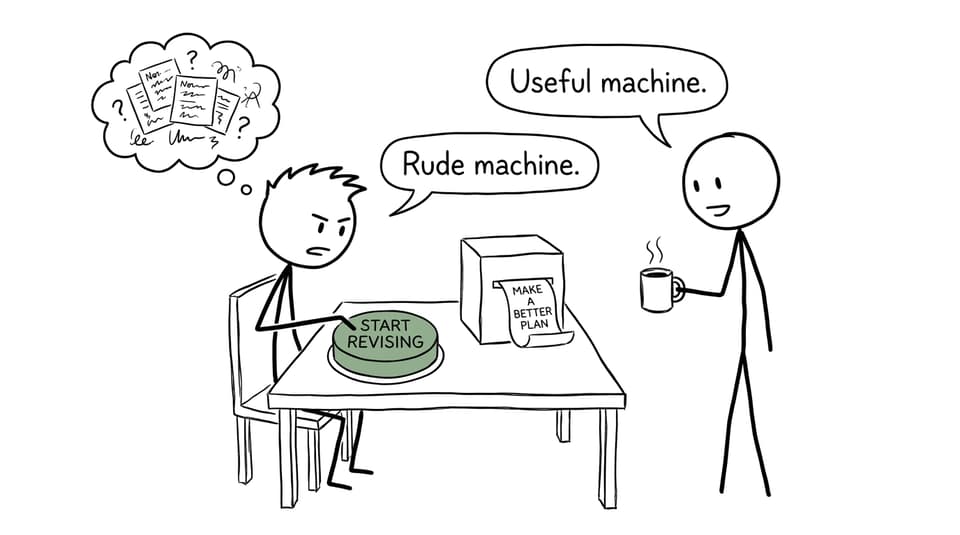
The review after practice matters more than the number of pages completed. Students should record why marks were lost: forgotten knowledge, misunderstood command terms, weak explanation, poor structure, or lack of time. The next study session should address that cause.
For a practical model, the RevisionDojo IB exam preparation workflow connects learning, recall, question practice, feedback, and timed simulation.
How RevisionDojo helps with this: RevisionDojo brings Questionbank, Study Notes, Flashcards, AI Chat, Grading tools, Predicted Papers, Mock Exams, the Coursework Library, and Tutors into one IB-focused system. That makes it easier to move from “study more” to a specific next action.
A reassuring way to see the IB Diploma
So, what is the IB Diploma Programme in practical terms? It is a demanding two-year structure combining six academic subjects, independent research, reflection, service, coursework, and final examinations. Its breadth is the point, but that breadth is also why students need deliberate routines.
Parents do not need to become experts in every rubric. They need to understand the architecture, recognize the difference between healthy effort and unsustainable pressure, and help students convert large worries into smaller decisions.
The natural next step is simple: confirm the student’s subjects and assessment calendar, identify the nearest meaningful deadline, and build one repeatable weekly routine around it. RevisionDojo can then provide the IB-specific resources needed at each stage, from first explanation to final timed practice.
How RevisionDojo helps with this: Start at the all-in-one RevisionDojo platform and choose one immediate need: learn a topic, practise questions, improve coursework, or simulate an exam. Clarity often begins with making the next step smaller.