
If you’ve ever felt calm in September and then suddenly panicked in February, you’re not imagining things. The IB has a special way of making deadlines appear all at once. And the most common question students ask when they finally look up from a syllabus is simple: how many IA tasks are there in total?
The short answer is comforting and slightly terrifying: as a full Diploma student, you usually complete six major IA submissionsone per subject. Then you add the Core (TOK and EE), which aren’t technically an IA, but absolutely compete for the same time, energy, and sleep.
What an IA is (and why it feels bigger than it looks)
An IA (Internal Assessment) is coursework that your teacher marks, and the IB later moderates to keep standards consistent across schools. That “internally assessed, externally moderated” structure is why your IA matters: it’s not just homework, and it’s not just a class grade.
Most IA tasks are investigations, reports, explorations, or recorded oral components. They’re designed to test what exams can’t always capture: sustained thinking, method, personal engagement, and communication.
If you want the clearest overview of what examiners reward in a strong IA, start with IB IA Guides: Internal Assessment Structure, Rubrics & More and then read What IB Examiners Look for in a Strong IA.
Total number of IA submissions for the IB Diploma
Here’s the breakdown most Diploma students are really asking for.
The typical total: 6 IA submissions
If you’re taking the full IB Diploma Programme:
-
You take 6 subjects
-
Each subject has 1 IA component
-
So you’ll complete 6 IA submissions in total
This is true across the six subject groups: Languages, Individuals and Societies, Sciences, Mathematics, and the Arts (or an additional subject from another group).
What about TOK and the EE?
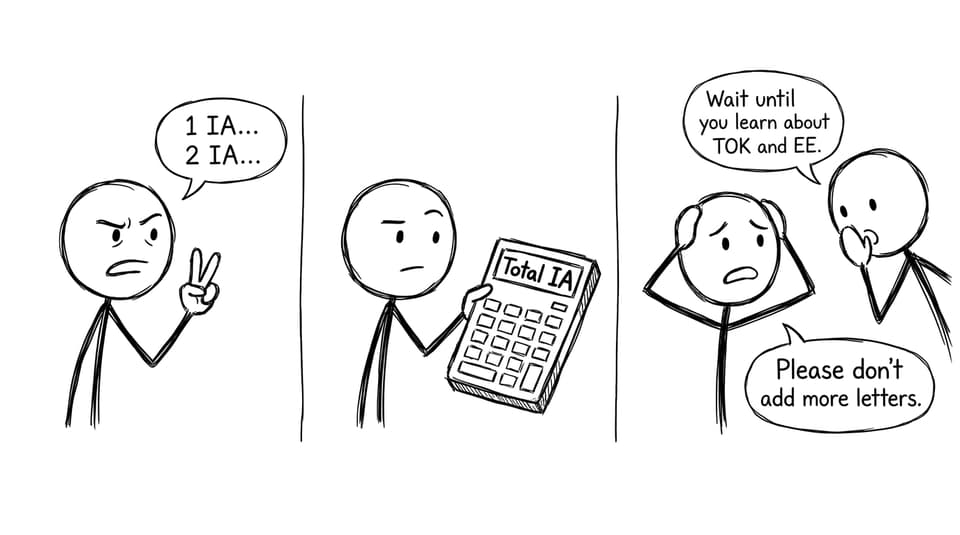
TOK and the EE are not called an IA, but they function like major internal coursework projects with their own rubrics, drafts, and deadlines.
So the practical “mental load” count looks like this:
-
6 IA submissions (one per subject)
-
1 Extended Essay
-
2 TOK pieces (Essay + Exhibition)
That’s 9 major submissions across the Diploma for most students. If it feels like a lot, it’s because it is.
To keep coursework from blurring into exam prep, use RevisionDojo like a control panel: the IB Coursework Grader for rubric-aligned feedback, the AI Chat to clarify criteria language, and the Coursework Library for models that show structure (not something you copy).
IA breakdown by IB subject group (what your “one IA” usually looks like)
Every subject has one IA component, but the format changes.
Group 1: Studies in Language and Literature
- IA: Individual Oral (a spoken component with preparation and supporting notes)
Group 2: Language Acquisition
- IA: Individual Oral (conversation + discussion/analysis depending on course)
Group 3: Individuals and Societies
- IA: Written investigation or research report (often around 1,500-2,200 words depending on the subject)
Group 4: Sciences
- IA: Scientific investigation report (often capped by page count rather than word count)
If you’re doing a science IA, it helps to see what “good” looks like early. For Biology students, bookmark Sample IB Biology IA: A Step-by-Step Example, explore ideas with Best Biology IA Ideas, and anchor your rubric understanding with the IB Biology Internal Assessment Guide.
Group 5: Mathematics
- IA: Mathematical exploration (commonly 6-12 pages)
Math students often underestimate how long the “write-up” takes. Use IB Math AI Internal Assessment: Step-by-Step Guide and scan exemplar structure in IB Maths AA IA Examples or IB Maths AI IA Examples.
Group 6: The Arts (or an additional subject)
- IA: Varies (portfolio, performance, composition, comparative study, process journal elements)
Quick checklist: plan your IA load like a sane person
This is the IA planning list that saves students later:
-
Pick realistic topics early (a good IA is specific, not “impressive-sounding”)
-
Block time for feedback cycles, not just writing time
-
Build a small evidence table by criterion (what earns marks vs what feels nice)
-
Keep one weekly “maintenance session” even during exam season
-
Use tools that shorten the feedback loop
RevisionDojo’s workflow makes this easier: learn with Study Notes, retain with Flashcards, practise exam technique in the Questionbank, and keep exam stamina with Mock Exams and Predicted Papers. When coursework becomes noisy, use Grading tools and Tutors to get clear next steps instead of vague stress.
How much is an IA worth?
Most subjects weight the IA around 20-30% of the final grade. That means a strong IA can protect you on a rough exam day, and a rushed IA can quietly cap your final result.
If you want a deeper look at weighting strategy, read Which IA Is Worth the Most Marks? (IB Guide).
Closing: your IA count is fixed, but your stress isn’t
You can’t change the fact that the Diploma usually means six IA submissions. But you can change the experience of doing them.
Use RevisionDojo to make your IA process lighter: start with the IB IA Guides, check drafts with the IB Coursework Grader, and keep exam skills moving with the Questionbank, Study Notes, Flashcards, Mock Exams, and Predicted Papers. The goal isn’t to do more. It’s to waste less time guessing what earns marks, so your effort finally translates into results.