
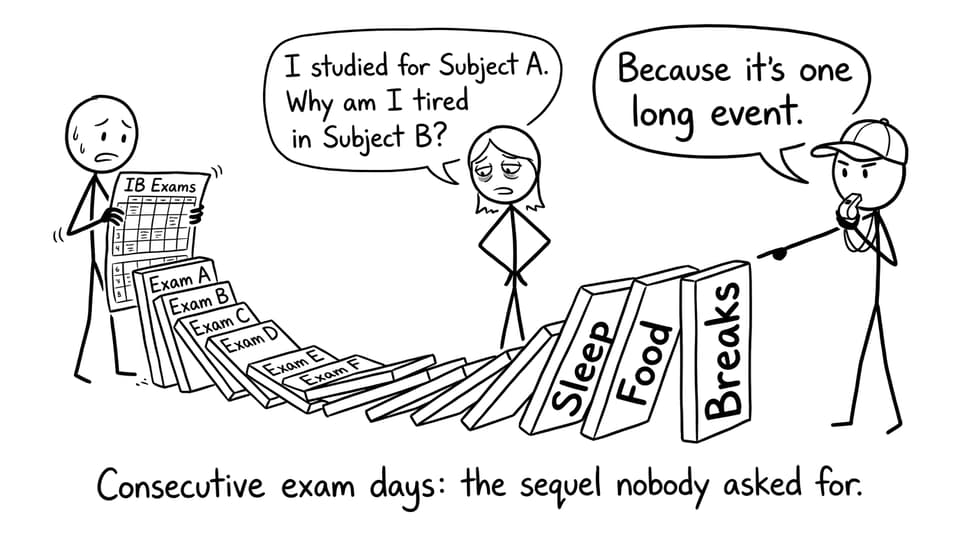
Consecutive exam days don’t feel hard at first. They feel busy. Then you sit the second paper, and it’s like your brain is wading through wet cement. That’s the trap: the content hasn’t changed, but you have.
These Exam Tips are about treating back-to-back IB papers like a sequence, not isolated events. The goal isn’t to study more. It’s to protect accuracy when fatigue starts quietly collecting interest.
Exam Tips: the 60-second checklist for back-to-back days
-
Identify your consecutive-day “pressure blocks” early
-
Finish heavy learning before exam week
-
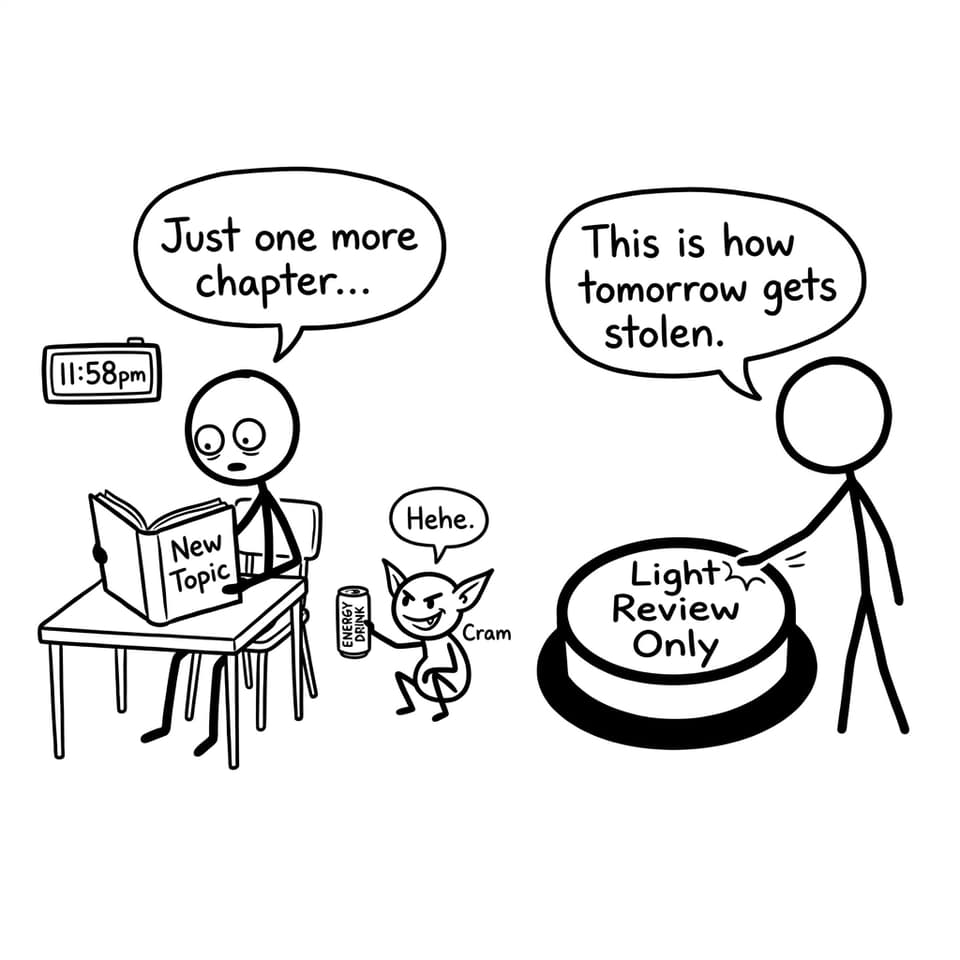
During exam week: light review, zero new content
-
Sleep and meals become part of your revision plan
-
Use short, targeted practice (not long marathons)
If you need structure fast, combine this with IB: The Last 2 Weeks Before Exams (What Matters).
Why consecutive days drain marks (even for strong students)
Back-to-back exams require sustained focus, fast emotional reset, and decent sleep at the exact moment students start negotiating with themselves.
The biggest performance drop usually isn’t “I didn’t know it.” It’s “I rushed,” “I misread the command term,” or “I made a silly error I wouldn’t normally make.” When you’re tired, you default to habits. That’s why Exam Tips for consecutive days are really habit tips.
To stay steady, build a repeatable loop: do questions, review mistakes, fix one thing, then stop. RevisionDojo supports this directly with Questionbank sets, Flashcards for recall, and AI Chat when you’re stuck.
The most common mistake: treating each day as a separate battle
Students often finish an exam, panic about what they wrote, then “make up for it” by over-revising at night. It feels responsible. It’s usually sabotage.
Instead, plan the entire run of days as one event. That means deciding in advance what you will do after each exam: a short reset, a light review window, and a hard stop.
For a practical night routine, use IB Exam Night Routine: What Actually Works.
How to prepare before exam week starts
The best Exam Tips happen early, when your schedule still has room.
Pre-load the heavy work
Finish the hardest topics and the longest timed sessions before the consecutive stretch. Use How to Use the IB Exam Schedule to Maximize Your Final Grade to spot where fatigue is most likely.
Train “slightly tired” conditions
Once a week, do a two-block simulation: one timed section, a real break, then another timed section. RevisionDojo’s Exam Mode is perfect for rehearsing pace without adding decision fatigue.
How to revise during consecutive IB exam days (without burning out)
Your job between papers is clarity, not coverage.
-
Use Flashcards for 10-15 minutes of retrieval (fast, calming)
-
Do a small, filtered Questionbank set (10-20 questions) on one weak area
-
Review mistakes, write 3 “error rules,” then stop
If you want a clean method for question practice, follow IB Question Bank | How to Use It Effectively.
And if your brain is tired but restless, IB: I Study All Day but Remember Nothing explains why more hours can produce less memory.
Recovery between days: treat sleep like a subject
Sleep loss accumulates. So do skipped meals. The simplest Exam Tips are the ones you stop renegotiating.
-
Choose a fixed bedtime cutoff for heavy work
-
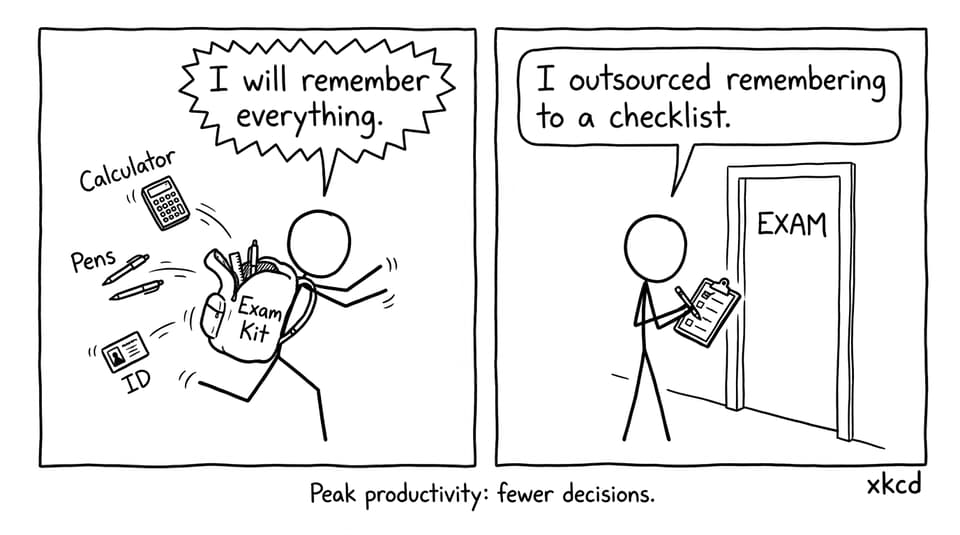
Pack your exam kit early
-
Eat something boring but reliable
-
Take a 10-minute walk to reset your nervous system
For a specific system, use Best Sleep Routine for IB Students (That Actually Works).
Where RevisionDojo fits (so you don’t rely on motivation)
Consecutive days reward systems, not heroics. RevisionDojo is built for that season: Study Notes to patch a gap quickly, Flashcards to keep daily recall alive, Questionbank drills for precision, Mock Exams and Predicted Papers for stamina, AI Chat and Grading tools to shorten feedback loops, plus a Coursework Library and Tutors when life overlaps with revision.
To plan the sequence itself, start here: RevisionDojo Study Planner.
Final word: plan the sequence, not the individual days
Consecutive IB exam days don’t require more intensity. They require fewer late-night negotiations and more deliberate recovery. Treat the whole stretch as one long event, run your light-review loop, and protect sleep like it’s part of the syllabus.
If you want the easiest way to map your back-to-back papers and avoid revision overload, use the RevisionDojo Study Planner and build your routine around Questionbank practice, Flashcards, and timed work in Exam Mode. These Exam Tips are simple on purpose. Simple is what survives exam week.