The night before an IB exam has a strange gravity.
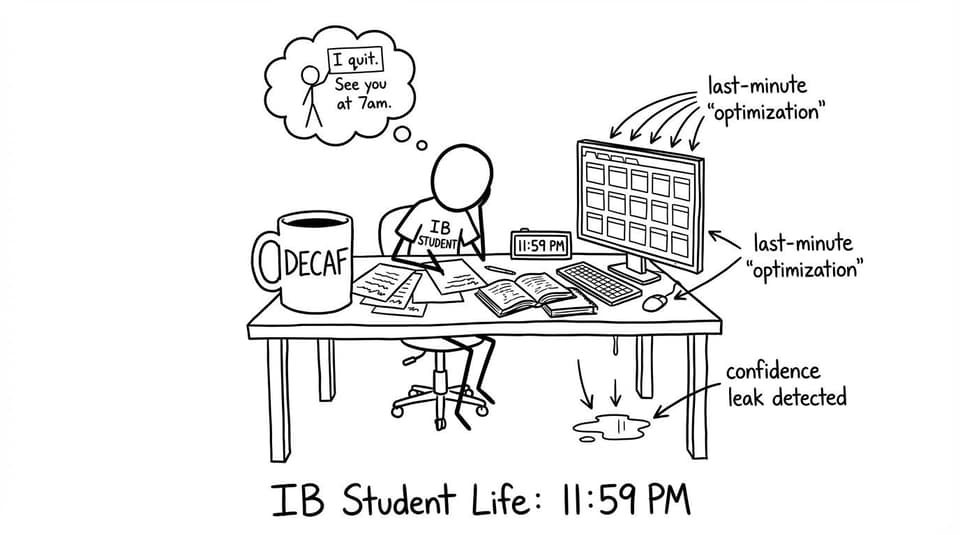
All week you told yourself you were fine. Then you look at the calendar, realize tomorrow is real, and your brain offers a brilliant new strategy: open 19 tabs, rewrite your entire notebook, and drink enough caffeine to see through time.
Most IB students don't need more intensity the night before. They need fewer decisions.
The goal of tonight isn't to become smarter. It's to arrive tomorrow calm, steady, and ready to access what you already know.

The night-before IB checklist (print this in your head)
Use this as your IB night-before routine. If you do nothing else, do these.
- Do a short, high-yield review (30–60 minutes)
- Stop studying at a fixed time
- Pack your exam kit (twice)
- Set up your morning (alarm, breakfast plan, route)
- Do a 5-minute calm-down routine
- Sleep like it's part of your study plan
If you want a deeper exam strategy for the whole season, pair this with How to Sleep Properly During the IB Exam Period and How to Prepare for Consecutive IB Exam Days.
Why the night before IB exams is different
The IB isn't just content. It's performance under constraints: timing, command terms, mark allocation, and pressure.
The night before, your brain is already stressed. Stress narrows attention. It makes you chase novelty and "one more thing" rather than doing what actually lifts marks: clear recall, calm execution, and predictable routines.
So the night-before strategy is simple:
You protect three assets: memory, mood, and momentum.
Do a "light review" that actually helps IB performance
Light review does not mean reading 40 pages with sad eyes.
Light review for IB means active recall on your highest-yield material, in a small time box.
Here are three options. Pick one.
Flashcard sweep (best when you feel scattered)
Do 20–40 flashcards focused on definitions, processes, and command-term-ready phrasing.
If you use RevisionDojo, open the Flashcards feature and run a short session. The point is not to "finish the deck." It's to warm up retrieval.
Mistake replay (best when you feel underprepared)
Open your last set of practice questions and redo only:
- questions you missed
- questions you got right for the wrong reason
- questions where your explanation was thin
RevisionDojo makes this easy because your Questionbank practice can become a focused loop rather than a random walk. If you haven't explored it yet, start with Comprehensive IB Question Bank: Thousands of Practice Questions.
One-page "anchor sheet" (best when you feel anxious)
Write one page with:
- 8–12 key facts/formulas/quotes
- 3 common mistakes you make
- 2 reminders about exam technique (timing, structure)
The act of compressing knowledge is calming. It tells your brain: "We have a map."
Stop studying earlier than you think you should
The hardest part of the night-before IB plan is the cutoff.
Pick a time (for most students: 8:30–10:00pm) and stop heavy work. When you stop matters more than what you do in the final hour.
If you need a rule:
- If you're learning new content, it's too late.
- If you're reinforcing what you already know, it's fine.
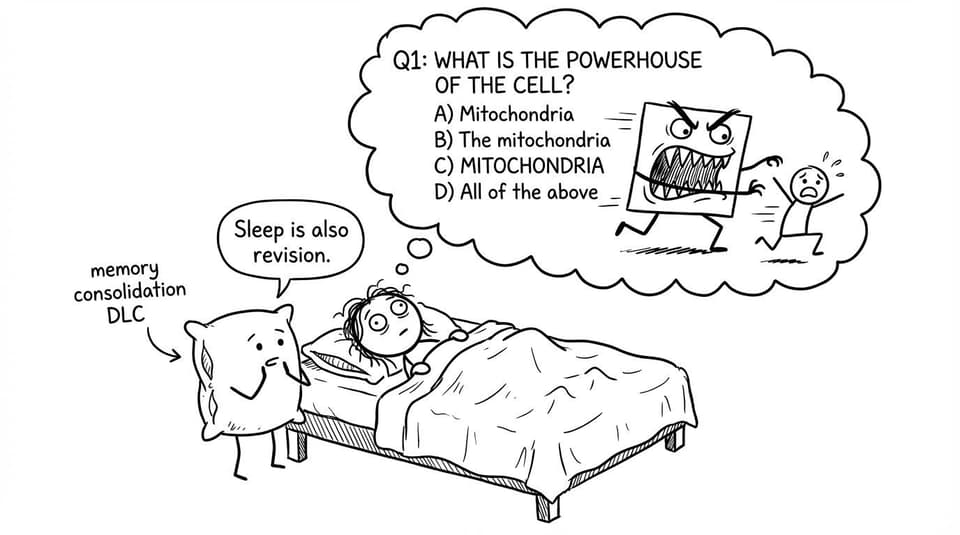
A useful mental shift is to treat sleep as the final revision block of the day.

Pack your IB exam kit like a professional
Anxiety loves the morning because mornings are full of tiny surprises.
Remove surprises.
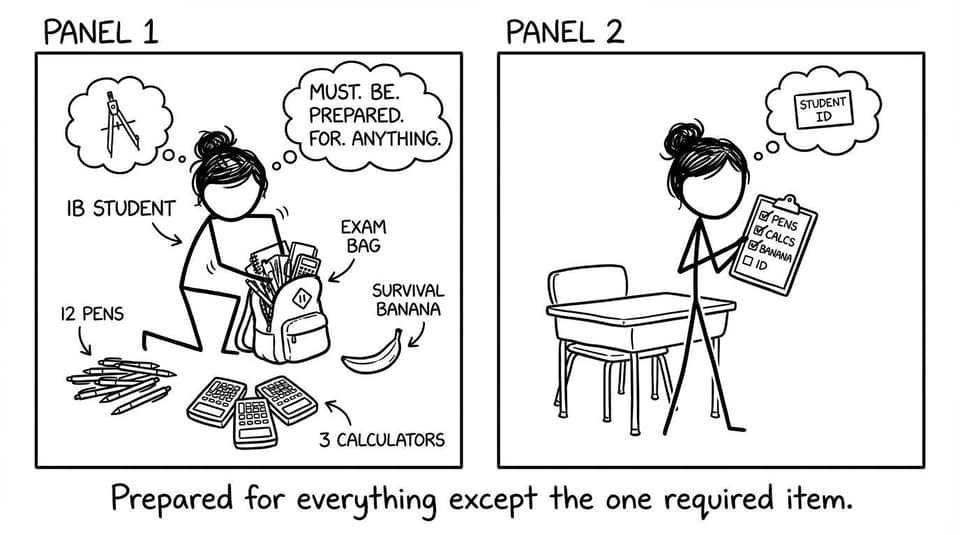
Pack tonight. Then do a second check.
Here's a practical IB exam kit list (adjust to your school rules):
- pens (at least 2)
- pencils, eraser, sharpener
- calculator (if allowed) + spare batteries
- ruler/protractor if relevant
- approved materials (e.g., data booklet if your school provides one, or anything your coordinator instructs)
- water bottle (transparent if required)
- simple snack (if permitted)
- exam ID / admission documents
And yes, you should put the documents somewhere ridiculous and obvious.

Use RevisionDojo to reduce decision fatigue (not to do more)
The night before an IB exam, the best tools are the ones that reduce thinking.
Here's a clean workflow inside RevisionDojo:
- Use Study Notes for a quick skim of your own "weak points," not the whole chapter. If you like building your own condensed notes, see Custom IB Note Creation: Build Your Own Study Materials.
- Use Flashcards for a short recall session.
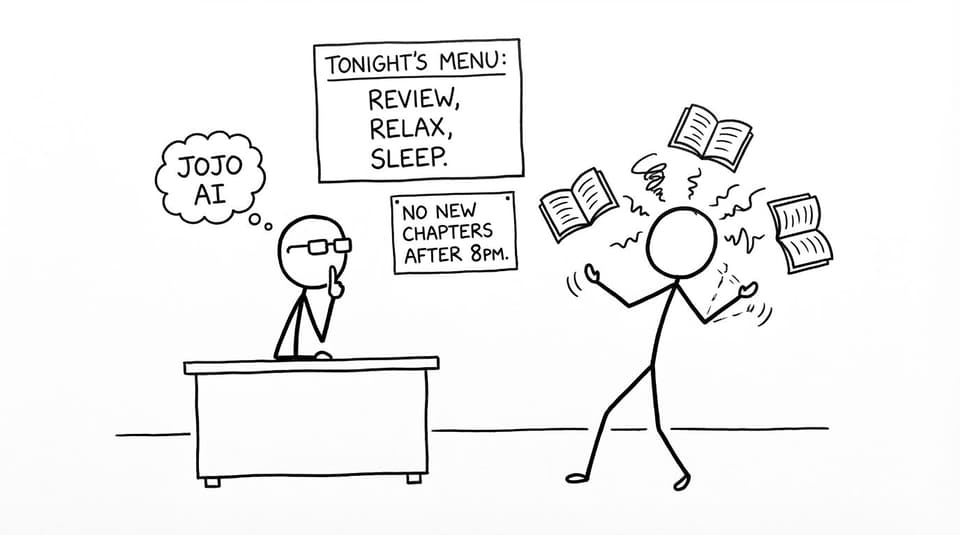
- Use AI Chat (Jojo AI) to clarify one confusing concept quickly, then stop. One concept, not ten.
- If you're tempted to take a full timed paper tonight, save it. Use Mock Exams and Exam Mode earlier in the week, not at midnight. If you want to learn the best way to simulate exam pressure efficiently, read Exam Mode | RevisionDojo and IB Mock Exam Tips: Expert Strategies for Better Performance.
This is the hidden advantage: RevisionDojo isn't just more resources. It's fewer choices.

Eat and drink like your brain has a timetable
Most IB students overthink dinner and underthink hydration.
Tonight, aim for:
- a normal, balanced meal (protein + carbs + vegetables)
- steady hydration through the evening
- minimal sugar spikes
- no new supplements, no experiments
If you rely on caffeine, keep it earlier. Sleep is worth more than a last-minute energy illusion.
Do a 7-minute calm-down routine (seriously)
A calm body makes a calm mind believable.
Try this sequence:
- 2 minutes: slow breathing (in 4, hold 2, out 6)
- 3 minutes: gentle stretch or short walk
- 2 minutes: write a "tomorrow script"
Your tomorrow script is three lines:
- What time you'll wake up
- What you'll do first (breakfast, shower, quick review)
- What you'll say to yourself on the way in ("I only need to do the next question well.")
This is not motivational fluff. It's a way to stop your brain from negotiating with itself at 2:00am.
The three biggest night-before IB mistakes (and what to do instead)
Mistake: trying to learn new topics
New learning is fragile under stress.
Instead: revise what you already know, and strengthen how you'll use it under IB exam conditions.
Mistake: doing a full paper late at night
A late timed paper often creates panic without giving you time to fix the weaknesses.
Instead: do 10–20 targeted Questionbank questions, or one structured section only, and log the mistakes.
Mistake: staying online "for just a second"
Your attention is your stamina.
Instead: set your phone to charge across the room. If you need a timer, use a simple one. If you need a tool, use one tool.
FAQ: night before IB exams
Should I study at all the night before an IB exam?
Yes, but keep it intentionally small, because the night before an IB exam is about readiness, not range. A short session of active recall can stabilize your confidence and wake up key facts without exhausting you. The most effective review is usually 30–60 minutes focused on weaknesses, not a full-topic marathon. If you use RevisionDojo, pick one pathway: Flashcards for quick recall, or a small set of Questionbank drills for accuracy. Then stop at a planned time so your brain has space to settle. The real win is arriving at the exam with enough sleep to think clearly.
What if I feel unprepared for my IB exam tomorrow?
Feeling unprepared is common in the IB, because the syllabus is big and your brain can't hold everything at once. The night before is not the time to "cover" the course; it's the time to decide what will earn marks tomorrow. Start by listing the 3–5 topics or skills most likely to appear and that you can still improve quickly (definitions, common calculations, essay structures, command terms). Do a short, targeted review and practice just enough to remove obvious gaps. If you're spiraling, use Jojo AI Chat inside RevisionDojo for one focused clarification, then close it. Your job tonight is to reduce uncertainty, not to achieve completeness.
How do I calm down if I'm panicking about IB exams at night?
Panic usually comes from your brain trying to solve tomorrow all at once. The fix is to shrink the problem to the next tiny action: pack your bag, set your alarm, write a simple morning plan. Then do a brief physical reset: slow breathing, a short walk, or a warm shower. Remind yourself that the IB rewards process: clear structure, command-term accuracy, and steady pacing, not perfection. If you keep replaying worst-case scenarios, write them down and answer them with practical steps ("If I blank, I skip and return" is a real strategy). Finally, protect sleep aggressively, because sleep is the fastest way to turn stress back into clarity.
Should I use RevisionDojo the night before an IB exam?
Yes, if you use it for simplicity. The best night-before IB use of RevisionDojo is quick recall and targeted confidence-building: Flashcards for retrieval, Study Notes for a skim of weak areas, and a small Questionbank set to reinforce accuracy. Avoid turning the platform into another form of doom-scrolling. If you want to practice under pressure, save Exam Mode, Mock Exams, and Predicted Papers for earlier in the week when you can actually apply the feedback. The night before is about arriving ready, not collecting more data. Use the tools to reduce decisions, then log off.
A calm ending is an IB strategy
The best IB students aren't the ones who do the most the night before.
They're the ones who protect their energy.
Tonight, your job is to close loops: review lightly, pack early, plan the morning, and sleep. Tomorrow, you'll cash in the work you've already done.
If you want an all-in-one system that makes the whole exam season less chaotic, build your routine around RevisionDojo: Questionbank for targeted practice, Study Notes for fast clarity, Flashcards for recall, AI Chat for quick explanations, Grading tools for feedback, Predicted Papers and Mock Exams for realistic practice, a Coursework Library for exemplars, and Tutors when you need human guidance.
For more exam-season guidance, start here: What to Do the Night Before a Big Exam, then deepen your plan with Effective Revision Techniques for IB Exams in 2024 and Countdown to IB Exams: A Guide to Effective Studying.
Walk into your IB exam tomorrow with one quiet thought: you don't need a new brain overnight. You just need access to the one you trained.