
Starting an IB Group 3 subject can feel like being asked to build an argument before anyone has shown you the tools. You may understand the lesson, remember the case study, and still hesitate when the question says evaluate rather than explain.
The best IB essay subjects study method is not to memorise complete essays. It is to build a reusable system for interpreting questions, selecting evidence, forming judgments, and writing under time pressure. For an IB DP1 student, this matters more than producing perfect answers immediately. Your first year is where you build the thinking habits that later make exam writing faster.
This guide applies broadly to essay-based Group 3 subjects such as History, Geography, Economics, Global Politics, Psychology, and related courses. Exact assessment requirements vary by subject, level, syllabus, and exam session, so use your teacher's instructions and current subject guide for format-specific details.
Your Group 3 essay checklist
Before writing, ask whether you can do these six things:
- Identify exactly what the command term requires.
- Turn the question into a clear, defensible argument.
- Select precise evidence rather than everything you remember.
- Explain how each example supports the argument.
- Consider a limitation, alternative interpretation, or counterargument.
- Reach a conclusion that answers the wording of the question.
Most weak essays do not fail because the student knows nothing. They fail because knowledge remains unselected and unexplained. A successful essay is an act of choice.
Understand what Group 3 essays are testing
An essay question usually tests more than recall. You may need to establish causation, compare interpretations, apply a model, assess significance, or judge how far a claim is convincing.
That is why rereading notes can create false confidence. Familiarity tells you that you have seen an idea before. An essay asks whether you can use it.
For example, a History student might remember several causes of a conflict. The harder task is deciding which cause was most significant and explaining the criteria behind that judgment. An Economics student might draw an appropriate diagram but still need to analyse the mechanism and evaluate assumptions. A Geography student may know a case study in detail while struggling to connect that material to the exact claim in the question.
RevisionDojo's guide to what students learn in the IB Diploma describes Group 3 learning as the development of explanations that can survive scrutiny. That is a useful standard. Do not ask only, “Is this fact correct?” Ask, “What does this evidence prove, and where does its explanatory power end?”
Decode the command term before planning
Command terms are instructions, not decorative verbs. If you misunderstand one, even accurate knowledge can become an answer to the wrong question.
The precise expectations should come from your current subject materials, but these practical distinctions are useful:
| Command term | Your practical task |
|---|---|
| Explain | Show how or why something happens through connected reasoning. |
| Analyse | Break an issue into relevant parts and examine relationships between them. |
| Compare | Address meaningful similarities and differences using shared criteria. |
| Discuss | Present a balanced examination of arguments, evidence, or interpretations. |
| Evaluate | Weigh strengths and limitations, then make a supported judgment. |
| To what extent | Test the stated claim against alternatives and decide how far it holds. |
Read the IB exam command terms guide, then create one flashcard for each term used regularly in your subject. On the front, write the term. On the back, write three items: its task, a suitable paragraph move, and one mistake to avoid.
For evaluate, that might be: weigh value against limitations; compare conditions or perspectives; avoid listing advantages and disadvantages without reaching a judgment.
Build evidence around arguments, not chapters
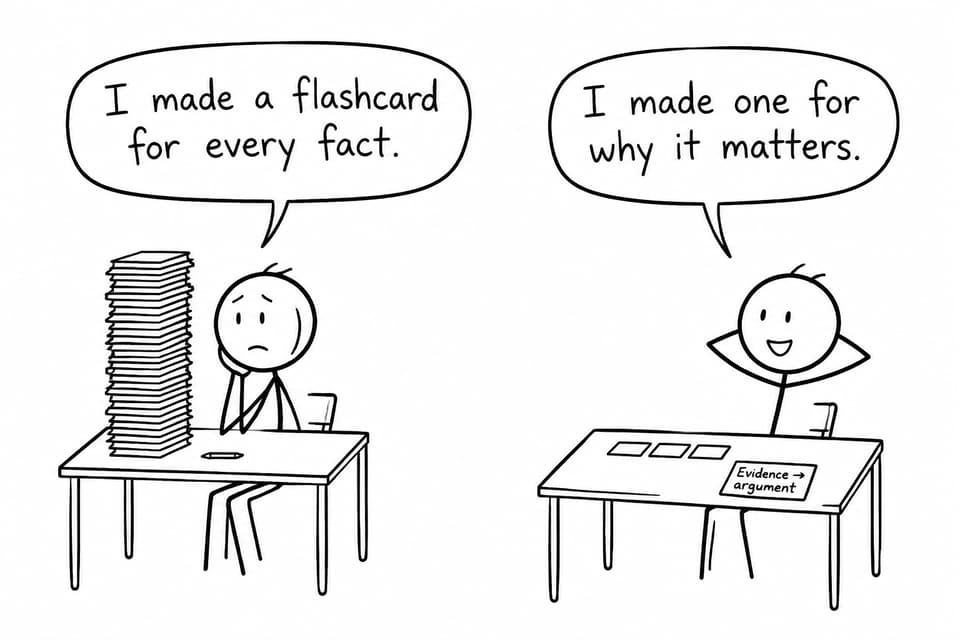
New IB students often organise revision by unit: everything about authoritarian states, development, market failure, or cognitive processes goes into one large collection. That mirrors the course, but it does not always mirror an essay.
Instead, build an evidence bank around arguable themes. A useful entry contains:
- Claim: the idea this evidence could support.
- Evidence: the specific event, study, example, data point, model, or case study.
- Reasoning: why the evidence supports the claim.
- Limitation: where the example becomes less convincing.
- Connection: another theme or question where it could be used.
Suppose a History topic concerns the consolidation of power. Rather than recording only what happened, classify evidence under coercion, propaganda, institutional weakness, economic conditions, and leadership. For Economics, organise real-world examples by policy objective, stakeholder effect, time frame, and limitation. For Geography, tag case studies by scale, context, process, and competing explanation.
This is active revision because every fact receives a job. It also makes later planning quicker: you search your memory for arguments, not pages.
Use a claim-evidence-reasoning paragraph structure
A paragraph should move the argument forward. One dependable structure is:
- Make a claim that answers part of the question.
- Introduce precise and relevant evidence.
- Explain the mechanism connecting the evidence to the claim.
- Test the claim with a limitation, comparison, or alternative.
- Link the resulting judgment back to the question.
Consider this simplified Economics example: “An indirect tax can reduce consumption of a demerit good because it raises firms' costs and tends to increase the market price. The size of the reduction, however, depends partly on price elasticity of demand. If demand is relatively inelastic, consumption may fall only slightly, limiting the policy's effectiveness in the short term.”
The useful part is not the terminology alone. Each sentence changes the argument. The response explains a mechanism, introduces a condition, and arrives at a qualified assessment.
In History, the same logic might compare an interpretation with evidence that supports and constrains it. In Psychology, it may connect a study's findings to a theory before addressing methodological or contextual limitations. Different subjects use different evidence, but strong reasoning remains visible.
Practise planning before writing full essays
Full essays matter, but they are expensive. They require time to write and time to review. A DP1 student can often improve faster by completing several focused plans before attempting another complete response.
Use this 10-minute planning sequence:
- Minutes 1-2: underline the command term, topic, scope, and any limiting words.
- Minutes 3-4: write a provisional one-sentence thesis.
- Minutes 5-7: choose two or three main claims and attach evidence.
- Minutes 8-9: add a counterargument or limitation to each claim.
- Minute 10: revise the thesis so it reflects the balance of your plan.
A thesis should answer the question rather than announce the topic. “There were several important causes” says very little. “Economic instability created the conditions for change, but institutional weakness was more decisive because it allowed short-term pressures to become a political crisis” establishes hierarchy and reasoning.
Once a week, turn one plan into a timed response. RevisionDojo's advice on how many hours to study each week makes an important point for humanities students: writing itself is revision. Planning retrieves knowledge, and drafting reveals whether that knowledge can support analysis.
Review essays like evidence
A grade tells you what happened. Feedback helps explain why.
After each essay, classify every problem under one of four headings:
- Knowledge: evidence was inaccurate, vague, or missing.
- Question reading: the response drifted from the command term or scope.
- Reasoning: the link between evidence and claim remained implicit.
- Execution: time, organisation, or expression weakened the answer.
Then rewrite the weakest paragraph. Do not merely read the teacher's comment and promise to “be more analytical.” Add the missing reasoning sentence, replace vague evidence, or sharpen the judgment.
RevisionDojo can support this loop without scattering your work across unrelated tools. Use the Questionbank to find targeted prompts, Study Notes and Flashcards to repair knowledge gaps, AI Chat to question your reasoning, and Grading tools to identify patterns for further review. Predicted Papers and Mock Exams become more useful once you are ready for complete timed conditions, while the Coursework Library and Tutors can help you understand what stronger academic choices look like without replacing your own thinking.
History students can also use the focused strategies in How to Get a 7 in IB History. Economics students should account for level-specific demands by consulting the IB Economics SL and HL revision comparison.
A short IB DP1 routine to start today
You do not need a dramatic new schedule. Try this 25-minute routine with the topic you studied most recently:
- Spend five minutes retrieving three key claims without notes.
- Spend five minutes attaching one precise example to each claim.
- Spend five minutes adding a limitation or counterargument.
- Spend five minutes planning one command-term question.
- Spend five minutes comparing the plan with your notes and recording one gap.
Repeat it three times this week. At the end of the week, write one paragraph from your strongest plan and ask for focused feedback on the reasoning rather than a general impression.
If the wider Diploma still feels unfamiliar, RevisionDojo's guide for IB DP1 students and its overview of the first month of the IB Diploma can help you build a sustainable system before deadlines become crowded.
Turn knowledge into judgment
The quiet challenge of Group 3 is that knowing more does not automatically produce a better essay. Better essays come from making better decisions: what the question requires, which evidence deserves space, how ideas connect, and what judgment the evidence can honestly sustain.
Begin small. Decode one command term. Build one evidence card. Plan one answer. Rewrite one weak paragraph. Those actions may look modest, but they compound across DP1.
RevisionDojo brings the complete process together, from learning content to practising and reviewing it. To make today's routine easier to repeat, save the topic flashcard deck to your free account. It gives your evidence somewhere useful to live and leaves you with one less reason to postpone tomorrow's retrieval practice.