
The first time most students hear what the IB actually asks of them, it sounds less like a school program and more like a personality test.
You are expected to write like a historian, think like a scientist, calculate like an engineer, and reflect like a philosopher--often in the same week. That’s the point. The IB isn’t designed to reward memorization alone. It trains you to use knowledge under pressure: to interpret prompts, build arguments, and prove understanding with evidence.
If you’re an IB student preparing for exams, knowing what you’re truly learning (beyond the subject names on your timetable) helps you revise with direction, not anxiety.
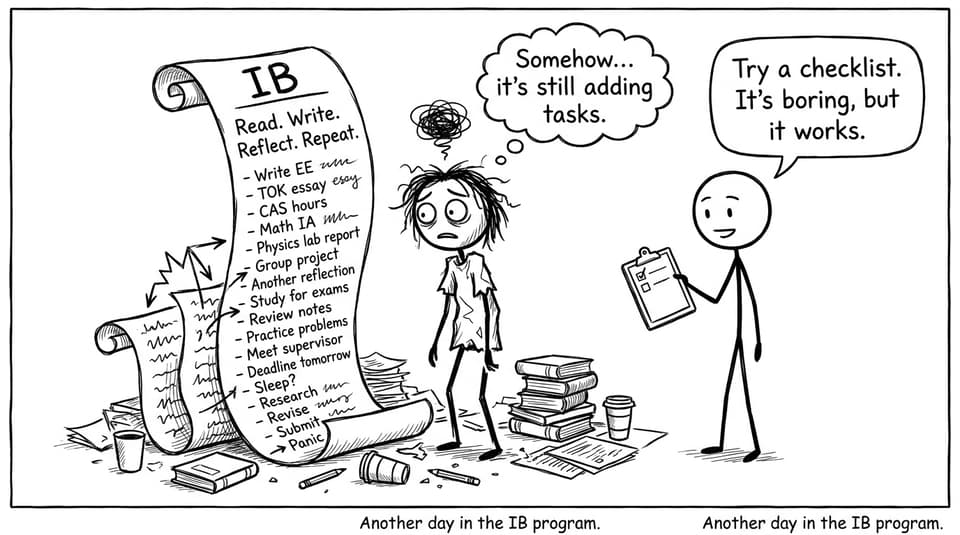
The IB Diploma at a glance (fast checklist)
Here’s what the IB Diploma Programme includes:
-
Six subjects across balanced academic groups (usually 3 HL + 3 SL)
-
Three core components: TOK, EE, CAS
-
Assessment that rewards analysis, application, and clear communication
If you want a single hub for how RevisionDojo supports IB students across that entire workload, start here: RevisionDojo for IB.
What you learn in the six IB subject groups
The IB structure is built to prevent you from becoming one-dimensional. Even if you’re “a math person” or “a humanities person,” the diploma keeps you practicing multiple ways of thinking.
Group 1: Language and literature (learning to argue with precision)
In IB Group 1, you learn how to read like someone who refuses to be manipulated. You study literary and non-literary texts, then explain how meaning is created: tone, structure, bias, context, and purpose.
This becomes exam power when you can do three things quickly: identify techniques, connect them to effects, and write a clean line of reasoning.
Group 2: Language acquisition (learning to communicate in real life)
In IB language acquisition, you’re not only collecting vocabulary. You’re learning how language works in the world: how culture shapes meaning, how registers change, and how to produce writing that sounds human (not translated).
The exam payoff is confidence: you stop guessing what the question wants because you’ve practiced responding in authentic formats.
Group 3: Individuals and societies (learning to think in cause and consequence)
History, economics, geography, psychology, global politics--Group 3 in the IB teaches you how to build explanations that survive scrutiny.
You learn to weigh evidence, compare perspectives, and write structured arguments. And you learn something quieter: most “obvious” answers collapse when you ask, “What’s the counterclaim?”
Group 4: Sciences (learning to investigate, not just know)
The IB sciences train a specific kind of honesty: your conclusion is only as good as your method.
You learn concepts and models, yes. But you also learn experimental design, data processing, evaluation, and how to explain results with limitations. In exams, that translates into clearer reasoning and fewer lost method marks.
Group 5: Mathematics (learning to model the world)
All IB students take mathematics, but the pathway differs.
-
Analysis and Approaches (AA) leans more abstract and algebraic
-
Applications and Interpretation (AI) leans more statistical and modeling-based
Either way, what you learn is deeper than “getting the answer.” You learn how to represent situations mathematically, justify steps, and use technology responsibly.
If you revise best by doing questions first, then fixing patterns, you’ll like RevisionDojo’s Questionbank and the guide on how to use an IB question bank effectively.
Group 6: The arts (or an elective) (learning to create with intent)
Group 6 in the IB can be visual arts, theatre, music, film, dance--or you can choose an additional subject from another group.
What you learn here is interpretation and intentionality: not just making something, but explaining choices, context, and meaning.
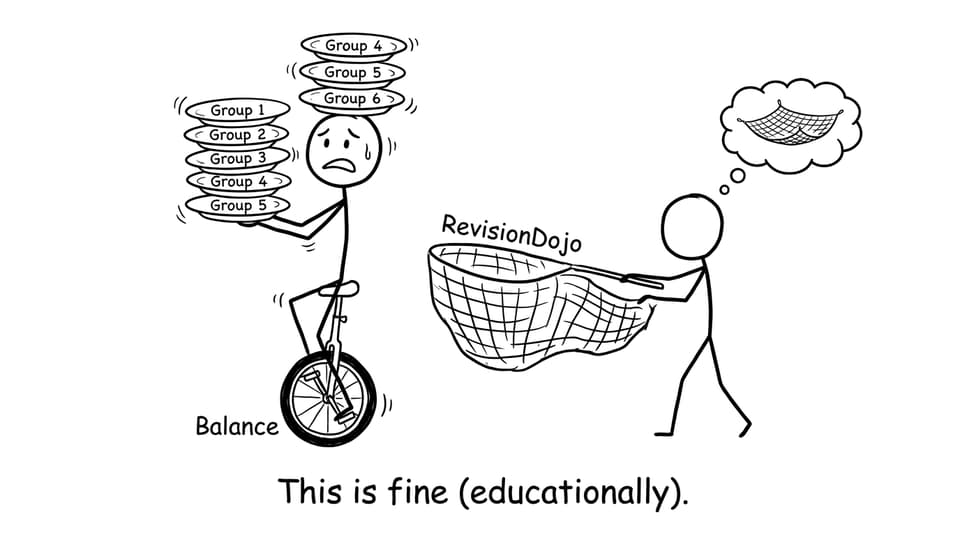
The IB core: what makes IB feel like IB
The IB core is where the program stops being only academic and becomes personal. It’s also where many students lose time, because it’s harder to “study” something when the task is thinking.
TOK: learning to question how knowledge is built
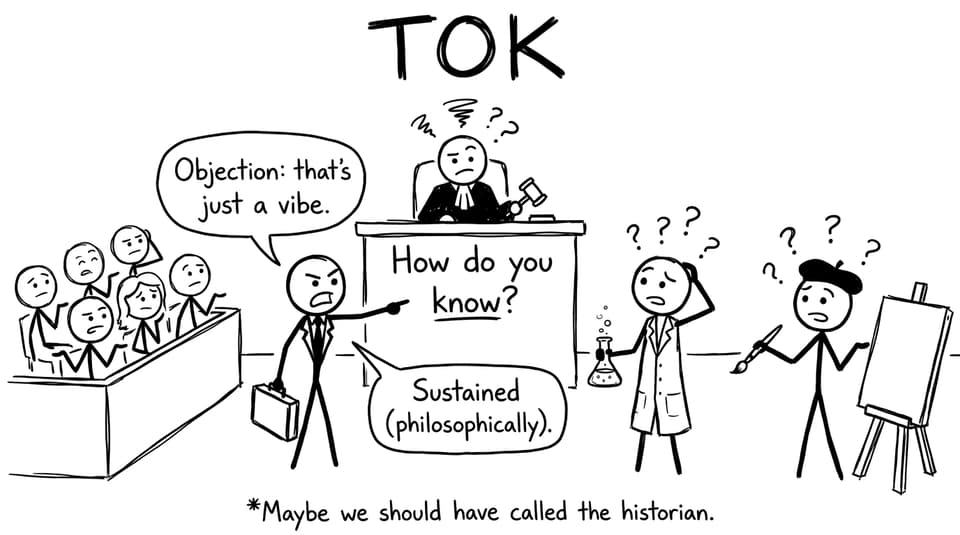
Theory of Knowledge teaches you to ask: How do we know what we claim to know? In the IB, TOK isn’t just philosophy. It’s a toolkit for evaluating evidence, spotting assumptions, and writing with intellectual humility.
If you want a clear breakdown of requirements and consequences, read What is the core requirement in IB? (TOK, EE, CAS).
EE: learning to do real research
The Extended Essay is 4,000 words of learning how to think independently. You choose a topic, narrow it into a research question, then build an argument with evidence and reflection.
If you want a structured starting point, use the IB Extended Essay Guide. If you want to strengthen analysis, this is excellent: How to use TOK to enhance your Extended Essay.
CAS: learning to prove growth, not perfection
CAS (Creativity, Activity, Service) is pass/fail, but it teaches a vital IB skill: reflection. You learn to document progress, connect experiences to outcomes, and show that you can follow through over time.
And yes, failing core elements can block the diploma--so it’s worth understanding early: What happens if you fail TOK or CAS in IB?.
What IB really teaches you (and how to revise for exams)
Across the IB, the hidden curriculum is transferable:
-
Writing arguments that stay organized under time pressure
-
Turning knowledge into evidence-based answers
-
Managing long projects without last-minute collapse
-
Communicating clearly: essays, labs, orals, calculations
A practical exam-prep loop looks like this:
-
Learn fast with Study Notes (and the strategy in IB Subject Note Collections)
-
Lock recall with Flashcards and spaced repetition
-
Practice with the Questionbank
-
Get unstuck using AI Chat and targeted explanations
-
Improve written work with IB Coursework Grader
-
Rehearse timing with IB Predicted Papers and the guide to IB predicted vs specimen papers
RevisionDojo matters because it keeps the entire IB workflow in one place: notes, flashcards, question practice, grading tools, predicted papers, mock exams, a coursework library, and tutors when you need a human diagnosis.
Closing: the real lesson of IB
What you learn in the IB Diploma isn’t just six subjects and three core components. You learn how to think when the answer isn’t obvious, how to write when the timer is loud, and how to keep going when the workload tries to convince you you’re behind.
If you want your IB exam prep to feel less like resource-hunting and more like momentum, build a simple loop inside RevisionDojo: Study Notes, Flashcards, Questionbank practice, AI Chat support, Grading tools, Predicted Papers, Mock Exams, the Coursework Library, and Tutors when you want a plan tailored to you.
