
A thesis statement is a small sentence with a big job.
In the first minutes of an IB English exam, it decides whether your essay will feel like a guided tour or a wandering walk. Examiners do not need you to prove you read the text. They need you to prove you understood how it works, why it works, and what that means. A good thesis is the promise you make to the examiner: this essay will argue something specific, and every paragraph will earn it.
What a thesis statement does in IB English
In IB English, your thesis statement is the single most concentrated version of your thinking. It is not a summary and not a theme. It is an interpretation turned into an argument.
A strong thesis typically does three things at once:
-
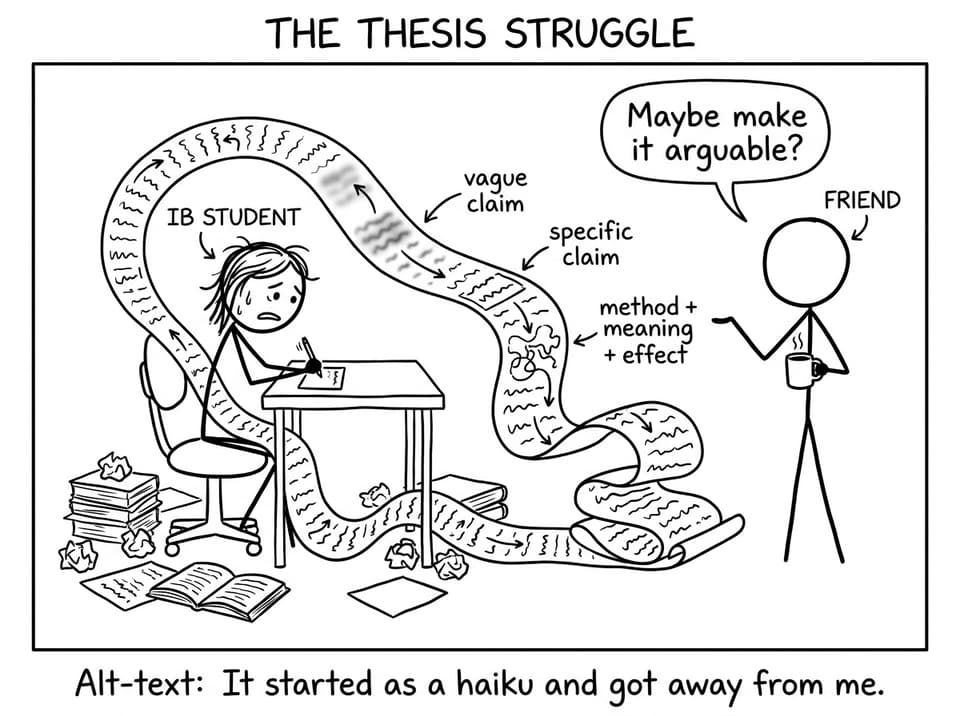
Answers the prompt using its key words (so you are clearly responding, not riffing)
-
Names the method (authorial choices: language, structure, tone, perspective, symbolism)
-
States meaning/effect (the idea, message, or impact created)
If you want a deeper breakdown of what examiners look for, RevisionDojo’s guide to Crafting a Strong HL Essay Thesis is a helpful companion even if you are not writing the HL Essay.
Quick checklist: an IB English-ready thesis
Use this quick filter before you commit to a thesis in IB English:
-
Is it arguable (could a smart student disagree)?
-
Is it specific (about this text, this effect, these choices)?
-
Does it include how + what + why?
-
Can you support it with 2-3 main lines of evidence?
-
Does it naturally create a roadmap for body paragraphs?
When you are practicing these under time pressure, it helps to work with exam-style prompts. RevisionDojo’s IB English A Lang & Lit Paper 1 and Paper 2 Questionbank make that practice feel closer to the real thing.
The core formula: method + meaning + effect
Most students freeze because they think a thesis must be “perfect.” In IB English, it just needs to be usable: precise enough to guide analysis, flexible enough to develop.
Try this reliable template:
Through and , [author] presents [interpretation/claim], revealing [purpose/implication/effect].
Weak vs strong (what changes?)
Weak (descriptive): “The writer uses imagery and tone to show sadness.”
Strong (analytical): “Through restrained imagery and a tightening, hesitant syntax, the writer frames grief as a form of self-censorship, suggesting that emotional control can become its own quiet violence.”
Notice what the strong version does for IB English criteria: it gives you something to prove, and it tells you what kind of evidence will prove it.
How to build a thesis fast in Paper 1, Paper 2, and HL Essay
Different tasks, same thesis logic. In IB English, the best students reuse the same mental steps.
Paper 1 (unseen commentary): start from the guiding question
Paper 1 rewards control. If you want structure support, pair this article with RevisionDojo’s Writing Effective Introductions and Conclusions in IB English Essays.
Mini-process:
-
Highlight the command term (analyze, discuss, to what extent)
-
Decide the text’s purpose + audience
-
Pick 2-3 techniques you can actually explain (not just name)
-
Write a thesis that makes a claim about meaning and effect
Paper 1 thesis example:
“By pairing an intimate, second-person address with abrupt tonal shifts, the writer constructs urgency as a moral demand, positioning the audience to feel complicit rather than merely informed.”
Paper 2 (comparative essay): make the comparison do the work
A Paper 2 thesis in IB English must compare meaning, not just list similarities. RevisionDojo’s Structuring Your IB English Paper 2 Essay is ideal if your comparisons keep turning into two separate mini-essays.
Paper 2 thesis example:
“While both writers portray conformity as socially rewarded, one frames compliance as seductive comfort through ironic narrative distance, whereas the other depicts it as open coercion through stark, declarative dialogue, revealing two routes by which power trains people to self-police.”
HL Essay: build from a line of inquiry
The HL Essay thesis in IB English becomes your compass for research, selection, and paragraph logic. If you need a clean approach to organizing support, see Structuring Your Points.
HL Essay thesis example:
“Across recurring domestic imagery and controlled focalization, the novel frames ‘home’ as a performance rather than a refuge, exposing how identity is negotiated under social surveillance.”
Common thesis mistakes (and quick fixes)
These are the traps that quietly lower marks in IB English:
-
Plot summary disguised as insight: Replace “what happens” with “what it suggests.”
-
Empty technique name-dropping: If you cannot explain the effect, choose a different feature.
-
Too broad to prove: Shrink the claim until you can support it with 2-3 strong pieces of evidence.
-
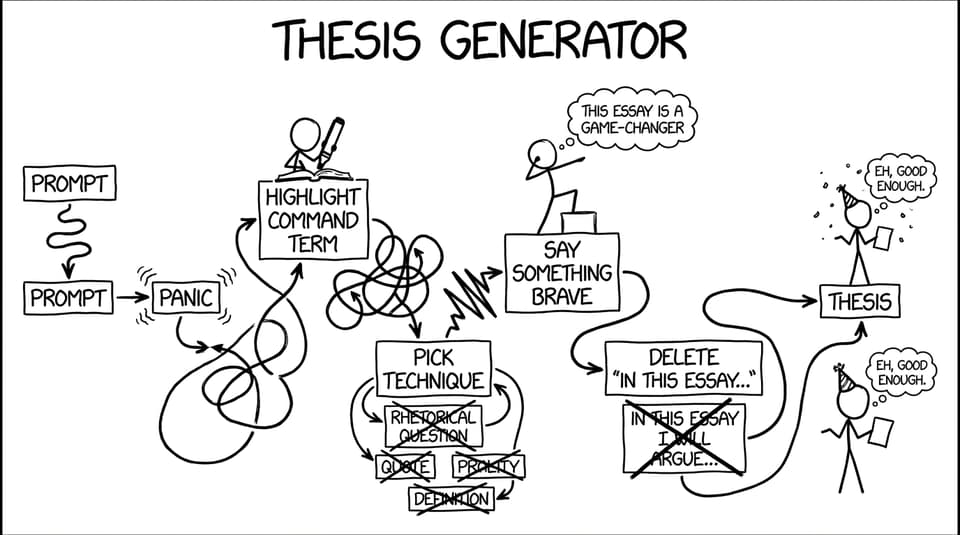
Future tense filler (“In this essay, I will…”): Just state the argument.
For targeted practice, RevisionDojo’s IB English A Lang & Lit Resources combine Study Notes, Flashcards, and guided lessons so you can rehearse thesis moves across text types.
How RevisionDojo helps you turn a thesis into marks
A thesis only matters if the essay delivers. RevisionDojo is built around that reality.
-
Use the Questionbank to practice thesis-writing from varied prompts.
-
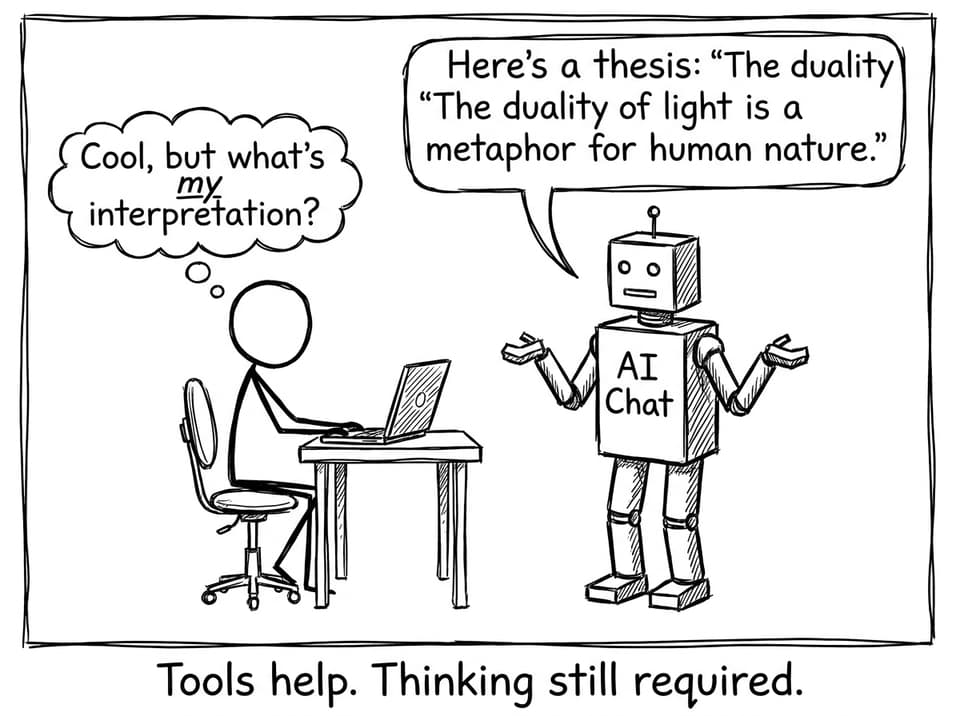
Use AI Chat to test whether your thesis is arguable and focused (then refine it with your own judgment).
-
Use Grading tools like the IB English Language and Literature Paper 1 Grader to see how your thesis and structure align with the rubric.
-
Use Study Notes and Flashcards to build a reliable bank of techniques and effects.
-
Use Predicted Papers and Mock Exams for timed rehearsal via IB English Lang & Lit Predicted Papers.
Closing: write a thesis that your essay can keep
The easiest way to lose marks in IB English is to write an essay that sounds busy but goes nowhere. The easiest way to prevent that is to write a thesis you can actually prove.
If you want to practice this skill with real prompts, instant feedback, and exam-style pacing, explore RevisionDojo’s Questionbank, Study Notes, Flashcards, AI Chat, Grading tools, Predicted Papers, Mock Exams, Coursework Library, and Tutors inside the RevisionDojo home platform. Write one brave sentence first. Then build an essay that earns it.