The night before an IB English exam has a particular kind of silence. Your desk is loud with paper. Quotations stare back like they’re waiting for you to do something brave with them.
Most students try to feel “ready” by collecting more notes. The strongest students do something quieter: they practice making IB English arguments that explain how a text works, not just what it’s “about.” That shift is what examiners reward, whether you’re writing a Paper 1 commentary, a Paper 2 comparison, or sharpening an internal assessment paragraph.
A quick IB English argument checklist
Use this as your reset when your writing starts drifting into summary:
-
Write a thesis that answers how meaning is made (technique + purpose/effect).
-
Choose evidence that contains craft (diction, imagery, structure, voice).
-
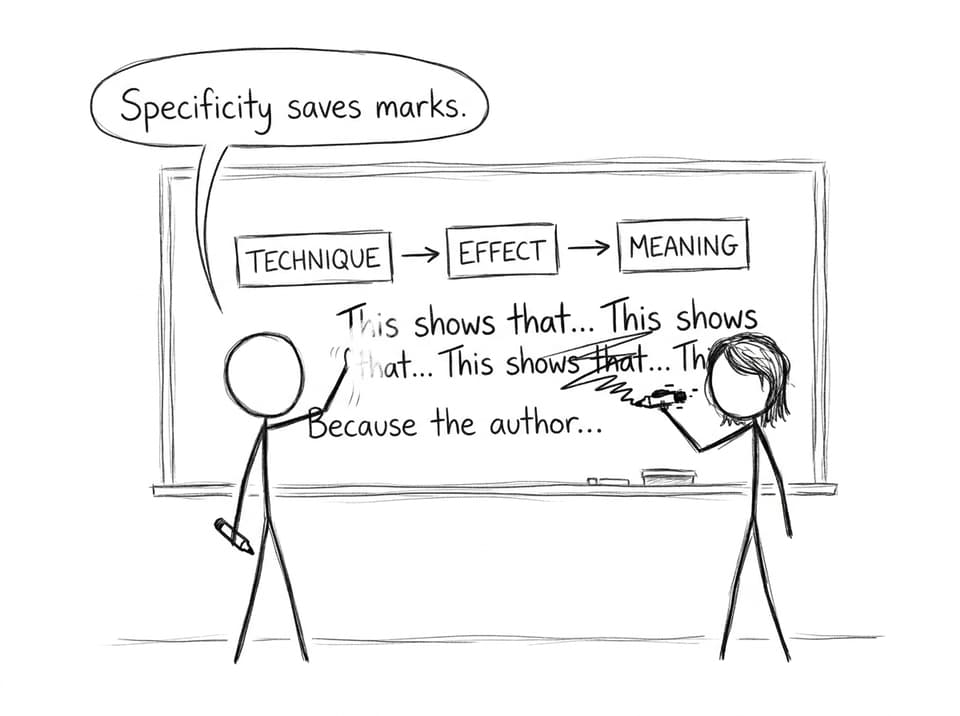
Explain authorial choice with a clear chain: technique -> effect -> meaning.
-
Keep paragraphs single-minded: one insight per paragraph.
-
End each paragraph by reconnecting to the thesis (your line of argument).
If you want a deeper Paper 1 workflow, pair this with Step-by-Step Guide to Revising IB English Paper 1.
What “insight” really means in IB English
Insight is not a rare talent. In IB English, it’s usually a habit of attention.
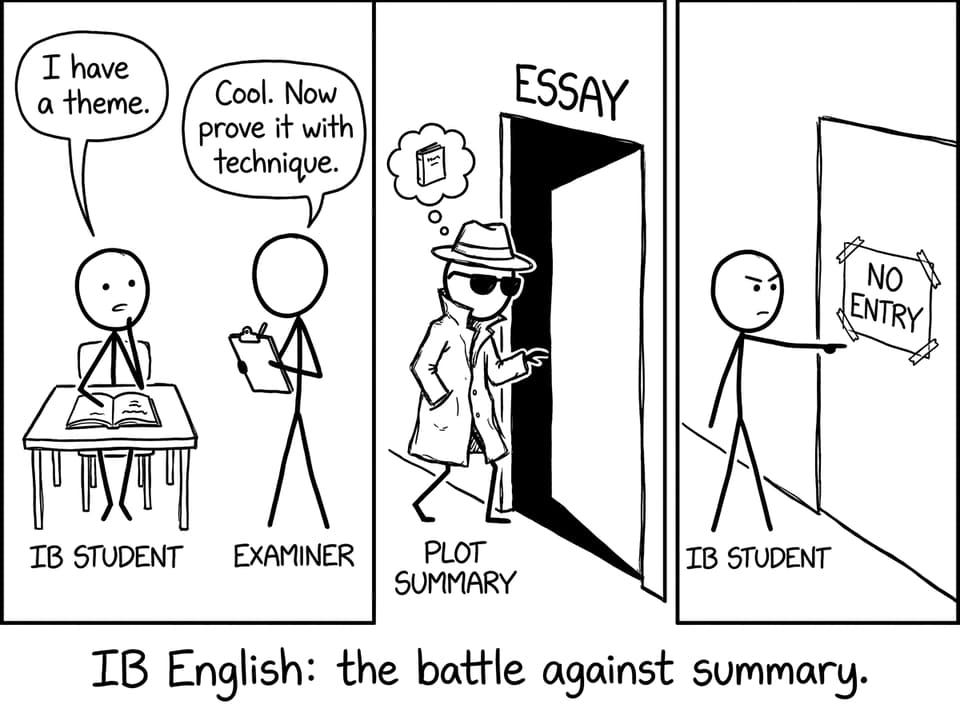
Summary says: “The character is lonely.”
Insight says: “The writer makes loneliness feel inescapable by narrowing the narrative perspective, repeating isolating spatial imagery, and using clipped syntax that mimics emotional shutdown.”
The difference is simple: insightful arguments name a method, then show what that method does. When you train yourself to think in methods and effects, you naturally hit what the criteria reward in analysis, organization, and interpretation.
If you’re building your overall exam strategy, keep the RevisionDojo English hubs bookmarked: IB English A Lang & Lit Resources and Paper 1 Lit resources.
Write an analytical thesis for IB English (not a theme statement)
A thesis in IB English is not a slogan. It’s a commitment. You’re promising the examiner: “This is the controlling idea, and I can prove it.”
A reliable thesis formula looks like this:
By using [technique choices], the author shapes [meaning] to create [effect/purpose].
Examples of thesis upgrades:
-
Weak: “The text explores power.”
-
Strong: “Through shifting pronouns, stark contrasts, and an increasingly interrogative tone, the writer frames power as unstable, forcing the reader to question who gets to define ‘truth.’”
For Paper 1 specifically, you can strengthen your opening moves with Writing a Commentary for IB English A: Step-by-Step Guide.
A fast thesis test
Before you start body paragraphs, ask:
-
Did I mention at least one authorial choice (language/structure/style)?
-
Could someone disagree with my claim (is it arguable, not obvious)?
-
Could I prove it with 2-3 strong pieces of evidence?
If you answer “no,” your thesis is still a theme sentence wearing a suit.
Choose evidence that makes analysis inevitable
In IB English, great evidence has “handles” you can grip: a loaded verb, a structural shift, a symbol that repeats, a line break that changes pace.
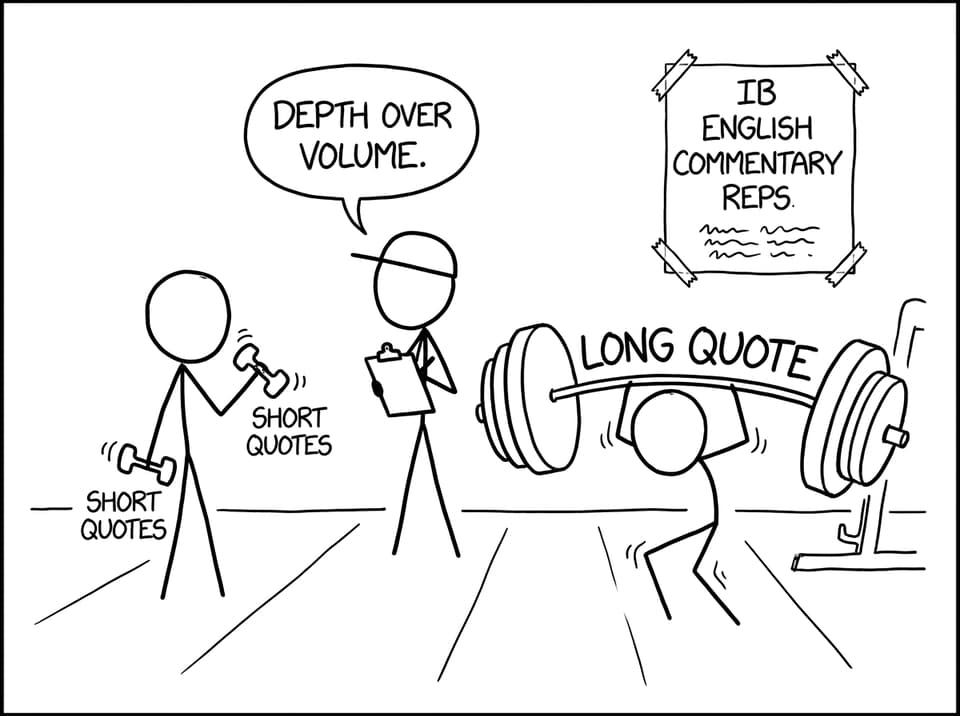
Practical rule: short quotes, deeper commentary. One precise phrase can carry an entire paragraph if you stay close to its texture.
If you want a structured way to think about evidence beyond English, this resource is surprisingly useful: Evidence selection Notes. It breaks down the claim -> evidence -> explanation logic that top-band essays quietly follow.
Explain authorial choice with a “because” chain
Most essays don’t lose marks because the student can’t spot techniques. They lose marks because the explanation stops too early.
Try this IB English commentary ladder:
-
What: Identify the technique (diction, imagery, irony, juxtaposition, narrative distance).
-
How: Describe what it does on the page (creates contrast, narrows focus, speeds rhythm).
-
Why: Explain the purpose/effect (shapes reader response, complicates theme, builds tension).
Add one word to force depth: because.
Instead of: “The metaphor shows fear.”
Write: “The metaphor intensifies fear because it turns a private emotion into a physical environment, making escape feel impossible.”
For more Paper 1-specific habits, see Tips for Writing Strong IB English Commentaries.
Structure paragraphs so your argument stays visible
A clear paragraph is not “formulaic.” It’s humane. It helps the examiner follow your reasoning at speed.
A simple approach:
-
Point (one arguable idea that supports the thesis)
-
Evidence (short, technique-rich)
-
Analysis (the because-chain)
-
Link (how this develops your overall argument)
If you need a model to practice with, RevisionDojo’s English writing support is built for repetition without mindlessness: the Study Notes and Flashcards help you internalize technique language, and the AI Chat helps you test interpretations quickly when you’re stuck between two readings.
For essay-building guidance, browse Body Paragraphs - IB Notes.
Common IB English traps (and the quick fixes)
Trap: Plot recap in disguise.
Fix: Mention craft in every topic sentence.
Trap: Big claims, thin proof.
Fix: Reduce the claim. Deepen the quote.
Trap: “This shows that…” 반복.
Fix: Replace it with “This positions the reader to…” or “This reframes the theme by…”
Trap: Two mini-essays in Paper 2.
Fix: Compare inside each paragraph, not in separate blocks. For Paper 2 strategy, use IB English Paper 2: Essential Guide for Success and How to Prepare for the IB English Paper 2 Exam Under Time Pressure.
Closing: the quiet skill that lifts every IB English score
The best IB English arguments don’t sound complicated. They sound certain, because they’re built on a simple habit: claim something about craft, prove it with evidence, and explain it with care.
If you want a place to practice that habit without guessing what “good” looks like, RevisionDojo pulls the whole loop together: Study Notes for technique language, Flashcards for recall, AI Chat for clearing confusion, Predicted Papers and Mock Exams for realistic exam pressure, and Tutors when you need human feedback on your line of argument.
Start with one timed paragraph today. Make it insight-first. Your next IB English essay will feel different, and so will your marks.



