


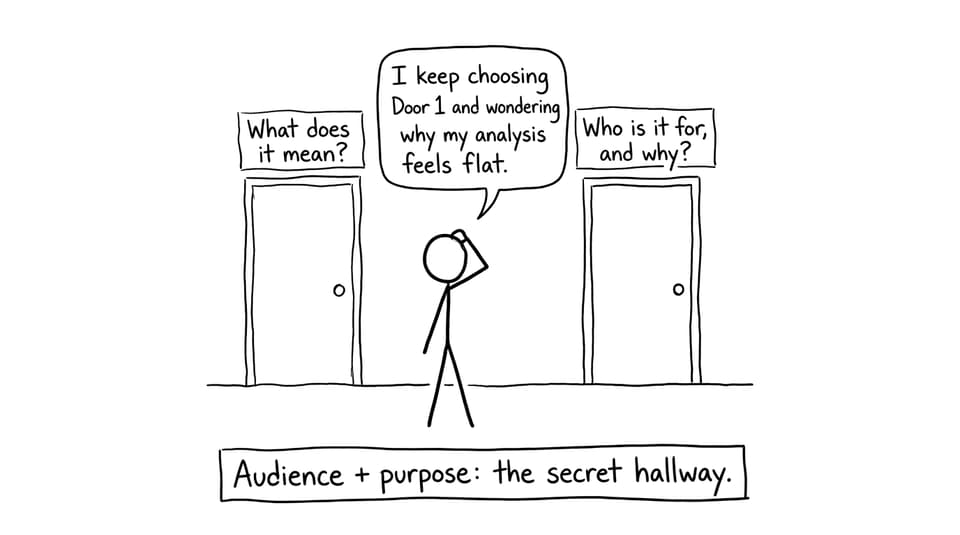
A text rarely fails because it lacks “good techniques.” It fails because the writer aimed those techniques at the wrong person, for the wrong reason.
That is why IB English students who learn to spot audience and purpose early often feel a strange kind of calm in Paper 1, the Individual Oral, and the HL Essay. The text stops being a mystery box. It becomes an intentional object: made by someone, for someone, to do something.
In IB English, that shift is where higher-band analysis begins.
A quick checklist for audience and purpose (save this)
When you open any IB English text, run this 30-second scan:
-
Text type: speech, opinion column, brochure, interview, short story extract, poem?
-
Target audience: who is the text primarily written for (not “everyone”)?
-
Purpose: inform, persuade, entertain, critique, commemorate, warn, provoke?
-
Tone + register: formal, ironic, intimate, urgent, instructional?
-
Reader positioning: what is the reader pushed to feel, believe, or do?
If you want structured practice for this exact skill, start with IB English A Lang & Lit Resources and pair it with timed tasks from the Paper 1 Lang & Lit Questionbank.
What “audience” means in IB English (and what it doesn’t)
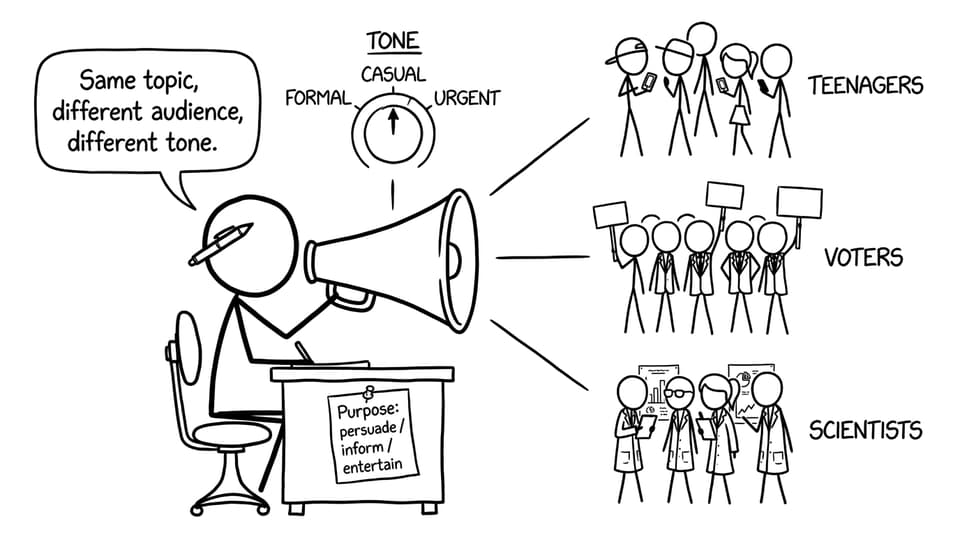
In IB English, audience is the intended reader, viewer, or listener the writer imagines while crafting the text. This can be narrow (first-time voters, parents, investors, teachers) or broad (a national public, an international community). But it is never random.
A useful way to phrase it in analysis is: “The writer assumes the audience values X, fears Y, and needs Z.” Those assumptions explain word choice, examples, tone, and even what the text leaves out.
Also note the common trap: confusing intended audience with actual audience. A campaign ad might be watched by everyone, but it’s designed to move a specific group.
What “purpose” means in IB English (and how to make it specific)
Purpose is the writer’s goal. In IB English, “to inform” is a starting point, not a finish line. Top responses specify the direction of the information.
Instead of:
- “The purpose is to inform about climate change.”
Try:
- “The purpose is to reframe climate change as an immediate personal risk, so readers support policy action.”
Purposes you will see constantly in IB English Paper 1 and IO:
-
To persuade (buy, vote, agree, donate, change behavior)
-
To inform (explain a problem, clarify misconceptions, report)
-
To entertain (engage, amuse, shock, sustain interest)
-
To critique (expose hypocrisy, challenge norms, satirize)
-
To build credibility (establish ethos, appear trustworthy)
Want to see how this connects to the assessment task? Keep a Paper 1 framework open while you practise: IB English A Lang & Lit Paper 1.
How audience and purpose shape choices (what examiners reward)
Most students can name features: metaphor, repetition, statistics, direct address, layout. In IB English, the marks come from explaining why those features make sense for this audience and purpose.
Here’s a practical chain you can use:
Choice (what) → Effect (how it lands) → Audience (who it fits) → Purpose (what it achieves)
Example sentence frame:
“Through direct address and inclusive pronouns, the writer positions the audience as responsible participants, which strengthens the persuasive purpose by making inaction feel like a personal failure.”
This is exactly the kind of thinking RevisionDojo trains with targeted drills: do a timed response, then run it through the English Language and Literature Paper 1 Grader to see whether your commentary stays analytical rather than descriptive.
A step-by-step method you can use in Paper 1, IO, and HL Essay
Start with context clues, not summaries
In IB English, context is often embedded in small signals: publication, formatting, slogan-like phrasing, or an authoritative voice. Before you paraphrase content, ask: Where would this live in the real world?
To build this instinct quickly, rotate genres using the IB English Lang & Lit Paper 1 Cheatsheet so your brain stops expecting only one “kind” of text.
Track tone shifts as audience management
Tone shifts are often the writer recalibrating for the audience: softening resistance, building urgency, or signaling expertise. Mark where the text becomes more personal, more technical, more moral, or more confrontational.
For a full revision routine that bakes this into your week, follow Step-by-Step Guide to Revising IB English Paper 1.
Write one “reader positioning” line per paragraph
After each body paragraph, force yourself to include one sentence that starts with:
-
“This positions the reader to…”
-
“For the audience, this creates…”
-
“This supports the purpose by…”
That single habit upgrades your IB English analysis faster than learning ten new device names.
Common mistakes (and quick fixes)
Mistake: “The audience is everyone”
Fix: Choose the most likely primary audience and justify it using tone, references, and assumptions.
Mistake: Purpose stated too vaguely
Fix: Add a verb that implies movement: “to pressure,” “to normalize,” “to warn,” “to undermine,” “to humanize.”
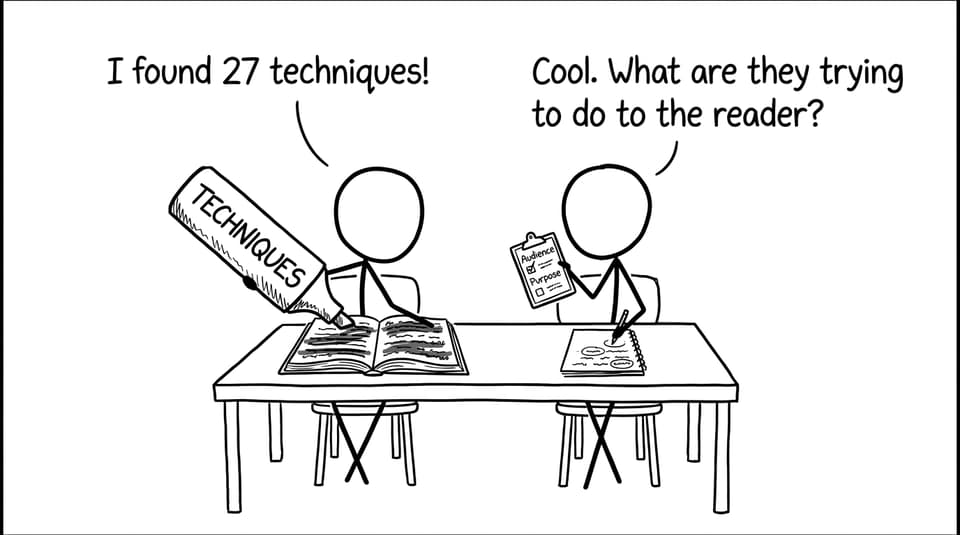
Mistake: Listing techniques without linking to impact
Fix: Use the chain: choice → effect → audience → purpose.
Mistake: Ignoring task differences across assessments
Fix: In Paper 1 you infer audience and purpose quickly; in the IO you connect them to a global issue and delivery; in the HL Essay you sustain them across a longer argument. For IO-specific planning support, use Individual Oral (IO) topic hub and practise with IB IO Practice Tool guidance.
Closing: the simplest upgrade in IB English
If you remember one thing for IB English, let it be this: writers don’t “use techniques.” They make choices to move an audience toward a purpose.
Train yourself to name who the text is for and why it exists before you chase devices. Then practise that skill deliberately: build timed sets in the Questionbank, convert recurring insights into Flashcards, test ideas with AI Chat, and check your writing with RevisionDojo’s Grading tools and Mock Exams. When exam day arrives, you’ll feel the difference, because you’ll be reading like someone who understands intent, not like someone hunting for labels.