
Choosing between Higher Level and Standard Level can feel strangely permanent when you have barely begun IB DP1. The labels make the decision sound simple: HL is more, SL is less. In IB Economics, that is only partly true.
The central difference in IB Economics HL vs SL is depth. Both levels study the same four syllabus units, use economic diagrams, analyse real-world issues, and complete the same style of internal assessment portfolio. HL adds substantial extension material, more quantitative work, and a third examination focused on applying economics to policy decisions.
The current course was introduced for first assessment in 2022. Under that guide, the IB recommends 150 teaching hours for SL and 240 for HL. Those extra 90 hours are not merely revision time. They accommodate additional theory, calculations, diagrams, and exam preparation.
The difference at a glance
| Feature | Economics SL | Economics HL |
|---|---|---|
| Recommended teaching time | 150 hours | 240 hours |
| Main syllabus units | Introduction, microeconomics, macroeconomics, the global economy | The same four units, plus HL extensions |
| External examinations | Paper 1 and Paper 2 | Paper 1, Paper 2, and Paper 3 |
| Internal assessment weighting | 30% | 20% |
| External assessment weighting | 70% | 80% |
| Quantitative demand | Some calculations | More calculations and multi-stage application |
| Best suited to | Students wanting a rigorous social science at SL | Students comfortable combining essays, diagrams, data, and calculations |
The quickest practical summary is this:
- Choose SL if you want the core economic models and evaluation skills without the full quantitative and theoretical extension.
- Consider HL if economics may support your university direction, you enjoy analysing policies, or you are willing to practise calculations consistently.
- Do not choose HL simply because you earned strong grades in an earlier business or humanities class. Economics has its own language and methods.
- Do not avoid HL solely because you think it is advanced mathematics. The mathematics is manageable for many students, but applying it economically requires care.
What stays the same at HL and SL
Both levels follow four units in the current IB Economics syllabus overview: introduction to economics, microeconomics, macroeconomics, and the global economy.
That means an SL and an HL student may sit in the same lesson discussing scarcity, opportunity cost, price elasticity of demand, market failure, inflation, economic growth, exchange rates, or development. Both need to construct and explain diagrams rather than simply reproduce them. Both must connect theory to real situations.
The conceptual framework is also shared. Students repeatedly encounter ideas such as scarcity, choice, efficiency, equity, economic well-being, sustainability, change, interdependence, and intervention. These are not decorative vocabulary. They help organise arguments about questions such as whether an indirect tax improves welfare or whether economic growth necessarily improves living standards.
Both levels also require evaluation. A response that defines inflation and draws an aggregate demand diagram has begun the task, but it has not necessarily answered whether contractionary monetary policy is appropriate. A stronger response considers assumptions, affected stakeholders, time periods, consequences, and alternative policies.
For a unit-level map, the IB Economics topic-by-topic revision guide can help DP1 students see how individual models connect before class notes become an unmanageable stack.
What HL adds to the syllabus
HL does not replace the SL course. It contains the shared material and extends it. This distinction matters because HL students must recognise which parts of a familiar topic carry additional demands.
In microeconomics, for example, both levels study competitive markets and market failure. HL goes further into market power and the behaviour of firms. This includes perfect competition, monopoly, oligopoly, monopolistic competition, profit maximisation, market concentration, game theory, and efficiency implications. HL students may need to calculate costs, revenues, profits, consumer surplus, or producer surplus and then interpret what those figures mean.
Suppose a firm maximises profit where . The calculation is not the final answer. An HL response may also need to identify the resulting price from the average revenue curve, compare price with marginal cost, and explain whether the outcome is allocatively efficient.
Macroeconomics also becomes deeper. HL extensions include more developed quantitative and theoretical treatment, including multiplier analysis. If the marginal propensity to consume is 0.8 in a simplified model, a student may calculate:
The economics begins after the arithmetic. A high-quality response asks whether leakages, spare capacity, inflationary pressure, or implementation delays make the predicted change in national income less certain.
Within the global economy, HL students face additional quantitative applications involving areas such as exchange rates and trade. Again, the recurring demand is to move from a numerical result to an economic conclusion.
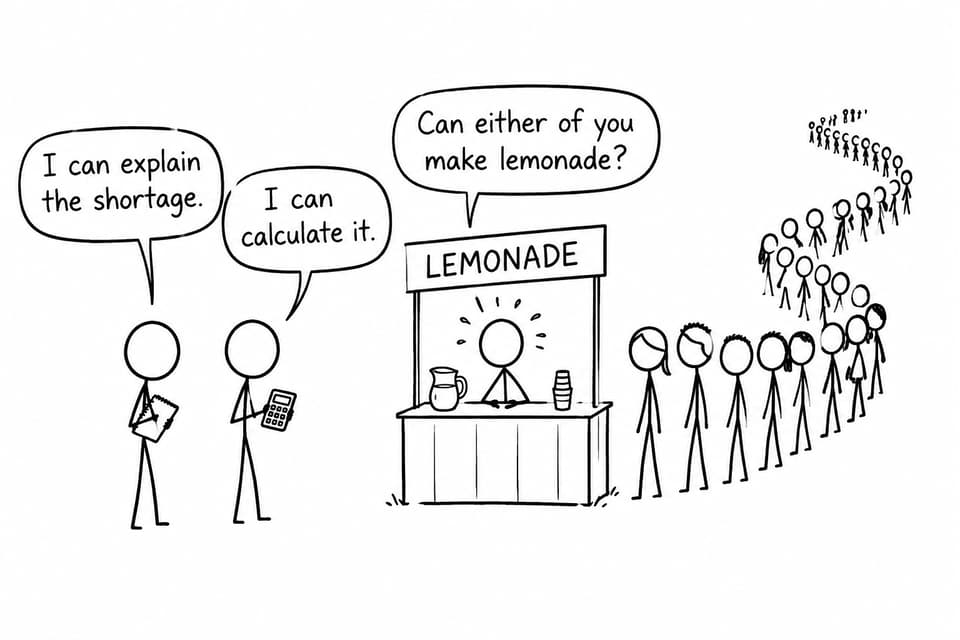
This is why HL often feels different rather than merely longer. The student keeps moving between four modes of thinking: theory, diagrams, calculations, and policy evaluation.
How the examinations actually differ
The assessment structure makes the clearest difference.
Paper 1 lasts 1 hour 15 minutes at both levels. It is an extended-response paper covering the relevant syllabus content. Students answer one question from a choice of three, worth 25 marks. It contributes 30% at SL and 20% at HL.
Paper 2 lasts 1 hour 45 minutes at both levels. It is a data-response paper that combines source material, economic theory, quantitative work, and evaluation. Students answer one question from a choice of two, worth 40 marks. It contributes 40% at SL and 30% at HL.
HL students also take Paper 3. Under the guide for first assessment in 2022, it lasts 1 hour 45 minutes, contains two compulsory 30-mark questions, and contributes 30% of the final grade. It is described as a policy paper and includes both quantitative and qualitative tasks.
Paper 3 is therefore not just a mathematics test. Students may calculate an economic value, explain the result, and recommend a policy using the evidence provided. A correct calculation with no interpretation leaves part of the economic task unfinished. A confident recommendation that ignores the data has the opposite weakness.
The guide to getting a 7 in IB Economics explains how diagram accuracy, developed chains of reasoning, and policy judgment work together across these papers.
The internal assessment is similar, but its weight changes
SL and HL students both produce a portfolio of three commentaries. Each commentary uses a published news extract, focuses on a different syllabus unit, applies a key concept, and has an 800-word limit. The portfolio is marked by the teacher and externally moderated by the IB.
The work itself is not supposed to become a miniature textbook chapter. A good commentary selects relevant theory and uses it to analyse the event in the extract. If an article concerns a sugar tax, for example, copying a general explanation of indirect taxation is not enough. The student should apply the tax diagram to that market, discuss stakeholder effects, and evaluate whether the intervention is likely to achieve its objective.
The portfolio contributes 30% at SL and 20% at HL. This does not make the HL portfolio easier. It means the additional external paper changes the balance of the final grade.
Common IA mistakes include choosing an article with little room for analysis, using an inaccurate diagram, describing rather than applying theory, and adding evaluation as an isolated final paragraph. The complete IB Economics syllabus, exam, and IA guide offers a useful starting framework, but students should always follow current instructions supplied by their teacher and school.
Command terms matter at both levels
New students sometimes treat command terms as polite variations of the same request. They are not.
Calculate requires working and a numerical answer. Explain requires a developed chain of reasoning. Using a diagram, explain means the diagram must be accurate, labelled, and integrated into the written argument. Discuss and evaluate require balanced judgment rather than a list of advantages and disadvantages. Recommend requires a defensible choice supported by theory and the supplied evidence.
Consider the instruction, “Evaluate the effectiveness of a price ceiling in making housing more affordable.” A weak answer explains how a ceiling creates excess demand. A stronger answer also considers whether the ceiling is binding, effects on quality and supply, non-price allocation, stakeholder consequences, and complementary measures such as housing subsidies or increased public provision.
HL students encounter more content that can be tested, but neither level can escape command-term discipline. Misreading the verb is one of the fastest ways to answer a question you were never asked.
Which level should a DP1 student choose?
Look beyond whether you currently find economics “easy.” Early microeconomics can feel intuitive because supply and demand appear familiar. Later work asks for greater precision.
HL may fit if you enjoy building arguments from data, can practise quantitative skills without postponing them, and are interested in economics or a related university course. SL may fit if you value the subject but need to preserve time for demanding HL commitments elsewhere.
Your wider subject combination matters. So do university entry requirements, which vary by country, institution, and course. Check requirements directly rather than assuming Economics HL is universally required or universally preferred.
Whichever level you select, begin with small cycles of retrieval and application. Learn one model through Study Notes and Flashcards, explain its assumptions aloud, draw it without looking, and then answer a targeted question. Use AI Chat when a chain of reasoning is unclear, not as a substitute for constructing your own response. Grading tools can then identify whether your terminology, diagrams, and evaluation actually meet the command term.
RevisionDojo brings these tools together with its Economics Questionbank, Predicted Papers, Mock Exams, Coursework Library, and Tutors. The point is not to collect more resources. It is to shorten the distance between “I recognise this topic” and “I can answer a timed question on it.” The Economics SL and HL revision comparison can help you turn the level distinction into a practical weekly plan.
The choice is about depth, not status
HL Economics asks for more content, more quantitative application, and another examination. SL remains a demanding economics course built around theory, real-world application, diagrams, and evaluation. Neither choice is automatically impressive or safe. The better choice is the one that matches your interests, future requirements, and total Diploma workload.
If you are still deciding, test the work rather than the label. Visit the RevisionDojo IB Economics hub and try 10 free questions in the subject Questionbank. Notice whether you enjoy correcting the model, calculation, or reasoning after a mistake. That reaction may tell you more about your fit for HL than the first grade you receive in DP1.